

- within Energy and Natural Resources topic(s)
- with readers working within the Law Firm industries
- within Energy and Natural Resources, Government, Public Sector and International Law topic(s)
- with readers working within the Law Firm industries
The Ministry of Power has notified the Electricity (Amendment) Rules, 2026 (2026 Amendment) on 13 March 2026, amending Rule 3 of the Electricity Rules, 2005 (Electricity Rules). The 2026 Amendment comes at a significant moment when India's commercial and industrial consumers have increasingly turned to group captive renewable energy projects as a cost-effective route to procure green power, and the captive power sector has grown substantially in scale and sophistication over the past decade. The 2026 Amendment introduces clearer statutory definitions and a new proportionality calculation framework for captive generating plants. The 2026 Amendment is a positive and timely step, providing the clarity, certainty and enabling framework that captive power consumers and project developers have been seeking.
Background
Captive power generation is an important mechanism through which commercial and industrial users in India secure reliable and cost-effective electricity outside the public distribution network. Sectors such as steel, cement, aluminium, chemicals and increasingly large commercial consumers have relied on captive and group captive structures to hedge against tariff volatility and ensure energy security.
The statutory basis for captive generation is Section 9 read with Section 2(8) of the Electricity Act, 2003 (Electricity Act), which permits any person to establish a generating station primarily for their own use. The detailed eligibility conditions for a generating plant to qualify as a captive generating plant (CGP) are prescribed under Rule 3 of the Electricity Rules.
Rule 3 has historically required that captive users collectively hold not less than 26% ownership in the generating plant and consume not less than 51% of the electricity generated on an annual basis. While these thresholds appear straightforward, their practical application read with various judicial interpretations, particularly in group captive structures involving multiple consumers investing through a special purpose vehicle (SPV), has been the subject of sustained regulatory scrutiny and litigation.
Judicial Clarification on Group Captive Structures
The legal position was authoritatively addressed by the Supreme Court in Dakshin Gujarat Vij Company Limited v Gayatri Shakti Paper and Board Limited (Civil Appeal Nos. 8527–8529 of 2009). The Court settled a long standing issue as to whether an SPV is an 'association of persons' within Rule 3, holding the same in affirmative. This also settled the issue that the proportionality requirement would be applicable to SPVs.
The Court further formulated a unitary qualifying ratio (UQR) as per which each captive user must annually consume at least 1.96% (± 10%) of power produced for every 1% of ownership held. In effect, each user had to independently demonstrate minimum consumption relative to their shareholding and failure by other users could exclude their consumption from the collective calculation and potentially render the entire plant non-captive, exposing all users to cross subsidy surcharge (CSS) and additional surcharge (AS) liability. This approach made each user responsible for maintaining their individual captive qualification, and was aimed at preventing "gaming" - where, for example, a 1% shareholder ends up consuming 30% of power.
Following the Supreme Court's decision, the Central Electricity Authority issued "Procedure for Verification of Captive Status of Generating Plants where the Generating Plant and Captive User(s) are Located in Different States" pursuant to Rule 3(3) of the Electricity Rules in February 2025 which adopted an approach for verification by requiring it to be calculated based on consumption by all users rather than individual users.
The Electricity (Amendment) Rules, 2026
The 2026 Amendment now revises the proportionate consumption framework and effectively displaces the UQR with a statutory standard that appears to be more commercially workable. The key changes are summarised below.
1. 'Captive User' enlarged to include group entities
The 2026 Amendment includes the following entities within the definition of 'captive user' - subsidiary company, holding company as well as 'other subsidiary or subsidiaries of such holding company'. Similarly, 'ownership'is now defined to mean proprietary interest or voting equity held directly, or through subsidiaries, holding company, or any other subsidiary of that holding company (i.e., fellow subsidiaries). The meaningful addition over the previous position is the explicit inclusion of fellow subsidiaries in the ownership chain, ensuring that group structures where ownership is held laterally across the group are recognised for captive qualification purposes. Pursuant to the 2026 Amendment, allocation of eligible collective captive consumption among group entities is to be determined by the group itself, subject to the collective eligibility limit.
2. New test for Proportionate Consumption
Pursuant to the 2026 Amendment, the aggregate consumption by all captive users collectivelyis considered for the purpose of verifying compliance with the 26% and 51% conditions. Therefore, even if an individual captive user does not consume in proportion to their ownership share, their actual consumption still counts towards the collective thresholds.This reduces counterparty risk within group captive structures, as compared to the earlier UQR framework under which other users' non-compliance could have exposed an otherwise compliant user to CSS and AS. The 2026 Amendment caps each individual captive user's consumption at100% of their proportionate entitlementcalculated by reference to their ownership share in total captive ownership. Consumption beyond this cap is treated as non-captive and CSS and AS are levied on the same.
Further, a captive user holding26% or above is exempt from the proportionate consumption cap entirely. This is a significant structural lever for anchor investors in group captive projects.
The 2026 Amendment comes into force from 13 March 2026, with the exception of the provisions governing proportionate consumption caps for individual captive users in association of persons structures and the captive status verification framework, which come into force on 1 April 2026, providing the market a short transition window to align existing structures with the new regime.
3. Verification Framework - Intra-State and Inter-State
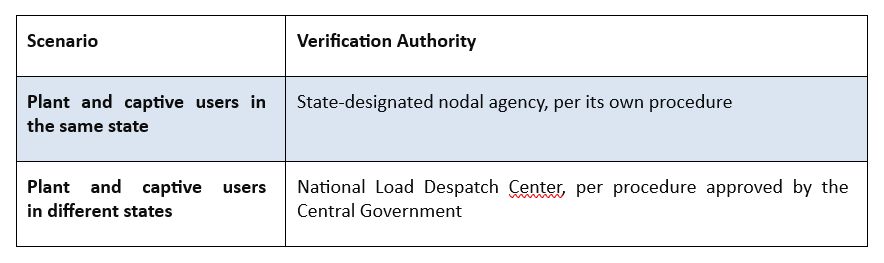
The 2026 Amendment now formalises a structured, two-track verification framework:
4. Grievance Redressal Committee
The 2026 Amendment also introduces an appeal mechanism through a grievance redressal committee. Importantly, CSS and AS will not be levied pending verification, provided the captive user furnishes a declaration. If the plant ultimately fails verification, the applicable charges will be payable with carrying cost at the late payment surcharge base rate.
What This Means for the Industry
From both a legal and commercial perspective, the 2026 Amendment represents a significant step towards bringing greater certainty to India's captive power framework. For several years, market participants have operated in an environment shaped by evolving judicial interpretations. By replacing the existing Rule 3 with a more detailed and structured framework, the 2026 Amendment effectively translates the principles articulated by the Supreme Court into a clearer regulatory framework. This will provide a more enabling business framework and certainty for structures and risk allocation of parties.
Equally important is the introduction of a centralised verification framework for inter-state captive projects, which have become increasingly common in renewable energy procurement. If implemented efficiently, the involvement of the NLDC has the potential to reduce the fragmentation that previously arose from multiple state-level interpretations.
The 2026 Amendment represents a pragmatic effort to codify judicial guidance, harmonise regulatory practice and provide greater operational clarity for a market that has grown significantly in scale and sophistication since the original rules were notified in 2005. For developers, lenders and captive consumers alike, the revised framework should provide a more predictable basis for structuring and evaluating captive power arrangements going forward.
The industry will now keenly await the procedures from NLDC and state nodal agencies to align equity participation and electricity consumption pattern in group captive structures.
The content of this document does not necessarily reflect the views / position of Khaitan & Co but remain solely those of the author(s). For any further queries or follow up, please contact Khaitan & Co at editors@khaitanco.com.
The content of this article is intended to provide a general guide to the subject matter. Specialist advice should be sought about your specific circumstances.


