

In a notable shift toward efficiency and pragmatism, the Competition Commission of India (CCI) has recently implemented a Settlement and Commitment (S&C) Framework. This mechanism provides companies with an opportunity to conclude inquiries pertaining to non- cartel enforcement cases without undergoing a full trial. Non-cartel enforcement cases involve violations of competition law beyond price-fixing and market allocation, such as abuse of dominant position or anti-competitive agreements that do not constitute a cartel. Introduced in March 2024, this framework is a step towards creating a more cooperative and timely approach to competition law enforcement in India. One year into its implementation, the CCI passed its first settlement order in the much-followed Google TV case, opening the door for further evolution of this new enforcement strategy.
The idea was simple: to enable businesses to acknowledge problematic conduct, propose remedies, and move forward with stronger compliance without being trapped in prolonged litigation. However, the existing enforcement mechanism was not fostering this approach, as investigations into anti-competitive conduct in India traditionally took 3–4 years to conclude. Recognizing the need for a faster, more constructive process, the CCI introduced the S&C, inspired by international best practices, to facilitate the timely resolution of non-cartel cases such as abuse of dominance or vertical restraints, while maintaining fairness and deterrence.
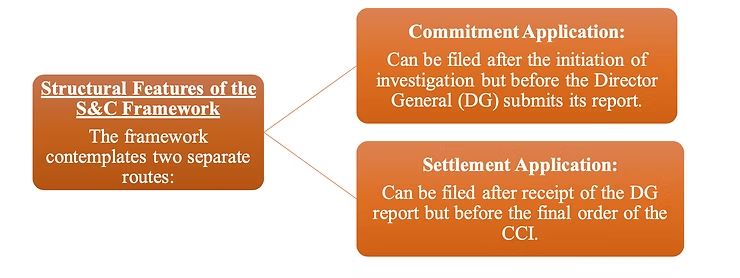
Orders passed under this framework are final and non-appealable, thereby providing closure and certainty. The right to approach NCLAT for compensation in case of settlements, however, stays open for the parties. A key procedural requirement is that the application must contain a detailed proposal explaining the applicant’s offer to mitigate the CCI's competition concerns.
The first-ever settlement order by the CCI on 21 April 2025 concerned allegations against Google of abusing its dominant position in the Smart TV operating system and related app store markets. The Commission had initiated the investigation based on complaints from two Android Smart TV users, alleging anti-competitive clauses in the Television App Distribution Agreement (TADA) and Android Compatibility Commitments (ACC).
The DG found inter alia:
-
Google bundled its Play Store with Android TV OS;
-
Imposed exclusivity obligations;
-
Prevented OEMs from developing forked Android OS versions; and
-
Imposed licensing restrictions creating entry barriers.
In its settlement proposal, Google proposed measures to remove these restrictions and argued that revenues from YouTube and the Play Store should be excluded from the penalty calculation. However, the CCI rejected this argument, holding that these platforms formed part of the same ecosystem and were essential to the abuse.
The Commission, after allowing a 15% statutory settlement discount, imposed a penalty of INR 202.4 million (~USD 2.38 million).Interestingly, this order also saw a dissenting opinion from one Commission member who believed the proposed remedy did not eliminate competitive risks, highlighting the evolving jurisprudence in assessing the adequacy of commitments.
This case reposed faith and gave impetus to the demonstration of CCI in awarding flexibility in accepting non-market-tested solutions, provided they met the concerns raised. The reasoned public order, with confidential portions appropriately redacted, enhances regulatory transparency and paves the way for potential follow-on claims. Notably, the CCI concluded the proceedings within 180 working days, demonstrating procedural commitment, even though internal stage-wise timelines were applied with some flexibility.
While the global landscape in this regard is tried and tested, as can be verified from the collaborative approach of Singapore or the US approach of mass settlements in anti-trust matters, the Indian model remains cautious, still finding its balance between regulatory leniency and market discipline.
Currently, with this framework active and its first test case concluded, certain trends and expectations emerge:
-
Regulatory certainty: As more decisions are published, parties will better understand the kinds of commitments or settlement amounts that are acceptable.
-
Encouraging early resolution: Timely invocation of this mechanism can avoid reputational harm and litigation costs.
-
Market correction: Immediate remedies can address market distortions faster than protracted legal battles.
However, institutional checks remain essential. Parties must be held to strict compliance with commitments, supported by robust mechanisms for review, penalties, and third-party feedback. The role of dissenting opinions, as evidenced in the Google case, will further contribute to balanced deliberation and the development of nuanced jurisprudence. In this context, the recent scrutiny of the Competition Commission of India’s March 2024 Commitment Regulations by the Rajya Sabha Committee on Subordinate Legislation, chaired by Milind Deora, assumes significance. The Committee has reportedly examined the regulations’ consistency with the parent statute, procedural safeguards, and broader public interest considerations, including concerns relating to limited appellate recourse, rigid timelines, and the absence of retrospective applicability. This ongoing parliamentary review marks an important phase of institutional calibration and may result in refinements that enhance the credibility and effectiveness of the framework.
Following the first settlement order in April 2025, the framework has now entered its operational phase, with the CCI increasingly engaging in commitment proceedings and stakeholder consultations. Nonetheless, the jurisprudence remains nascent, with a limited body of precedents delineating the contours of settlement outcomes, procedural safeguards, and the scope of acceptable remedies. This evolving landscape reflects both the promise and the uncertainty inherent in the mechanism.
As jurisprudence matures and regulatory confidence deepens, the settlement and commitment mechanism is poised to emerge as a preferred tool for resolving non-cartel disputes, heralding a significant step in the evolution of Indian competition law.
The content of this article is intended to provide a general guide to the subject matter. Specialist advice should be sought about your specific circumstances.
[View Source]