

Continuous disruption is challenging operations
Over the last few years disruption has become a constant challenge for businesses. Volatility has become ingrained, putting companies on the back foot as they react in piecemeal fashion to unforecastable shocks. According to the 2025 AlixPartners Disruption Index, 67% of businesses now report high levels of disruption, and 62% expect fundamental changes to their business models in the coming years.
It is clear that reacting to successive and sometimes simultaneous shocks in isolation is unsustainable. It is a pattern that drains management focus, overloads teams, and erodes profitability. While no company can control geopolitical crises, pandemics, or macroeconomic swings, they can control how their internal operations are structured and run, building their own platform of resilience.
Today's operational failures are rarely due to a lack of capability. More often, they stem from historic systems built for a more predictable world, with outdated priorities and siloed planning. At this point what is needed is strategic and operational clarity and consistency. Consistency in strategy does not mean inflexibility. It means a coherent direction, maintained as tactics evolve. Companies that know what they want to excel at can align their resources, talent, and decisions in a coordinated way, even during times of turbulence.
At the center of this alignment lies operations, where supply chains, factories, workflows, and product development can work together. Companies must make deliberate choices on how to design and coordinate the operational system as a whole: done well, an operational strategy reset will enable companies to improve efficiency, control costs, and maintain quality.
Elements of operations strategy – a COO perspective
In the absence of an integrated operations strategy, different operational functions often work in silos, with disconnected goals, timelines, and constraints. Strategies, if they exist, are often developed independently within the existing R&D, manufacturing and procurement functions. From a COO's point of view, this fragmentation hinders the definition of a clear and coherent plan (COO agenda). Companies must address this inconsistency by developing a shared operating plan across the three operational pillars of product development, value delivery, and supply chain.
Figure 1: Core strategies and sub-strategies
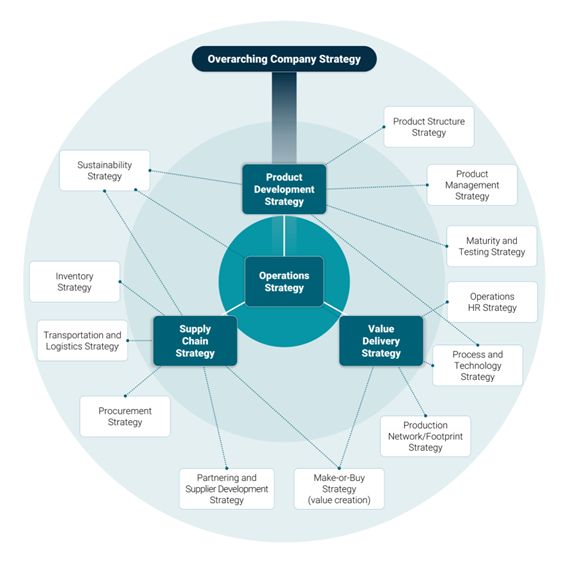
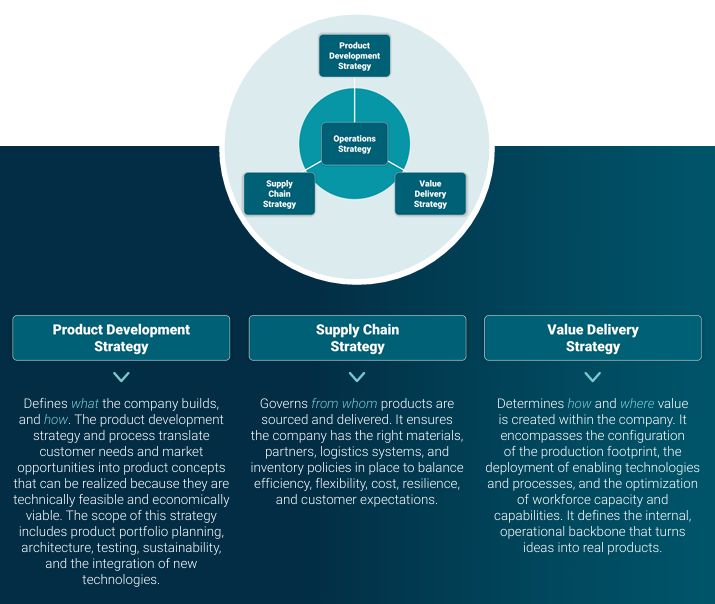
Each of the three operational pillars rest on a set of interdependent sub-strategies. If these sub-strategies are not aligned around common goals, the system breaks down. Most companies struggle with this because functional teams plan sequentially and independently. Product teams commit to designs without manufacturing input, or operations invests in capabilities that don't match future product needs.
Resilient operations strategies must confront trade-offs up front, shifting from reactive coordination to integrated planning and decision-making. Product development must consider what can be built and sourced. Manufacturing must prepare for future product needs. Supply chains must balance efficiency with flexibility and risk. Achieving this requires cross-functional understanding and experience to align goals and decision-making across traditionally independent domains.
Overall, the framework provides COOs with a clear approach to define and drive their agenda. It helps them to identify areas of concern and manage the interfaces between R&D, manufacturing and procurement. It allows to identify gaps between the desired target state and the current reality.
Operations strategy and leadership ambition
The strategies and the sub-strategy variants of product development, value delivery and supply chain cannot function in isolation. They need to be adjusted and fine-tuned in the light of the leadership vision of the company. Vision is about where the company chooses to compete, whether it be on cost, quality, customization, speed or disruption.
In the discussion that follows we use both lenses: the operations lens, and the vision / leadership ambition lens. Designing an optimal operations strategy is the primary concern, but in the bigger picture operations strategy is a fulfillment mechanism for corporate leadership ambitions.
The three pillars of product development, value delivery and supply chain are interdependent and mutually reinforcing. For example, a product development approach centered on customization through modularity or advanced innovation will directly influence the technologies needed in manufacturing and the capabilities required from suppliers. Similarly, limitations in production capacity or supplier availability will shape the feasibility and direction of new product development.
Most successful companies focus on only one or at most two dimensions for their leadership ambitions. That allows operations strategy to be narrowed down to what best supports the organization's vision.
Figure 2: Strategy archetypes based on leadership ambitions
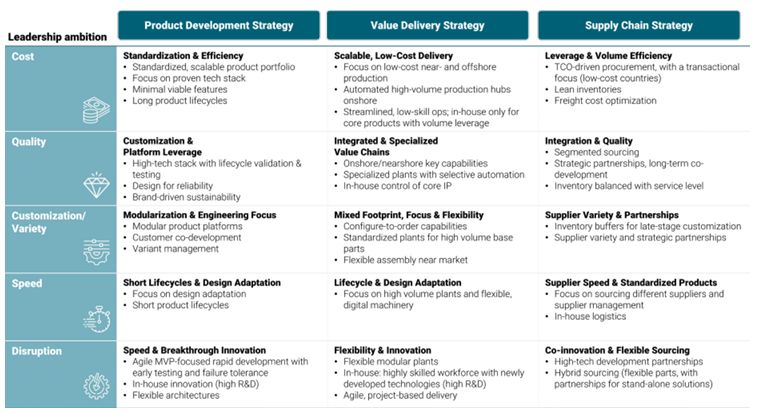
In the case of companies with a COST LEADERSHIP AMBITION, the primary emphasis is on value delivery and supply chain operations, built around standardization, scale, and efficiency. Product development is deliberately limited in scope as the strategy is focused on proven products with long lifecycles. Development efforts are focused on manufacturability and complexity reduction while the overall strategy is driven by minimizing the total cost of ownership across the product lifecycle. Supply chains are designed for bulk purchasing, lean inventory management, and tight integration with the production network. Manufacturing is typically located in low-cost regions through nearshoring or offshoring, while high-cost areas host standardized, automated volume hubs to maintain consistent output at minimal cost.
To read this article in full, please click here.
Footnote
The content of this article is intended to provide a general guide to the subject matter. Specialist advice should be sought about your specific circumstances.
[View Source]


