For decades, a key hurdle facing patent and trademark professionals has been managing the repetitive and labor-intensive administrative tasks of data entry, document classification, and IP search. Fortunately, our new era of tech-empowered legal practice is unlocking new possibilities for attorneys, replacing the burden of manual docketing, boosting productivity across IP workflows, and freeing them to play a more strategic role.
- AI digital assistants are freeing IP professionals from manual tasks, allowing them to focus on high-value advisory work.
- However, seamless synchronization between IP management software is vital to unlocking the time-saving potential of AI.
- By automating workflows and connecting to external AI agents, integrated IP management systems further boost the productivity of IP teams.
- Using an AI docketing agent is a quick and easy way to automate document classification and streamline docketing workflows.
- Connecting an IP digital assistant supports effective IP creation, search/analysis, filing, management, and more through targeted prompts.
- To ensure security, confidentiality, and accuracy, IP tech providers should restrict AI analysis to specific datasets and proven use cases.
IP was once considered a cost center for organizations; today, it is highly valued as a strategic tool. For IP teams to maximize its potential, they need access to dedicated systems and support that augment their roles, rather than overwhelming them, or making them obsolete.
As we covered in our recent webinar on ‘How to Leverage GenAI for Advanced Patent and Trademark Workflows,’ emerging technologies can enable in-house IP departments and law firms to achieve significant gains in operational efficiency and quality while maintaining the rigorous security standards required for sensitive legal data.
How to Unlock the Benefits of Generative AI and IP Management Tools
By choosing integrated systems for IP portfolio management, such as Questel’s IP management software, Equinox, and specialist AI agents for IP, such as our IP digital assistant, Qthena, you can establish a flexible and centralized platform that supports you throughout the entire IP lifecycle.
Equinox as Your Strategic Command Center
For IP owners, the Equinox IP management system (IPMS) provides the ‘command center’ for the entire IP life cycle. It is not merely a database of IP rights; it is a connected environment that facilitates strategic alignment across the creation, management, and maintenance of IP assets, from idea generation to enforcement.
For example, connections with IP search databases and analytics tools, such as Questel’s Orbit Intelligence and Markify platforms, enable rapid case creation and data validation against official office records. Meanwhile, integration with our IP digital assistant, Qthena, establishes a closed-loop workflow that boosts productivity at every stage:
- The ‘Launch Project’ Button:
A dedicated link allows professionals to push case files directly into Qthena, ensuring the AI assistant can access immediate, relevant context.
- Template Synchronization:
Users can prepare response templates within Equinox and import them directly tinto Qthena.
- Bi-Directional Intelligence:
Crucially, this is not a one-way street. Users can sync documents between both systems (retaining the full history), including invention disclosure forms, patent and trademark drafts, search reports, office action responses, and more.
Qthena: Beyond General-Purpose AI
Qthena is not a standard AI assistant. Unlike conventional AI systems with large language models (LLMS) that rely on external internet searches to retrieve information, Qthena operates through a 'closed review' methodology, keeping all data processing secure and contained, with no risk of data leakage or confidentiality breaches. It was also created by IP specialists specifically for IP users.
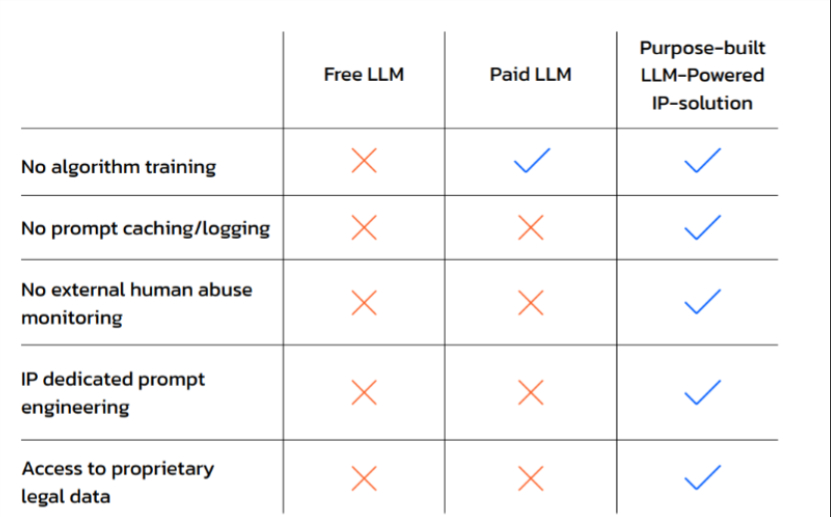
Technical Distinctives for the IP Professional
- Visual Capacity:
The system does not merely process text strings. It "reads" the full document, including claims and drawings, with a visual reasoning capacity that allows it to interpret figures and diagrams as a human practitioner would.
- Context Window Security:
By operating within a secured environment and focusing strictly on the provided project context, the system eliminates the "black box" risk of the open internet.
- Attorney-Led "Skills":
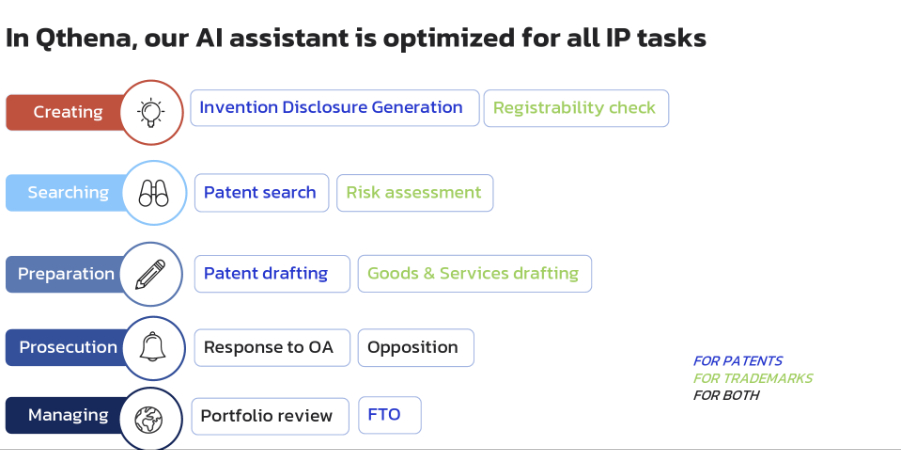
Qthena is optimized for specific skills and workflows, such as IP Search Analysis, Patent Drafting & Filing and Trademark Goods & Services (G&S) Drafting. These are pre-engineered prompts designed by veteran patent and trademark attorneys to "teach" the AI the nuances of the law, ensuring outputs are relevant for IP-grade requirements and actually help IP practitioners work more efficiently.
Real-World Application: Validating AI Strategy via the Nintendo Case Study
The power of this integrated approach is best illustrated by using the AI agent to conduct a retrospective analysis of the Nintendo stylus patent (EP 2442211). Originally filed in 2011, this historical case was used as a simulation to demonstrate how the AI’s strategic proposals align with successful, real-world outcomes.
The workflow below demonstrates how the AI-assisted process mirrored the actual path to grant:
- Retrospective Objection Analysis: Assuming a timeline just before the original publication, Qthena summarized the examiner’s search opinion and provided a strength assessment of the objections, identifying the same hurdles the original attorneys faed.
- Feature Mapping: The system performed a side-by-side mapping of claim features against prior art (D1). It pinpointed the "elastic material" feature as a key differentiating factor for novelty, a critical insight for the eventual grant.
- Strategic Alignment (The "Proof of Concept"): The AI proposed "Strategy 2," which suggested limiting the elastic material specifically to "memory foam". This served as a vital validation of the technology, as this was the exact strategy that led to the real-world granted claim.
- EPC-Compliant Drafting: To finalize the simulation, Qthena generated a formal response using the Problem-Solution Approach. This included the strike-through edits for deletions and bold text for additions required by the EPO, demonstrating that the AI could have produced a submission-ready draft for the attorney's final review.
The "Human-Expert-in-the-Loop" Philosophy
Despite the technical sophistication of these tools, the final responsibility for strategy and risk mitigation remains with the expert user. Qthena acts as a high-level, collaborative, and highly intelligent assistant, taking responsibility for the ‘heavy lifting’ work of researching case law. It excels at the ‘heavy lifting’ work of researching case law, sourcing citations, and drafting initial arguments. However, patent and trademark attorneys remain responsible for verifying the output and making the final strategic choice. The technology augments human judgment;it does not substitute it.
Expanded Use Cases Across the IP Life Cycle
The Equinox-Qthena integration establishes a competitive foundation across various stages of IP management:
Workflow Stage
AI-enhanced workflows that support the creation, clearance and analysis, preparation, prosecution, and management of IP rights.
The Rise of the AI Docketing Agent
The latest frontier in this integration has been eliminating administrative friction through the AI Docketing Agent in Equinox. This dedicated docketing agentagent helps users move beyond simple data storage to active correspondence management.
The agent already possesses the capability to read and classify documents, including automatically analyzing incoming emails and PTO documents, classifying them as filing receipts, Office Actions, or publication notices.
Soon, it will also be able to Suggest Tasks: Based on the document type, it will suggest the correct task presets and deadlines, virtually eliminating manual data entry.
- Extract Data: It will propose updates to existing cases based on newly extracted data from the PTO, ensuring the IPMS is a real-time reflection of the patent's status. (find out more).
Conclusion: Strategic Takeaways for IP Professionals
The power of this integrated approach is best illustrated by using the AI agent to conduct a retrospective analysis of the Nintendo stylus patent (EP 2442211). Originally filed in 2011, this historical case was used as a simulation to demonstrate how the AI’s strategic proposals align with successful, real-world outcomes.
The workflow below demonstrates how the AI-assisted process mirrored the actual path to grant:
- Retrospective Objection Analysis: Assuming a timeline just before the original publication, Qthena summarized the examiner’s search opinion and provided a strength assessment of the objections, identifying the same hurdles the original attorneys faed.
- Feature Mapping: The system performed a side-by-side mapping of claim features against prior art (D1). It pinpointed the "elastic material" feature as a key differentiating factor for novelty, a critical insight for the eventual grant.
- Strategic Alignment (The "Proof of Concept"): The AI proposed "Strategy 2," which suggested limiting the elastic material specifically to "memory foam". This served as a vital validation of the technology, as this was the exact strategy that led to the real-world granted claim.
- EPC-Compliant Drafting: To finalize the simulation, Qthena generated a formal response using the Problem-Solution Approach. This included the strike-through edits for deletions and bold text for additions required by the EPO, demonstrating that the AI could have produced a submission-ready draft for the attorney's final review.
Integrating your Equinox IPMS with a dedicated IP digital assistants, such as Qthena, will help you gain time, boost productivity, and improve quality. But that’s not all. By using Equinox as the "command center" for your IP ecosystem, you can move data seamlessly across the entire IP lifecycle, eliminating manual uploads, siloed information, and administrative friction. In turn, IP professionals can focus more time and effort on their strategic roles, delivering high-value decision-making while routine tasks are automated.
The content of this article is intended to provide a general guide to the subject matter. Specialist advice should be sought about your specific circumstances.
[View Source]