

Each year on 1 May, several countries mark International Labour Day, recognising the contributions of workers worldwide. While often linked to a statutory day of rest, its date, legal status and protections vary. Below, our experts consider the implications for employers when asking employees to work on a public holiday.
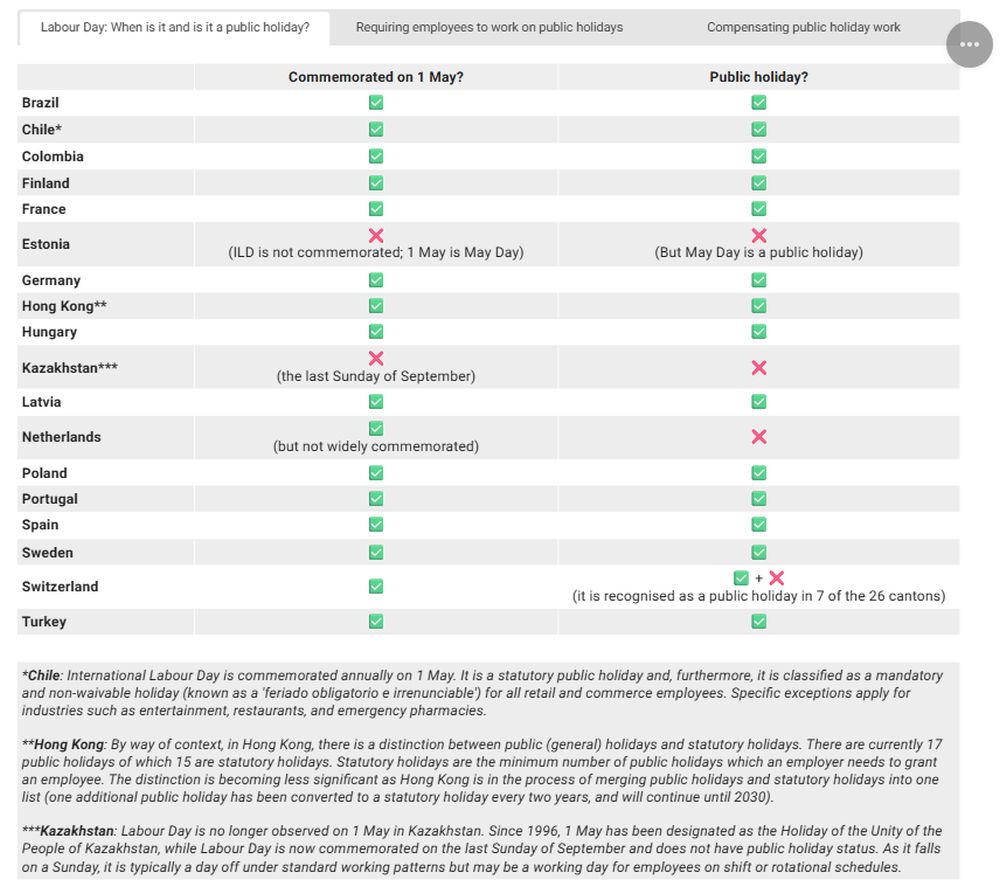
Drawing on contributions from 18 countries, in the comparative table below we set out:
- when Labour Day is observed and whether it has public holiday status;
- whether employers may require employees to work on a public holiday without their prior agreement; and
- how work performed on such days must be compensated.
While Labour Day provides the key focus of this analysis, it extends to public holiday rules more generally, as many legal systems regulate Labour Day in line with, or by reference to, their broader public holiday frameworks. Where a particular jurisdiction treats Labour Day differently from other public holidays, this distinction is set out in the table.
For ease of comparison, the term ‘public holiday’ is used as a general label, with important distinctions such as different categories of holidays or heightened protections for Labour Day identified in the relevant country entries.
Working on a public holiday: Employment implications worldwide
Takeaway for employers
The comparative table shows that while many jurisdictions recognise 1 May as a public holiday, the extent to which employers may require employees to work varies depending on local law, the sector, working patterns and collective agreements. In some countries, employers retain broad scheduling discretion, while in others, employee consent is required or work is permitted only in exceptional or essential circumstances. Compensation rules also vary, ranging from enhanced pay to compensatory time off, with some jurisdictions prohibiting TOIL altogether.
For employers, the key takeaway can be summarised as follows: check local rules on consent, exemptions and compensation if employees may be asked to work on a public holiday.
The content of this article is intended to provide a general guide to the subject matter. Specialist advice should be sought about your specific circumstances.
[View Source]