In late June 2026, the Indonesian Directorate General of Intellectual Property (DGIP), executed several enforcement actions targeting digital content piracy. The DGIP’s Directorate of Law Enforcement issued blocking orders against 29 illegal webtoon platforms and 50 illicit Korean drama (K-drama) streaming networks.
Indonesia’s Copyright Content Blocking Framework
The DGIP’s mechanism governing content blocking runs as follows:
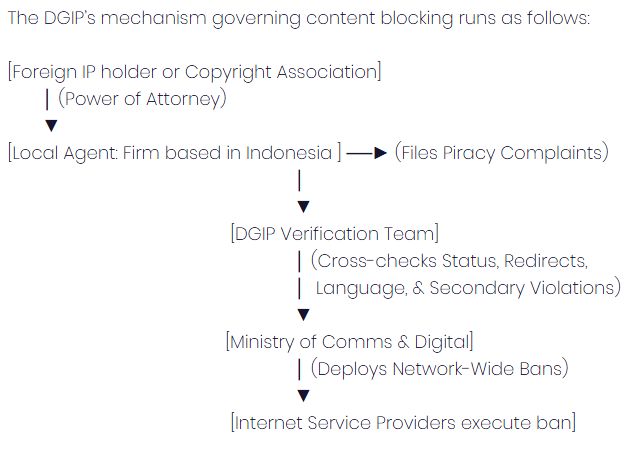
The 4-step Process
-
Proxy-Driven Reporting: In both actions, overseas Copyright Associations initiated the enforcement. For the K-drama sweep, the Copyright Overseas Promotion Association (COA), representing major South Korean broadcasting conglomerates including KBS, MBC, SBS, JTBC, and SLL Joongang—filed complaints through a local agent under a Power of Attorney.
-
Verification: Once complaints are registered, the DGIP Verification Team evaluates each URL individually. Of 59 reported streaming sites, 50 were recommended for immediate ban. The remaining 9 were filtered out because they had already been added to the state's Trust+ Positif blacklist through concurrent cyber-patrols, so didn’t need duplicate action.
-
Multi-Factor Infringement Triggers: Verification Team investigators do check if a link is active as well as searching for unauthorized localization markers. A key criterion that sealed the fate of the 50 K-drama domains was the presence of unauthorized Indonesian-language subtitling (fansubs), which the DGIP classified as a derivative-work copyright infringement.
-
Secondary Cyber-Crime Bundling: The verification process regularly uncovers auxiliary criminal operations. DGIP investigators documented that the targeted piracy networks systematically bundled copyright theft with illicit grey-market monetization streams, notably displaying intrusive ads for online gambling (judi online) and explicit pornography—both of which violate Indonesia’s strict national cyber-sanctity laws too.
Cross-Ministry Execution and Regulatory Blind Spots
Once the DGIP confirms structural copyright theft, it lacks the technical authority to drop the digital guillotine. It transfers its formal legal findings downstream to the Ministry of Communications and Digital (KOMINFO), which has regulatory control over the nation’s Internet Service Providers (ISPs). It then orders the ISPs to block the content.
There are problems with this kind of digital enforcement. Pirated domains frequently exploit inconsistent firewall deployments among minor regional internet providers to remain accessible despite central blacklisting. Many jump to new domain names (called hopping).
DGIP’s goals
Indonesia suffers from widespread and well documented copyright piracy. ISPs may not like being forced to gatekeep content. But Indonesia itself has a vast creative sector, plagued by piracy too. DGIP has in recent months expressed the desire to get off the USTR’s Priority Watch List. And Indonesia’s conservative culture does not fit with how illegal digital content is inextricably linked to illegal online gambling, pornography or other illegal activities.
The content of this article is intended to provide a general guide to the subject matter. Specialist advice should be sought about your specific circumstances.
[View Source]