

When extraordinary events disrupt commercial activity in the Gulf, businesses face an urgent question: does the law excuse us from performing our contractual obligations? The answer depends on which legal system governs your contract, what the disruption actually prevents you from doing, and whether you have followed the right procedural steps. This article provides a practical guide.
I. What Force Majeure Actually Means
Force majeure — literally "superior force" — excuses a party from performing a contractual obligation when an extraordinary external event makes performance impossible. It is not a general escape clause. It does not apply because performance has become more expensive, more difficult, or less commercially attractive. Three conditions must be satisfied in all four jurisdictions covered here. The party invoking force majeure carries the full burden of proving each one.
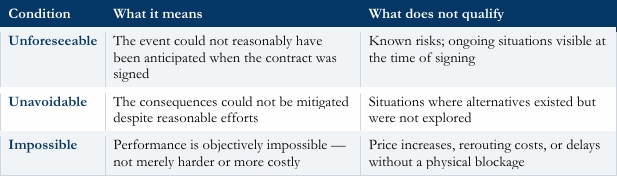
One further limitation applies universally: force majeure cannot be invoked retroactively to excuse obligations already in breach before the triggering event. A party that was underperforming before a disruption cannot use that disruption to cure an earlier default.
II. The Law by Jurisdiction
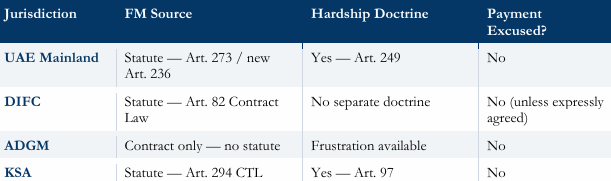
The UAE operates three distinct legal systems. Saudi Arabia operates a fourth. Which one governs your contract determines both the available relief and how it is obtained.
A. UAE Mainland — Civil Law
The UAE Civil Transactions Law provides statutory force majeure through Article 273, shortly to be replaced by Article 236 of the new Civil Transactions Law (Federal Decree-Law No. 25 of 2025, effective 1 June 2026). The conceptual approach is unchanged. Where total impossibility is established, the contract automatically terminates by operation of law. Where impossibility is partial, the affected portion is extinguished and the remainder continues.
Article 249 (Hardship): Where performance remains technically possible but has become excessively onerous due to an extraordinary and unforeseeable event, a court may rebalance the contractual obligations to a reasonable level. This is frequently the more appropriate remedy where disruption has raised costs significantly without creating total impossibility — and it is often underused.
B. DIFC — Common Law Hybrid
Article 82 of the DIFC Contract Law implies a statutory force majeure term into all DIFC-governed contracts, even where the agreement is silent. Non-performance is excused where the party proves an impediment beyond its control that it could not reasonably have foreseen or overcome. This provision does not excuse payment obligations unless the contract expressly provides otherwise. Affected parties must notify counterparties within a reasonable time; failure to do so may create liability for resulting losses.
C. ADGM — English Common Law
The ADGM applies English law on an evergreen basis. There is no statutory force majeure in the ADGM: the concept exists only where the parties have included an express clause. Where no clause exists, the only recourse is the common law doctrine of frustration — which requires showing that performance has become impossible, illegal, or something radically different from what was originally agreed. This is a high and rarely satisfied threshold. An ADGM-governed contract that is silent on force majeure leaves the affected party in a materially weaker position.
D. KSA — Civil Transactions Law (2023)
Article 294 of the Saudi Civil Transactions Law mirrors the UAE approach: where a supervening event renders performance impossible, the affected obligation is extinguished in whole or in part. Article 97 provides the equivalent of the UAE Article 249 hardship doctrine — courts may intervene to rebalance contracts where extraordinary circumstances have made performance excessively onerous.
III. The Three Conditions: What Courts Require
Across all four frameworks, the party invoking force majeure bears the full burden of establishing three cumulative conditions. A failure on any one element defeats the claim.
To view the full article clickhere
The content of this article is intended to provide a general guide to the subject matter. Specialist advice should be sought about your specific circumstances.

