- with Senior Company Executives, HR and Finance and Tax Executives
- in European Union
- in European Union
- with readers working within the Accounting & Consultancy, Business & Consumer Services and Property industries
Why This Distinction Costs Businesses Real Money
Zero-rated and exempt supplies both have one thing in common at the cash register: your customer pays no GST or HST either way. That surface similarity is exactly why so many business owners misclassify their sales, and why the mistake is expensive.
A zero-rated supply lets you keep claiming input tax credits (ITCs) on everything you buy to produce it. An exempt supply does not.
Treat an exempt supply as zero-rated, and you may end up claiming ITCs you were never entitled to, an amount the CRA will reassess with interest and, in the wrong circumstances, gross negligence penalties on top. Treat a zero-rated supply as exempt, and you may be needlessly giving up ITCs you were entitled to claim, quietly overpaying tax on your own inputs for years.
This article is a working checklist for classifying your own supplies and understanding what follows from that classification.
The Three (Really Four) Categories at a Glance
The Excise Tax Act sorts every supply into one of these buckets:
- Taxable supplies (standard-rated): GST/HST applies at the regular rate. You collect it, remit it, and claim ITCs on related inputs.
- Zero-rated supplies: GST/HST applies, but at a rate of 0%. You collect nothing, but you still claim ITCs on related inputs, because the supply is still legally “taxable,” just taxed at zero.
- Exempt supplies: GST/HST does not apply at all. You collect nothing, and you cannot claim ITCs on inputs related to making that supply.
- Out-of-scope transactions: not a “supply” under the Act in the first place. Common examples include wages and salaries paid to employees, owner draws, and transfers of property between divisions of the same legal person. These sit outside the GST/HST system entirely and are a separate question from zero-rating or exemption.
The practical difference that matters to your bottom line is entirely in the middle two categories. Both feel the same to your customer. They are not the same to you.
The Classification Checklist
Work through these questions for each distinct revenue stream your business generates, not just once for the business as a whole. Many businesses supply a mix of taxable, zero-rated, and exempt items, and each stream needs its own answer.
1. Is what you’re selling specifically listed in Schedule VI of the Excise Tax Act?
Zero-rating is not a general concept; it is a specific, enumerated list. Common Schedule VI categories include basic groceries, prescription drugs actually dispensed on a practitioner’s prescription, certain medical devices, most agricultural and fishing products, and most exports. If your supply isn’t on the list, it is not zero-rated no matter how “essential” or “healthy” it seems.
2. Is what you’re selling specifically listed as exempt under Schedule V?
Exempt categories include most health care services, educational services, long-term residential rent, most domestic financial services, and day care. Again, this is a specific list, not a general principle about what “shouldn’t” be taxed.
3. If neither list applies, it’s taxable at the standard rate.
There is no default assumption in favour of zero-rating or exemption. Silence in the schedules means fully taxable.
4. Does your revenue mix include more than one category?
If you make taxable or zero-rated supplies alongside exempt ones, you need to apportion your input tax credits between them, claiming ITCs only on the portion of your inputs used to make taxable or zero-rated supplies. This apportionment, and the record-keeping behind it, is one of the more common sources of GST/HST audit adjustments for mixed-use businesses.
5. Does your small-supplier calculation include the right revenue?
The $30,000 small-supplier threshold is based on your taxable supplies, which includes zero-rated supplies. Exempt supply revenue is not counted toward that threshold. A business with mostly exempt revenue and a small amount of taxable or zero-rated revenue may find itself required to register well before its total revenue looks large.
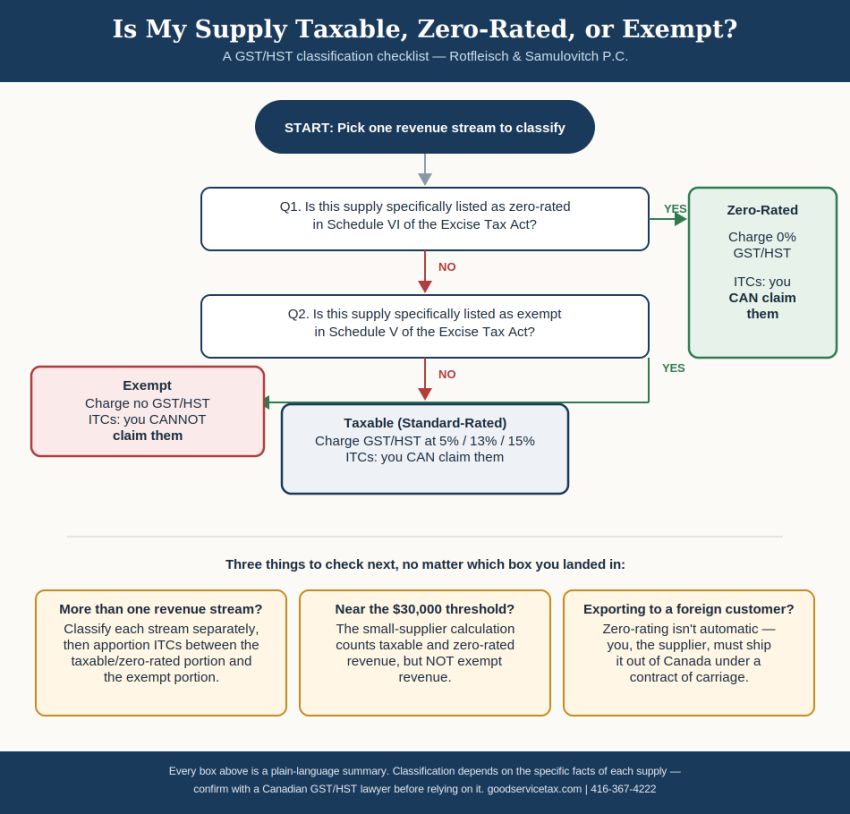
Figure: Zero-rated / exempt / taxable classification checklist.
Common Misclassification Traps
Basic groceries versus prepared food.
Zero-rating for “basic groceries” does not extend to most restaurant meals, snack foods, or many prepared or heated foods sold for immediate consumption. A bakery selling a loaf of bread is making a zero-rated supply; the same bakery selling a made-to-order sandwich is generally making a taxable supply. The line is drawn by specific carve-outs in Schedule VI, not by whether the product is “food.”
Short-term versus long-term residential rent.
The residential rent exemption is built around long-term occupancy, generally accommodation rented for a month or more to the same tenant as a place of residence. Short-term accommodation, such as a nightly or weekly rental, does not qualify for the exemption and is a taxable supply, even when the property is a residential home. Businesses and individuals renting out property short-term through platforms or direct bookings are a common source of this misclassification.
Medical cannabis.
It is a common and reasonable assumption that medical cannabis is zero-rated, the way most other prescription drugs are. It is not. The CRA’s long-standing position is that the “medical document” used to access cannabis under the Cannabis Regulations does not meet the definition of a prescription for GST/HST purposes, so cannabis obtained this way does not qualify for the zero-rated prescription drug relief in Schedule VI. The Federal Court of Appeal upheld this treatment in Hedges v. Canada. Medical cannabis is, with narrow exceptions, fully taxable.
Exports assumed to be automatically zero-rated.
Many businesses assume that selling to a foreign customer automatically zero-rates the sale as an export. It does not. Zero-rating for exported goods under Schedule VI requires the specific statutory conditions to be met, generally that the supplier itself ships the property to a destination outside Canada under a contract for carriage, not merely that the customer intends to take the goods out of the country. In Montecristo Jewellers Inc. v. The Queen, 2019 TCC 31, a Vancouver jewellery retailer zero-rated sales to customers who were departing for China with the goods in hand, timing the handoff to just after a customs officer stamped an export form. The Tax Court held this did not qualify, since no third-party carrier had been engaged under a contract for carriage and the customers had unencumbered possession of the goods while still in Canada. The retailer was assessed for GST/HST it should have collected on sales it had treated as zero-rated exports.
Mixed-use professional practices.
A health care practice that bills some services to a public health plan (generally exempt) and also sells retail products or non-insured services (generally taxable) needs to track and apportion ITCs across both revenue streams. Treating the entire practice as exempt, or entirely taxable, is a frequent and costly simplification.
“The two categories look almost identical to a customer at the register, but they are opposite from a compliance standpoint, and that’s exactly where we see clients get into trouble. A business that assumes its whole revenue is zero-rated because none of it looks taxable to a customer can end up with years of improperly claimed input tax credits, and that gets expensive fast once the CRA notices.”
— David J. Rotfleisch, Certified Specialist in Taxation Law (Law Society of Ontario)
What Happens If You Get the Classification Wrong
Misclassifying a supply is not simply a matter of paying a bit more or less tax. If a CRA audit finds that you claimed ITCs on an exempt activity, the CRA will deny those credits and reassess, with interest running from when the credits were claimed. Where the CRA takes the position that the misclassification was a gross or wilful error rather than an honest mistake, gross negligence penalties can also apply. Our companion article on GST/HST gross negligence penalties discusses how those penalties are assessed and when they can be successfully challenged.
Tax Tips
- Classify each revenue stream at the transaction level, not at the business level, and revisit that classification whenever your business adds a new product, service, or rental arrangement, since a small operational change can move a supply from one category to another.
- Keep the documentation that supports your classification decisions, including any rulings, invoices, or regulatory documents you relied on, since the burden of justifying an ITC claim or an exemption falls on you in an audit, not on the CRA.
- If your business makes a mix of taxable, zero-rated, and exempt supplies, set up your bookkeeping to track and apportion ITCs by revenue stream from the outset rather than trying to reconstruct the split after the fact.
- If you are uncertain how a specific supply should be classified, or if the CRA has already reassessed you on this basis, speak with an experienced Canadian GST/HST lawyer before responding to the CRA, since the classification questions above are frequently more fact-specific than they first appear.
- If you use QuickBooks Online or similar bookkeeping software, carry this same three-way distinction directly into your tax codes: use the Zero-Rated code for zero-rated supplies, the Exempt code for exempt supplies, and the Out of Scope code for transactions like wages, owner draws, and inter-company transfers that aren’t a supply at all.
- Coding a transaction under the wrong tax code produces the same downstream ITC and reporting errors as misclassifying the underlying supply itself, so it is worth getting your bookkeeper or accountant to periodically audit how your products and services are tagged, not just how they are described in your invoices.
FAQs
What is the difference between a zero-rated and an exempt supply?
Both are supplies on which you charge no GST/HST to your customer. The difference is on the input side: a zero-rated supply still lets you claim input tax credits on your related purchases and expenses, while an exempt supply does not.
Does making zero-rated supplies count toward the $30,000 small-supplier threshold?
Yes. The threshold is based on taxable supplies, and zero-rated supplies are taxable supplies taxed at 0%. Exempt supply revenue is not counted toward the threshold.
Is medical cannabis zero-rated like other prescription drugs?
No. The CRA does not treat the medical document used to access cannabis as a prescription for GST/HST purposes, so medical cannabis generally does not qualify for zero-rated prescription drug treatment and is fully taxable, a position upheld by the Federal Court of Appeal in Hedges v. Canada. See the CRA’s own position in Excise and GST/HST News No. 107.
Are coffee beans zero-rated the same way a cup of coffee at a café is?
No. Ground coffee purchased at a grocery store for home brewing is zero-rated as a basic grocery, the same as whole coffee beans; grinding it doesn’t change the classification. A prepared cup of coffee sold at a café, coffee shop, or other eating establishment is a different transaction and is generally taxable, since food and beverages sold by establishments where prepared food makes up most of sales are excluded from the basic grocery zero-rating regardless of how simple the item is to prepare.
Are exports from Canada zero-rated?
Most goods exported from Canada are zero-rated under the export provisions of Schedule VI, but the zero-rating is not automatic just because the customer is a foreign resident. The specific conditions in the applicable section of Schedule VI Part V must be met, and for goods this generally means the supplier itself ships the property to a destination outside Canada under a contract for carriage with a third-party carrier, with documentation to support it. Services and intangible property are zero-rated as exports under a different set of conditions, generally turning on whether the recipient is a non-resident and where the service is performed or used.
If I rent out my home short-term, is that GST/HST-exempt like long-term residential rent?
No. The residential rent exemption applies to long-term accommodation, generally rented for a month or more to the same tenant as a place of residence. Short-term rentals are taxable supplies.
Can I claim ITCs on expenses that relate to both my exempt and taxable revenue?
You can claim the portion of the ITC that reasonably relates to your taxable or zero-rated activities, but you must apportion the credit and cannot claim the portion related to your exempt activities. The appropriate method of apportionment depends on the nature of the expense and the CRA’s input tax credit allocation rules.
What happens if the CRA decides I misclassified a supply?
The CRA can deny improperly claimed ITCs and reassess with interest. Where the CRA considers the misclassification to reflect gross negligence, additional penalties may also apply.
Do registered charities charge GST/HST on their supplies?
Generally not. The CRA’s own guidance states that most supplies made by registered charities are exempt, in contrast to the general rule for businesses, where most supplies are taxable. Charities can still make taxable supplies in some circumstances and are subject to their own net tax calculation rules.
What is the difference between Schedule V and Schedule VI of the Excise Tax Act?
Schedule V lists exempt supplies, and Schedule VI lists zero-rated supplies. Whether a supply appears in one schedule, the other, or neither is what determines its classification under this checklist.
The content of this article is intended to provide a general guide to the subject matter. Specialist advice should be sought about your specific circumstances.
[View Source]