

A nation-building project
Nova Scotia, under Premier Tim Houston, is betting big on Wind West – and it’s a winning bet. The details and proposed benefits of Wind West have been carefully laid out in successive reports issued by the Government of Nova Scotia (the NS Government):
- Capacity: Establish 5,000 MW in the first phase (licensed by 2030), with long-term goals for 66,000 MW to meet 27% of Canada's current electricity demand.
- Areas of interest: Up to four areas identified for development, with both fixed and floating technologies.
- Costs: Initial phase capital costs are pegged at CA$60 billion (CA$40 billion for turbines, CA$20 billion for transmission), with the province seeking federal partnerships for funding.
Recent developments demonstrate there is serious interest outside of Nova Scotia in developing this incredible resource. In February, the NS Government and the Commonwealth of Massachusetts signed a memorandum of understanding (the Offshore MOU) to collaborate on offshore wind development in the North Atlantic, including transmission planning.
Hot on the heels of the MOU, Hydro-Québec issued a request for information (RFI) “to assess options for the supply and transmission of electricity generated by offshore wind farms located off the coast of Nova Scotia.” Hydro-Québec issued the RFI since it had received numerous informal offers by developers to sell power generated from the future development off of Nova Scotia’s shores, notwithstanding that there is currently no transmission line in place capable of carrying the electrons. It is not clear whether the NS Government was aware of the RFI ahead of the announcement, although the NS Government did follow with a letter of support following the announcement.
On March 27, 2026, the Canadian and NS Government announced a deal to simplify the permitting process for major infrastructure and resource projects. Dubbed the “one project, one review” model, the process is meant to streamline environmental review for such projects. How this review process will align with projects that have been referred to the Major Projects Office (MPO) or designated under the Building Canada Act1 remains unclear at this time. Although identified by the federal government as a project of interest, Wind West has not been referred to the MPO.
Wind West timeline
Outside of public announcements and non-binding MOUs, the NS Government, and in some instances the federal government, have taken concrete steps to advance the project.
On July 29, 2025, the NS Government and the federal government jointly designated four areas – French Bank, Middle Bank and Sable Island Bank off mainland Nova Scotia and Sydney Bight off Cape Breton – as potential sites for offshore wind development that could be licensable under the proposed offshore wind licensing regime.
Figure 1. Designated areas for development
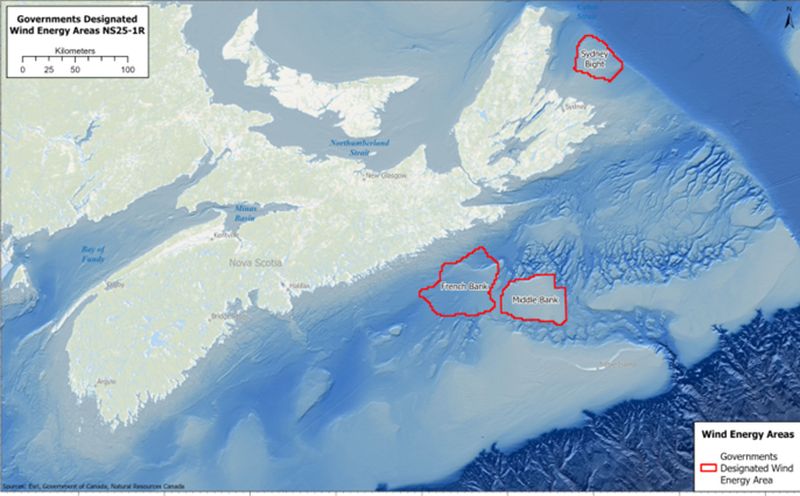
Image source: Canada–Nova Scotia Offshore Energy Regulator (CNSOER), Governments Designated Offshore Wind Energy Areas, https://cnsoer.ca/renewable-energy/lands-management/governments-designated-offshore-wind-energy-areas.
The Middle Bank and Sydney Bight contemplate fixed-bottom development, while the French Bank site contemplates floating turbine technology. Sable Island is further away from the mainland and is only slated for development in the later years.
On October 16, 2025, the Canada-Nova Scotia Offshore Energy Regulator (CNSOER), with its recently expanded mandate to include renewable energy, opened a 90-day Call for Information and Prequalification NS25-1R for offshore wind with respect to three of the designated sites. The call for information and prequalification closed on January 13, 2026. The prequalification process will identify companies that are eligible to participate in the next offshore wind call for bids that will be run by the CNSOER for up to 3,000 MW (possibly increasing to 5,000 MW).
On February 24, 2026, the NS Government tabled legislation in the form of the Offshore Renewable Energy Act. The new act creates a revenue framework for offshore wind projects, including an annual levy of CA$7,000/MW of nameplate capacity for the first 10 years of operation, and for years 11 and onward, an annual amount that is the greater of CA$7,000/MW of nameplate capacity and the percentage prescribed by the regulations of the gross revenue of the project in question. The NS Government has also, via the CNSOER, implemented a refundable bid application fee of CA$250,000 due at the time the proponent files for the submerged land licence. A fee of CA$750,000 is payable upon the issuance of a submerged land licence.
The federal government is interested in Wind West, but will not declare it a project of national interest until partners from the private sector sign on. The MPO does however, have a business development team to support the advancement of Wind West. The CBC quoted federal Energy and Natural Resources Minister Tim Hodgson as saying that the MPO needs to see “that industry is ready.” Meanwhile, the private sector will not sign on until they have clarity from the governments (both federal and provincial) on certain key matters, including a predictable revenue framework, who is going to buy the energy, availability of federal tax credits, development of supply chains and port infrastructure and perhaps most importantly, path to market.
Getting to market
Wind West struggles with a path to market. Nova Scotia’s existing transmission system, which services an average hourly load of 1,700 MW across the province, cannot accommodate the potential 60,000 MW of power that is Wind West. The Nova Scotia government’s Strategic Plan for Wind West released in September 20252 identifies two major transmission routes, both of which end up in Québec, where the power would tap into the Hydro-Québec’s bulk transmission system. Hydro-Québec has numerous interties into the US and recently completed the Hudson connection into New York. Hydro-Québec has contractual obligations to supply its US customers with power, but was not able to meet its obligations recently.
Although the Offshore MOU references transmission development as an area of collaboration, a direct transmission line to the US northeastern states would be longer, more technically and legally complex and more expensive than the contemplated Canadian transmission routes into Québec.
All three of Ontario, Québec and New England have a need for power. Québec’s geography makes it a central player in getting power to Ontario (any direct line to Ontario would need to pass through Maine) or New England. What is lacking is the commercial structure to develop, finance and ultimately own and operate the transmission line that Wind West will utilize. Canada and the provinces may need to consider a commercial model that does not yet exist to fix the ‘first mover’ problem. Consider for example, a transmission line in Nova Scotia that is owned jointly bought and paid for by Québec and Ontario, with a possibility of Indigenous ownership, coupled with a tolling arrangement between Québec and Ontario that ensures that Ontario has access to a portion of the energy generated by Wind West at a firm price. In this ownership structure, the transmission line would not be subject to rate regulation. The revenue and ownership model is closer to that of a pipeline or merchant transmission.
Economics of offshore
The economics and business case for offshore wind continue to improve year over year. According to the International Renewable Energy Agency (IRENA), offshore wind is a rapidly maturing technology with declining costs but generally remains more expensive than onshore wind, solar PV, and combined-cycle gas. Fixed-bottom offshore projects averaged CA$117/MWh in 2024 and floating projects up to CA$181/MWh in 2024. Despite higher capital costs than traditional generation, offshore wind’s high capacity factors make it increasingly competitive.
While the IRENA report provides a good snapshot, the overall trend is even more promising. Governments, when setting policy, need to take these trends and forecasting into account. Solar was incredibly expensive until it wasn’t. Now it’s the cheapest form of energy to build. Different studies will provide different levelized costs of energy for offshore wind, but this much is clear – in all cases costs are declining while capacity factors are improving. This is due to the cost efficiencies gained by increased build out. Offshore wind capacity has surged tenfold since 2013. The world had 7.2 GW installed in that year, and 73 GW as of 2023 – most of it in China. By 2019, offshore wind costs had also come down such that it was cheaper than most conventional power generation, the exception being combined cycle gas. However if a carbon price is factored in – which is meant to represent a true external cost to our economy – offshore will be cost competitive if not cheaper than combined cycle. Capital expenditures for offshore have also declined by an incredible 48% between 2010 and 2035.3
Role of the federal and provincial governments: De-risk, de-risk, de-risk
Governments continue to play an oversized role in the energy sector in Canada. Energy policy is intrinsically tied to politics. The policies that governments put in place – from targeted RFPs, to permitting regimes, to taxes (or tax credits) and the regulations that follow - hugely impact which technologies will be built and where. The NS Government and the federal government have demonstrated a level of coordination and cooperation not often seen. Wind West can become a reality if this trend continues and both levels of government expeditiously work to solve the path to market.
Cross-jurisdictional comparators: UK case study
The UK serves as an interesting case study for build out of offshore wind capacity, having expanded from the first GW scale project in 2010 to approximately 16 GW in 2026. Whilst the physical environment is different, there are relevant parallels for building out this sector in Canada. Dentons has been involved in all aspects of this sector including advising: (i) lenders in connection with project financing structures for offshore wind and offshore transmission assets; (ii) developers and operators on permitting, operations and maintenance (O&M) requirements and regulatory issues (including for hybrid green hydrogen projects); (iii) the UK energy regulator Ofgem and in relation to the design and implementation of a regulatory regime for offshore transmission; and (iv) the UK Government on the Contracts for Difference (CfD) revenue support drafting (see below).
Growth of this sector has been a deliberate UK Government priority. The UK has a government target to expand to 45-50 GW of offshore wind capacity (including 5 GW floating offshore wind) by 2030. This growth has been supported by a number of policy and regulatory measures, the main ones being:
- Early projects were supported by the Renewables Obligation which provides subsidy via tradeable certificates for each unit of power produced.
- Since 2014, offshore wind has been supported by Renewables CfD which provide revenue certainty through a fixed guaranteed "strike price" per unit of electricity. If the market price is lower than the strike price, the generator receives a top up amounting to the difference, if it is higher that the generator pays back. The CfD also includes additional de-risking measures through change of law protection, allowing projects to attract large institutional investors.
- The CfD regime has seen costs for offshore wind drop dramatically – from approximately £110/MWh in 2015 to £37/MWh in 2022. Following this there was a failed CfD allocation round in 2023 where no offshore wind projects came forward as the strike price was set too low while supply chain costs had increased significantly: this has since been recovered with a successful allocation round in 2024. However, cost pressures remain a significant risk in this sector with inflation and supply chain costs leading to significant uncertainty.
Crown Estate seabed leasing
- This is a centralised system to grant rights to offshore developers for seabed leasing to build offshore wind farms. The Government sets the policy direction and Crown Estate (which owns all of the seabed) identifies suitable zones and runs leasing rounds. Developers pay option fees in advance, and annual rent once projects are operational.
Offshore Transmission Owner (OFTO) regime
- Pursuant to this regime offshore transmission assets (cables, offshore substations) are built by the wind farm developer, and then sold (in a process managed by the regulator Ofgem) to a separate operator (OFTO) due to the UK's regulatory requirements for separation of control of transmission from that of generation. The OFTO then runs the transmission assets pursuant to fixed regulated payments. This allows the wind farm operator to recover the capital costs of these assets, and pass responsibility for long term operation to a third party. The OFTO licence also contains the potential for a process known as "OFTO build" where the OFTO entity rather than the generator or developer builds the transmission assets. To date this has not been taken up but is now being used as a supporting model for proposed onshore transmission works competition.
After over a decade of growth, the regulatory structures which support offshore wind in the UK are still evolving. In addition, there are reforms underway regarding planning and consenting for large infrastructure and grid reform to ease connection delays.
Going forward, in the UK supply chain pressures remain potential blockers to investment especially given cheaper (but sometimes politically undesirable) competition for manufacture of component parts – see for example the UK's recent decision to block Chinese company Ming Yang’s plans to build a turbine factory in Scotland on national security grounds. These cost pressures can be exacerbated by frequent technology shifts which require new infrastructure to support (such as port capacity, vessels and specialist skills especially with the proposed shifts to floating technologies). In addition, the UK continues to wrestle with ensuring competition and appeal where: (i) planning processes still consume a significant amount of time and cost for bidders; and (ii) comparably to certain regions of Canada, grid constraints and securing a connection remains an issue. Despite challenges, the sector remains thriving in the UK – there are strong fundamentals in terms of government support, a pipeline of large projects, and the amount of jobs and investment involved.
Footnotes
1. Projects that have been designated under the Building Canada Act are subject of a legislated, streamlined two-year approval process.
2. See: https://novascotia.ca/wind-west/docs/wind-west-strategic-plan-en.pdf
3. NOTE: See https://www.sciencedirect.com/science/article/pii/S030626192500710X for a recent study looking at the LCOE of offshore wind.
About Dentons
Dentons is the world's first polycentric global law firm. A top 20 firm on the Acritas 2015 Global Elite Brand Index, the Firm is committed to challenging the status quo in delivering consistent and uncompromising quality and value in new and inventive ways. Driven to provide clients a competitive edge, and connected to the communities where its clients want to do business, Dentons knows that understanding local cultures is crucial to successfully completing a deal, resolving a dispute or solving a business challenge. Now the world's largest law firm, Dentons' global team builds agile, tailored solutions to meet the local, national and global needs of private and public clients of any size in more than 125 locations serving 50-plus countries. www.dentons.com
The content of this article is intended to provide a general guide to the subject matter. Specialist advice should be sought about your specific circumstances. Specific Questions relating to this article should be addressed directly to the author.
The content of this article is intended to provide a general guide to the subject matter. Specialist advice should be sought about your specific circumstances.
[View Source]


