
- with readers working within the Healthcare industries
- within Transport topic(s)
- with Senior Company Executives, HR and Inhouse Counsel
Key takeaways
- Ontario’s Construction Act now includes swift payment deadlines and allows for private adjudicators.
- Saskatchewan and Alberta have implemented similar reforms with nuanced provisions on invoice submissions and adjudication procedures.
- New Brunswick established the Construction Prompt Payment and Adjudication Act, which awaits proclamation of force.
How recent developments are impacting the Canadian construction and infrastructure sector
Updated on: March 30, 2026
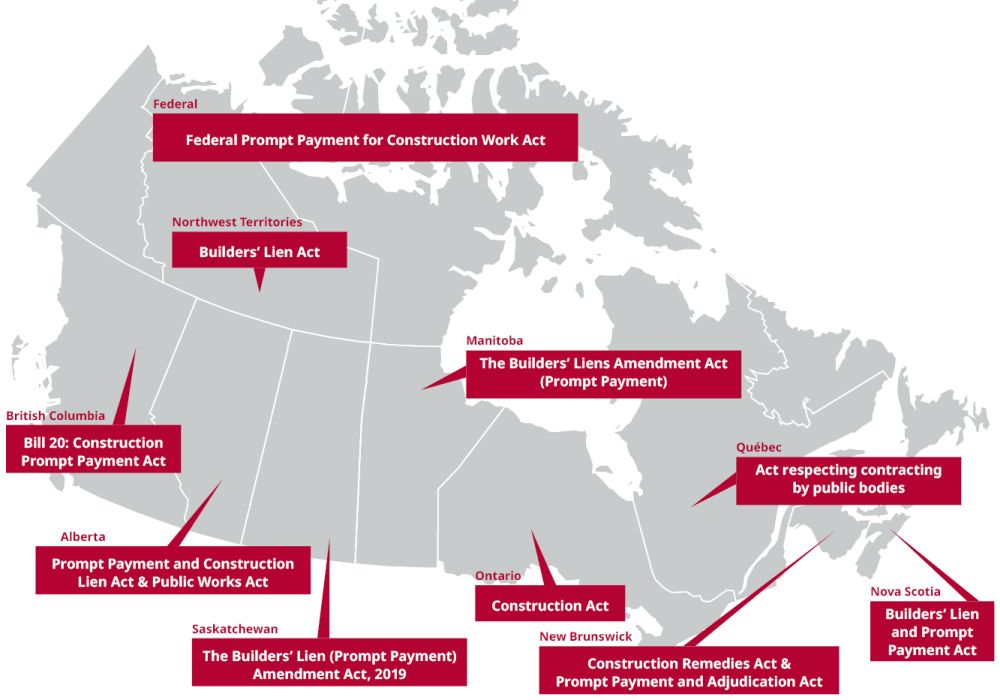
Prompt payment and adjudication legislation has been enacted across Canada in an effort to alleviate perceived payment delays down the construction pyramid. We have provided a brief overview covering the developments in each jurisdiction which we will continue to update with the latest news and useful insights; so check back regularly.
In Ontario, the changes to the Construction Act (formerly the Construction Lien Act) introducing prompt payment and adjudication came into force on October 1, 2019. The prompt payment regime comprises swift payment deadlines, requiring the owner either to pay within 28 calendar days or to dispute within 14 calendar days, describing the reasons for non-payment. In turn, the contractor must either pay its subcontractors within seven calendar days of receipt of payment or send notices of dispute within seven calendar days.
Introduced by the Construction Act, adjudication is a quick interim method to resolve disputes on a construction project. The adjudication regime in Ontario is being administered and overseen by the Ontario Dispute Adjudication for Construction Contracts (ODACC), which releases Annual Reports, as discussed in our blog post.
On January 1, 2026, several amendments to Ontario’s Construction Act (the Act) came into force pursuant to Bill 216, the Building Ontario For You Act (Budget Measures) and Bill 60, the Fighting Delays, Building Faster Act, 2025. As discussed in our webinar, “Amendments to Ontario’s Construction Act”, the amendments to the Act included modifications to the provisions on prompt payment, adjudication and the payment of holdback, including transitional measures built into section 87.4 of the Act. In addition, parties to an adjudication are now permitted to choose a private adjudicator and the availability of adjudication has been expanded in both time and scope. This follows a global trend of expanding access to statutory adjudication. Since Ontario was the first jurisdiction to layer a prompt payment and adjudication regime on top of an existing construction lien regime, our team continues to uncover additional issues in the interactions between these regimes and devise contractual solutions for our clients.
In Nova Scotia, the Builders’ Lien Act (amended) (Bill 119) received royal assent on April 12, 2019, but it has yet to come into force. Once in force, the current lien legislation will be renamed Builders’ Lien and Prompt Payment Act. Although the amendments introduce concepts from Ontario’s new prompt payment regime, it takes a narrower approach with regard to availability of adjudication. Unless exempted by the regulations, the amendments are applicable to contracts and subcontracts made after the date of enactment. On November 9, 2022, An Act to Amend Chapter 277 of the Revised Statutes, 1989, the Builders’ Lien Act (Bill 211), which establishes the Adjudication Authority, received royal assent, but it too has yet to come into force. Our team is monitoring progress on this front, as we await regulations prescribing application of the amendment, payment timelines, adjudication procedures, and details regarding notice of non-payment.
In Saskatchewan, The Builders’ Lien (Prompt Payment) Amendment Act, 2019 (the Amendment Act) and The Builders’ Lien Amendment Regulations, 2020 (SR 92/2020) (the Amendment Regulations) came into force on March 1, 2022, as described in our blog post. The Amendment Act and Amendment Regulations describe a prompt payment and adjudication regime that largely parallels Ontario’s regime. The Saskatchewan Construction Dispute Resolution Office (SCDRO), a new not-for-profit corporation, will act as the official adjudication authority and the ADR Institute of Saskatchewan Inc. will work with the SCDRO to provide adjudicators. The prompt payment and adjudication regime does not apply to architects, engineers, land surveyors and persons providing services or materials for any improvement with respect to a mine or mineral resource that is not oil and gas (including any activities regarding exploration, development, production, decommissioning or reclamation) or an improvement related to infrastructure in connection with the generation, transmission or distribution of electrical energy pursuant to the Power Corporation Act.
In Alberta, The Builders’ Lien (Prompt Payment) Amendment Act, 2020 (the Amendment Act) came into force on August 29, 2022, along with the Prompt Payment and Adjudication Regulation and the Prompt Payment and Construction Lien Forms Amendment Regulation, as discussed in our Update, Alberta’s prompt payment and adjudication regulations. The Amendment Act focuses on major reforms to the Builders’ Lien Act (the Act), including the introduction of prompt payment, adjudication, an extension of lien registration periods, and renaming the Act as the Prompt Payment and Construction Lien Act (PPCLA).
Unlike Ontario’s prompt payment regime, monthly billings are mandated through proper invoices issued at least every 31 days, unless any applicable contractual provisions for testing and commissioning are not met, or unless the project agreement has been exempted pursuant to Alberta Regulation 122/2023 [PDF], which describes qualifying criteria and names specific project agreements. The Amendment Act also makes major lien fund and minor lien fund payments to the contractor mandatory if certain conditions are met, as detailed in our blog, Amending Bill 37: Alberta’s prompt payment regime.
While the PPCLA applies to registered professional engineers and architects contracted to act in a consultative capacity in respect of an improvement, only Part 5 (Dispute Adjudication) applies to public works (as defined in the Public Works Act (PWA), which now includes its own prompt payment provisions) and it does not apply to agreements to finance and undertake an improvement in which either the Crown, in right of Alberta, or certain agents of the Crown, in right of Alberta, is a party.
On December 5, 2024, the Service Alberta Statutes Amendment Act, 2024 (Bill 30) received royal assent. Bill 30 introduced amendments to both the PPCLA and the PWA to bring Alberta’s prompt payment legislation more in line with industry expectations and have similar payment and adjudication rules apply across public construction projects. Details of this bill are discussed in our previous blog post. The sections of Bill 30 that amended the PPCLA and the PWA came into force on April 1, 2025.
In British Columbia, a series of town hall events were held in November 2021 to promote the adoption of prompt payment legislation. On May 4, 2023, the British Columbia Construction Association was notified that the Ministry of Attorney General staff would convene a large table consultation with interested groups to determine how prompt payment legislation could best work in the province. These consultations resulted in the Construction Prompt Payment Act (Bill 20), which received royal assent on November 27, 2025 and is discussed in detail in our blog post, British Columbia’s Construction Prompt Payment Act: from cash-flow friction to clear framework. While the legislation has been adopted, the British Columbia Government has not yet proclaimed this Act to be in force. When the Act comes into force it will introduce a prompt payment and adjudication regime largely mirroring Ontario’s regime. The Act will not apply to contracts entered into before the transitional section of the legislation comes into force.
In Manitoba, The Builders’ Liens Amendment Act (Prompt Payment)[PDF] (the Amendment Act) came into force on April 1, 2025. The Amendment Act introduced a prompt payment and adjudication regime into The Builders’ Lien Act, including the requirement to submit a proper invoice, deadlines for payment or notice of non-payment, interest on delayed payment, and mandatory adjudication for the determination of payment disputes, for contracts and subcontracts entered into on or after the date the Amendment Act comes into force. To accommodate the new prompt payment regime, the Amendment Act also extended the deadlines for lien remedies from 40 days to 60 days. Unlike Ontario, the prompt payment and adjudication regime does not apply to the professional fees and charges for architects and engineers. The Builders’ Liens (Prompt Payment) Regulation [PDF], which was made under The Builders’ Liens Act and came into force alongside the Amendment Act, addresses transitional matters, including the designation of an adjudication authority by the minister and the requirements to become an adjudicator.
In New Brunswick, the Construction Remedies Act and the General Regulation, which both came into force on November 1, 2021, repealed and modernized the existing lien legislation by amending lien, holdback, trust, substantial performance and security bond provisions. The Construction Prompt Payment and Adjudication Act(the Act), which received royal assent on June 16, 2023, creates a prompt payment and adjudication regime applicable to all contracts entered into on or after the date the Act comes into force and all subcontracts associated with such contracts, unless exempted by regulation. This new legislation has not been proclaimed to be in force by the New Brunswick Government.
In Québec, on June 2, 2022, An Act mainly to promote Québec-sourced and responsible procurement by public bodies, to reinforce the integrity regime of enterprises and to increase the powers of the Autorité des marchés publics received royal assent, amending the Act respecting[MB1] contracting by public bodies and established the legal foundation for a prompt payment regime and rapid dispute resolution process in public construction contracts. Among the adopted amendments are the obligation to pay sums due in the context of public construction contracts within a timeframe established by regulation and the accumulation of interest in the event of late payment. The act also establishes the option for a party to require the other party to participate in a third-party dispute resolution mechanism for payment disagreements.
This Act is implemented by the Regulation respecting prompt payments and the prompt settlement of disputes with regard to construction work (the Regulation) which came into force on September 8, 2025 and includes transition provisions for certain building and civil engineering contracts. The prompt payment scheme requires payment requests to contain detailed information, such as descriptions of the work performed, expenses incurred, and the amounts claimed, and mandates prompt payment timelines. For example, public bodies must pay an invoice not later than the last day of the month or dispute an invoice not later than the 21st of the month. Debtors who refuse all or part of a claim must issue a written notice specifying the grounds and the amount disputed. The dispute resolution settlement establishes a confidential and efficient process. This mechanism can be used to resolve issues relating to the validity of payments, refusals or withholding, changes in the scope of work, and the interpretation of contracts or regulations.
The Regulation excludes several categories of agreements from the prompt payment regime. These include public contracts signed in emergency circumstances, contracts for activities carried out on foreign soil by a delegation representing Québec abroad, as well as claims to compensate for certain damages (i.e., a loss of profit, productivity or a business opportunity) caused by a change relating to the scope of the work or the conditions for its performance. Implementation of the regulation is planned to occur in stages, based on the type of contract (differentiating between work on a building and civil engineering work) and the contract value as described in section 94 of the Regulation. The Regulation will be fully in force by September 8, 2027.
In the Northwest Territories, the Builders’ Lien Act [PDF] received royal assent on October 6, 2023, and came into force on September 1, 2025, providing prompt payment provisions intended to ensure contractors are paid in a timely manner. However, the Builders’ Lien Act does not provide for adjudication in the event of disputes over payment.
At the federal level, the Federal Prompt Payment for Construction Work Act (the Act), addresses the non-payment of contractors and subcontractors performing construction work for federal construction projects. The Federal Prompt Payment for Construction Work Regulations (Criteria, Time Limits, Interest and Circumstances) [PDF], and the Federal Prompt Payment for Construction Work Regulations (Dispute Resolution) [PDF], came into force on December 9, 2023. Canada Dispute Adjudication for Construction Contracts (CanDACC) has been appointed as the Adjudicator Authority. The Act surprisingly will not grandfather existing contracts. Instead, it will provide for a one-year deferral period before it applies to existing contracts. At that point, it may be imagined that the sudden application mid-performance of the new law to existing contracts drafted before the Act came into effect may be quite disruptive to those contracts. The federal government may choose to exempt federal projects from the federal regime individually and has designated the provinces of Ontario, Saskatchewan and Alberta, where reasonably similar provincial legislation has been adopted, for the non-application of certain provisions of the Act. For more information on the federal prompt payment landscape, see our previous update and blog post.
Preparing your organization
Industry participants can ensure that their existing projects are not disrupted in mid-performance and new projects are structured in the most effective way by staying informed and engaging legal experts with proven experience and know-how. This mitigates the risk of encountering serious issues after the fact and minimizing the potential of unforeseen delays and cost overruns.
Osler’s National Construction and Infrastructure Group, ranked Band 1 in Chambers Canada, and which is comprised of commercial and disputes lawyers, advises stakeholders on how to best shape the transition to new prompt payment legislations across Canada, redesign internal processes to remain compliant, and revise existing contracts and contract templates, scaled from the smallest to the largest and most complex projects in Canada.
The content of this article is intended to provide a general guide to the subject matter. Specialist advice should be sought about your specific circumstances.
[View Source]