

In short
Build asset resilience by improving asset data, prioritising investment based on risk, integrating climate adaptation into planning and strengthening governance to support reliable services, financial sustainability and long-term community outcomes.
Roads, bridges, drainage networks, sporting facilities, libraries, depots, public lighting and community buildings form the foundation of local government service delivery.
These assets are often viewed as physical infrastructure, but they represent much more than that. They enable communities to move around safely, access services, connect with one another and participate in local life. When assets fail, the impact extends beyond repair costs. Service delivery is disrupted, community confidence is impacted and councils can face increased safety, regulatory and financial risks.
For councils and other major asset owners, the challenge is growing. Asset portfolios are ageing, maintenance backlogs are increasing and extreme weather events are placing greater pressure on infrastructure that was often designed for different conditions. Councils are also balancing competing demands for new projects, service improvements and financial sustainability.
This is why asset resilience has become a critical component of organisational resilience.
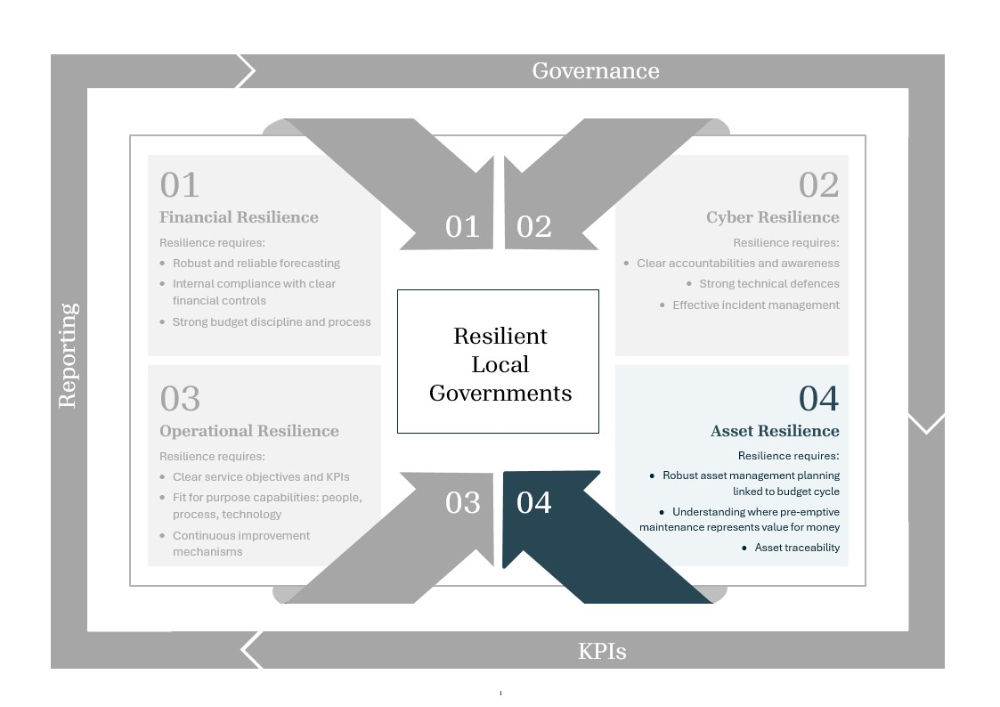
Asset resilience is about more than asset management
Asset resilience is the ability of an organisation’s asset portfolio to withstand disruption, adapt to changing conditions and continue supporting essential services over time.
While asset management frameworks remain important, resilience requires a broader perspective. It considers not only the condition of assets today, but also whether they’ll remain fit for purpose in the future.
That means understanding how infrastructure will perform under increasing demand, changing environmental conditions, evolving regulatory requirements and ongoing financial constraints.
Resilient councils make asset decisions through the lens of long-term service delivery outcomes rather than short-term budget cycles.
What asset resilience looks like
While every council’s asset portfolio is different, resilient organisations tend to share four common characteristics.
Risk-based decision making
Not all assets carry the same level of risk. Resilient councils prioritise maintenance, renewal and investment decisions based on criticality, condition, consequence of failure and community impact. They understand which assets are essential to public safety and service continuity and focus resources accordingly.
This helps councils move beyond reactive maintenance and direct investment where it has the greatest impact.
Whole-of-life asset thinking
Resilience starts well before an asset is built. Leading organisations consider the full lifecycle cost of an asset, including operation, maintenance, renewal and eventual replacement. They recognise that decisions made during planning and design can create financial pressures that persist for decades.
By understanding whole-of-life costs, councils can make more sustainable investment decisions and avoid creating future liabilities.
Climate adaptation embedded into planning
Historical performance is no longer a reliable predictor of future conditions. Flooding, extreme heat, bushfire risk and severe storms are changing how infrastructure assets perform and how communities use them. Resilient councils incorporate climate and hazard considerations into asset planning, design standards and renewal programs rather than treating them as separate initiatives.
This allows infrastructure investment to better reflect future risk.
Strong capital governance
Asset resilience is strengthened when capital investment decisions are supported by disciplined governance. This includes robust business cases, realistic delivery planning, active benefits management and post-project reviews that capture lessons for future programs.
Good governance improves delivery outcomes and helps ensure scarce investment dollars are directed to projects that create genuine community value.
What councils should do now
While these characteristics provide a useful picture of what resilient organisations look like, many councils are still working towards this level of maturity. There are several practical steps councils can take to strengthen resilience.
1. Improve the quality of information
Many councils hold large volumes of asset data but have varying levels of confidence in its completeness, accuracy or consistency. Improving asset information provides a stronger foundation for maintenance planning, renewal forecasting and investment decisions.
2. Prioritise investment where failure matters most
Not every asset can be renewed at once. Councils should understand which assets are most critical and pose the greatest risk to safety, service continuity and community outcomes, and use this information to guide maintenance and capital investment decisions.
3. Challenge assumptions about future demand
Population growth, changing community expectations and climate impacts can alter how assets are used over time. Councils should regularly test whether existing asset strategies remain aligned to future service needs rather than relying on historical assumptions.
4. Strengthen links between asset, financial and service planning
Asset decisions are rarely infrastructure decisions alone. Bringing together asset planning, long-term financial planning and service planning can help councils make more informed trade-offs and avoid creating future financial pressures.
Asset resilience is an organisational responsibility
Asset resilience can sometimes be treated primarily as an engineering or infrastructure function. However, asset decisions influence service delivery, financial sustainability, risk and reputation management and community outcomes. They require input from across the organisation, including executives, finance teams, operational leaders and elected members.
The most resilient councils recognise that infrastructure exists to support services and communities, not simply to be maintained. Like cyber, financial and operational resilience, asset resilience is ultimately about preparedness. It’s the ability to make informed decisions today that reduce disruption, manage risk and ensure community assets continue delivering value for years to come.
The content of this article is intended to provide a general guide to the subject matter. Specialist advice should be sought about your specific circumstances.
[View Source]