

On 14 August 2026, the International Centre for Settlement of Investment Disputes (ICSID), the leading forum for investor-State arbitrations, published its Caseload Statistics for the 2026 Fiscal Year (1 July 2025 to 30 June 2026) (FY 2026).
While we consider the global trends from the report in our separate blog post here, this update focuses on key data points for investors and States in the Asia-Pacific region.
Key takeaways
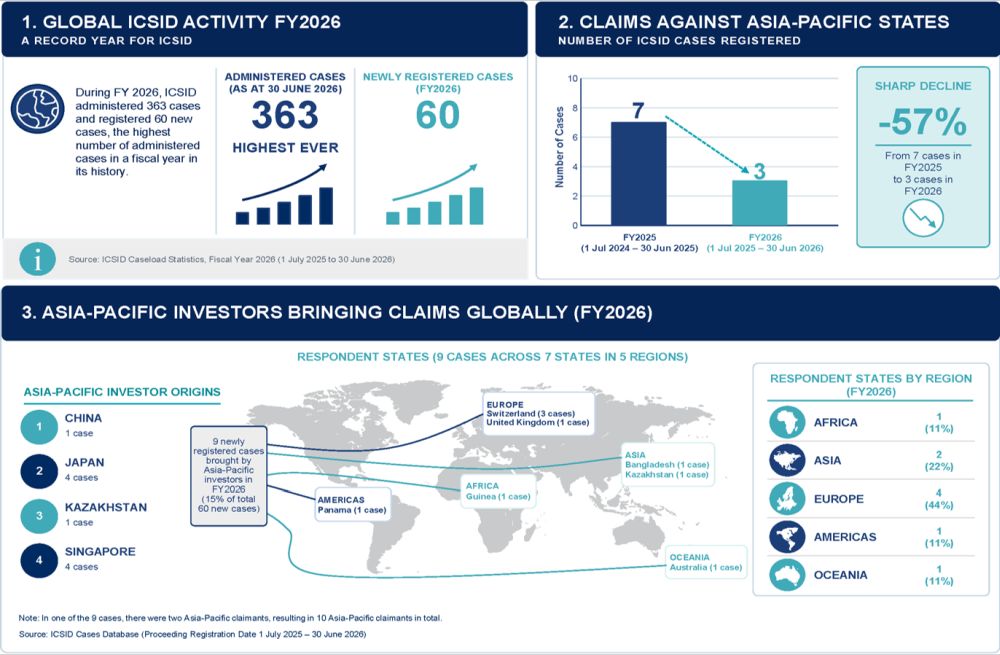
- ICSID’s administered caseload reached a record high in FY 2026, with 363 administered cases and 60 newly registered cases. This heightened caseload reflects the current climate of heightened geopolitical risk, increased nationalism, and regulatory flux which often result in the interests of foreign investors diverging from those of States hosting their investment, and investor-State disputes arising.
- Asia-Pacific investors brought nine newly registered ICSID cases in FY 2026, representing 15% of newly registered cases, broadly in line with the 11 cases registered in FY 2025.
- New ISDS cases against Asia-Pacific States fell from seven in FY 2025 to three in FY 2026.
- Claims involving Asia-Pacific investors and States were concentrated in the oil, gas and mining sector, with additional claims in construction, electric power and other energy, finance, information and communication, transportation, and services and trade.
- Treaties remained the primary basis for claims with an Asia-Pacific connection, with investors relying principally on bilateral investment treaties and free trade agreements, and to a lesser extent on domestic laws and multilateral investment treaties.
A closer look at the Asia-Pacific data
- Investor-State arbitrations brought by Asia-Pacific investors comprise 15% of new cases: In FY 2026, there were 9 cases registered with ICSID brought by Asia-Pacific investors (representing 15% of cases registered with ICSID in FY 2026), which is largely in line with the 11 cases registered in FY 2025 (representing 16% of cases registered with ICSID in FY 2025).
- Concentration in location of Asia-Pacific investor claimants: The FY 2026 Asia-Pacific investor claimants were based in China (1), Japan (4), Kazakhstan (1) and Singapore (4). Whilst there were 9 Asia-Pacific investor claims, the total number of Asia-Pacific claimants was 10, as one claim featured two Asia-Pacific claimants. This represents a concentration and shift in country representation from FY 2025, where claimants hailed from a wider array of States, including Australia, Armenia, Indonesia, Kazakhstan, South Korea, Malaysia, the Philippines, and Singapore.
- Asia-Pacific investors bringing claims against States globally: The States facing claims by these investors in FY 2026 are widespread, but concentrated in Europe, including countries from Africa (Guinea (1)), Asia (Bangladesh (1), and Kazakhstan (1)), Europe (Switzerland (3), and the United Kingdom (1)), the Americas (Panama (1)) and Oceania (Australia (1)). This geographic spread is similar to that in FY 2025 although involving different countries, namely in Africa (South Sudan), Asia (Kazakhstan, Malaysia, Myanmar, the Philippines and Uzbekistan), Europe (France and Spain), and the Americas (Canada, Honduras and Panama).
- Decline in investor-State cases against Asia-Pacific States:In FY 2026, there were 3 cases registered against States in the Asia-Pacific (Australia, Kazakhstan and Turkmenistan) which is down from the 7 cases registered in FY 2025 (involving Bangladesh, Kazakhstan, Malaysia, Myanmar, the Philippines, Turkey and Uzbekistan).
- High proportion of claims against Asia-Pacific states brought by investors in the same region: In both FY 2025 and FY 2026, Asia-Pacific States faced a relatively high proportion of claims from investors in the region. In particular, in FY 2026, claims were brought by investors from the Americas (the Bahamas), Asia (China and Japan) and Europe (the Netherlands and the United Kingdom). In FY 2025, Asia-Pacific States faced claims from investors in Asia (Indonesia and Singapore), Europe (Malta and the United Kingdom) and Oceania (Australia).
- Claims involving Asia-Pacific investors and States primarily involve extractive sectors: The vast majority of claims brought by Asia-Pacific investors and against Asia-Pacific States in both FY 2026 and FY 2025 were in the oil, gas and mining sector, with claims also in the construction, electric power & other energy, finance, information & communication, transportation and services & trade sectors.
- Treaties the primary source of claims with an Asia-Pacific connection: Consistent with the global trend in FY 2026 of a reduction in contract-based claims, not a single claimant invoked a contract in their claims, but instead they primarily relied on bilateral investment treaties, and free trade agreements and, to a lesser extent, domestic laws and multilateral investment treaties.
Comment
ICSID’s FY 2026 caseload statistics show continued activity by Asia-Pacific investors in investor-State arbitration, alongside a decline in new claims against Asia-Pacific States. For investors, States and funders, the data highlights the continuing importance of treaty protection, dispute readiness and sector-specific risk management, particularly in oil, gas and mining.
The content of this article is intended to provide a general guide to the subject matter. Specialist advice should be sought about your specific circumstances.
[View Source]

