

The Department of Justice (DOJ) and the Department of Health and Human Services (HHS) recently announced the DOJ-HHS False Claims Act Working Group, created to continue the longstanding collaboration between the departments to detect and prosecute healthcare fraud using the False Claims Act (FCA).1, 2
The FCA provides that any person who submits a false claim to the government can be liable for three times the government's damages plus penalties for each claim submitted.3
The FCA Working Group, led by the Deputy Assistant Attorney General and lead counsel from HHS and HHS-OIG, includes leadership from the HHS Office of General Counsel, the Centers for Medicare & Medicaid Services Center for Program Integrity, the Office of Counsel to the HHS Office of Inspector General (HHS-OIG), and the DOJ Civil Division (represented by designees from U.S. Attorneys' Offices).
The group is expected to meet monthly. In the announcement, DOJ "encourage[d] whistleblowers to identify and report violations of the [FCA] involving priority enforcement areas."4
The DOJ announcement listed the following priority enforcement areas:5
- Medicare Advantage
- Drug, device, or biologics pricing, including arrangements for discounts, rebates, service fees, and formulary placement and price reporting
- Barriers to patient access to care, including violations of network adequacy requirements
- Kickbacks related to drugs, medical devices, durable medical equipment, and other products paid for by federal healthcare programs
- Materially defective medical devices that impact patient safety
- Manipulation of Electronic Health Records systems to drive inappropriate utilization of Medicare-covered products and services
The announcement of the FCA Working Group also signals an effort to streamline FCA cases. The FCA Working Group will perform early assessment of the merit of FCA filings and is tasked with considering dismissal of non-intervened qui tam suits pursuant to 31 U.S.C. § 3730(c)(2)(A).
The working group will use additional tools, including payment suspensions under 42 C.F.R. § 405.370, even before an intervention in an FCA case.6 This is not a new provision, but the announcement suggests a more robust use of pre-liability payment suspensions.
The FCA provides that any person who submits a false claim to the government can be liable for three times the government's damages plus penalties for each claim submitted.
While streamlining is potentially helpful to healthcare providers, enhanced use of pre-liability payment suspensions poses significant financial risks to providers that submit claims to the government.
DOJ is continuing a long tradition of using the FCA as a crucial tool to combat healthcare fraud. In 2024, the federal government recovered $1.67 billion in settlements and judgments from hospitals, pharmaceutical companies, labs, physicians, and other medical companies.7
This announcement follows other recent DOJ enforcement announcements, including the Corporate Whistleblower Awards Pilot Program, Civil Rights Fraud Initiative, the creation of the Health Care Fraud Data Fusion Center, and a National Health Care Fraud Takedown. Taken together, the message is clear that DOJ is committed to identifying and prosecuting healthcare fraud using a variety of measures and tools.
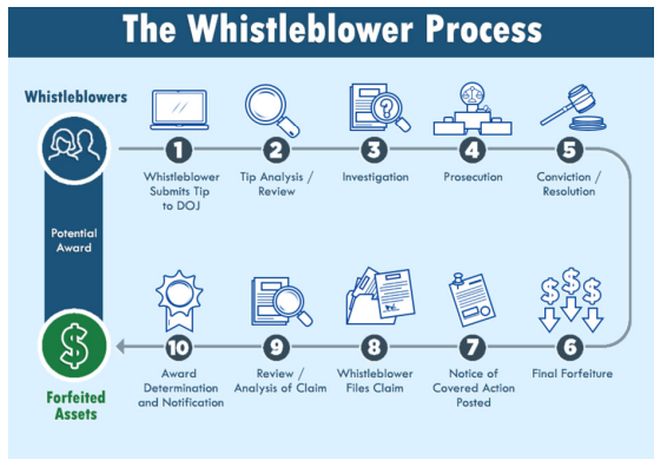
DOJ's Criminal Division launched a Corporate Whistleblower Awards Pilot Program to "uncover and prosecute corporate crime."8
Under the program, a whistleblower who provides DOJ with truthful and original information about corporate conduct that ultimately results in forfeiture may receive an award; the information provided must relate to one of the following areas: (1) certain crimes involving financial institutions, from traditional banks to cryptocurrency businesses; (2) foreign corruption involving misconduct by companies; (3) domestic corruption involving misconduct by companies; or (4) healthcare fraud schemes involving private insurance plans. This provides the DOJ with another tool to identify and combat healthcare fraud.
The Civil Rights Fraud Initiative,9 announced in May, directs DOJ to use the FCA to ensure that the "federal government [does] not subsidize unlawful discrimination." The initiative partners the Civil Division's Fraud Section and the Civil Rights Division.
The Health Care Fraud Data Fusion Center combines experts from the HHS, DOJ, and HHS Office of Inspector General to use artificial intelligence (AI), cloud computing, and advanced analytics to detect health care fraud.
In 2024, the federal government recovered $1.67 billion in settlements and judgments from hospitals, pharmaceutical companies, labs, physicians, and other medical companies.
The National Health Care Fraud Takedown resulted in 324 defendants charged in connection with over $14.6 billion in alleged healthcare fraud. The defendants included 96 doctors, nurse practitioners, pharmacists, and other licensed medical professionals, in 50 federal districts and 12 state attorneys general's offices across the United States.10, 11
Entities that are involved in federal healthcare programs should take note of this announcement as it signals an increase in enforcement. Those who are involved in Medicare Advantage should pay particular attention as this program was highlighted as a priority for enforcement. Indeed, on May 1, 2025, DOJ filed a complaint-in-intervention alleging Anti-Kickback Statute violations by several Medicare Advantage plan sponsors and insurance brokers.12
The FCA Working Group plans to expedite ongoing investigations as well as identify new leads through the use of cross-agency collaboration and enhanced data mining.13 These initiatives should put fraudsters on notice — and alert all healthcare industry participants of the increased scrutiny toward targeted areas of enforcement.
The increased scrutiny that will stem from the FCA Working Group will have implications for healthcare payers and healthcare providers, particularly those that have significant business related to Medicare and Medicaid.
The cross-agency collaboration and increased emphasis on data analytics should provide a road map for internal control design and implementation and are also likely to intensify related compliance efforts. Industry participants should use tools similar to those being used by the FCA Working Group in order to promptly and thoroughly respond to regulatory inquiries.
Companies should undertake proactive steps to mitigate risk and assess/strengthen their compliance programs. Healthcare payers should expect scrutiny of their network adequacy, patient access, and billing practices. Additionally, companies should apply renewed emphasis to compliance programs related to discounts and rebate practices for drugs and biologics, which are additional areas listed as priority areas of enforcement.
The FCA Working Group will increasingly focus on data analytics and AI to more quickly identify fraudulent schemes and outlier utilization and billing patterns.14 This effort is consistent with the DOJ's creation of a Health Care Fraud Data Fusion Center. This newly created center intends to revolutionize the detection, investigation, and prosecution of healthcare fraud by leveraging advanced data analytics and interagency collaboration.
With increased data-driven fraud investigations and prosecutions, it will be more important for companies to have sophisticated data analysis tools and procedures that allow early detection of errors or other anomalies. Getting ahead of these issues prior to a government inquiry is imperative. And once an inquiry occurs, companies need to be able to match the analytical capabilities of the FCA Working Group.
While the FCA Working Group will continue to encourage and rely on whistleblowers to identify certain fraudulent schemes, the cross-agency collaboration and data mining capabilities should allow a more efficient evaluation of the allegations and scope of possible impact; these tools may allow a more selective prosecution of alleged fraud.
On the other hand, these tools may encourage the DOJ to move to dismiss qui tam complaints determined to be frivolous. Overall, the FCA Working Group and its resources should allow for a more effective and efficient identification and prosecution of healthcare fraud under the FCA.15
As companies invest more resources into data analytics tools and processes, they will be better prepared to respond to regulatory inquiries and defend against government allegations. Companies will be able to couple superior knowledge of their own procedures, systems, and data with their own data analytics resources. This will improve their compliance and risk management profile.
Further, the rapid development of AI tools should benefit both the FCA Working Group and industry participants. While AI is not a new tool in fraud detection, the AI tools are improving
rapidly, and for the FCA Working Group, the use of AI tools and the ability to access cross-agency data sets should be a powerful combination.
For companies, it will be important to evaluate their own various data sets in order to maximize the potential for AIgenerated analysis.
Proactive steps healthcare entities can take now
- Review current compliance programs and procedures to ensure they are up-to-date and consistent.
- Examine internal reporting and whistleblower systems to make sure they are available and accessible to employees, that complaints are reviewed promptly, and that necessary corrective action is taken.
- Ensure that internal reporting and whistleblowing procedures adequately protect employees from retaliation.
- Consider utilizing data analytics and AI tools to detect outliers and anomalies.
- Healthcare providers should consider how they collect and store data and who has access to it. Compliance personnel should have access to current data and understand how to use it for fraud detection.
- Ensure your company is able to quickly identify, investigate, address, resolve, and document reports of misconduct.
Footnotes
1. U.S. Dep't of Justice, Office of Pub. Affairs, DOJ-HHS False Claims Act Working Group (July 2, 2025), https://bit.ly/3IVf1lP.
2. U.S. Dep't of Health & Human Servs., DOJ-HHS False Claims Act Working Group (July 2, 2025), https://bit.ly/4lJPRoO.
3. U.S. Dep't of Justice, Civil Div., The False Claims Act (updated January 15, 2025), https://bit.ly/454qdEc.
4. U.S. Dep't of Justice, supra.
5. U.S. Dep't of Justice, supra.
6. U.S. Dep't of Justice, supra.
7. U.S. Dep't of Justice, Archives, False Claims Act Settlements and Judgments Exceed $2.9B in Fiscal Year 2024 (January 15, 2025), https://bit.ly/3IPBnFu.
8. U.S. Dep't of Justice, Criminal Div., Criminal Division Corporate Whistleblower Awards Pilot Program (August 1, 2024), https://bit.ly/4faqA4C (guidance revised May 12, 2025), https://bit.ly/46COzrb.
9. U.S. Dep't of Justice, Office of Pub. Affairs, Justice Department Establishes Civil Rights Fraud Initiative (May 19, 2025), https://bit.ly/46rC95g.
10. U.S. Dep't of Justice, Office of Pub. Affairs, National Health Care Fraud Takedown Results in 324 Defendants Charged in Connection with Over $14.6 Billion in Alleged Fraud (June 30, 2025), https://bit.ly/4mhHMr9.
11. Health Law Advisor, The First National Health Care Fraud Takedown of the Second Trump Administration: What Stayed the Same and What Is New? (July 15, 2025), https://bit.ly/45xNz5x.
12. U.S. Dep't of Justice, Office of Pub. Affairs, The United States Files False Claims Act Complaint Against Three National Health Insurance Companies and Three Brokers Alleging Unlawful Kickbacks and Discrimination Against Disabled Americans (May 1, 2025), https://bit.ly/4l5Md7r.
13. U.S. Dep't of Justice, supra.
14. U.S. Dep't of Justice, supra.
15. U.S. Dep't of Justice, Criminal Div., The Whistleblower Process, graphic image from Criminal Division Corporate Whistleblower Awards Pilot Program, August 1, 2024, https://bit.ly/3HcTV1I, last accessed July 25, 2025.
Originally published by Westlaw Today on 25 August 2025
The content of this article is intended to provide a general guide to the subject matter. Specialist advice should be sought about your specific circumstances.
[View Source]
