

Summary: A Division Bench of the Delhi High Court recently stayed an injunction in a patent dispute against Automat, criticizing the "fragmented" approach of focusing solely on the "characterised in that" clause. The Bench ruled that Indian patent law requires holistic claim construction, reinforcing that two-part claims do not grant special status to any single clause.
I. Introduction
Claim construction is an important aspect of infringement analysis. In several jurisdictions, such as the United Kingdom, Germany, and the European Union, claims include a "characterised in that" clause. In such claims, the portion before this clause is what is known in the art, while the elements that come after this clause are the novel inventive features of the claims. In a recent case, Automat Industries Pvt. Ltd. v, Aquestia Limited (FAO(OS) (COMM) 123/2025 & CM APPLs. 49211/2025, 49212/2025 & 49213/2025, decision dated 5 January 2026), the Delhi High Court deliberated on the construction of claims that include the "characterised in that" clause, asking whether in an infringement suit, can an Indian court confine its analysis to the portion of a claim following the phrase "characterised in that"?
II. Background
Aquestia Limited (or 'Aquestia') instituted an infringement suit against Automat Industries Pvt. Ltd. (or 'Automat'), alleging that the latter's Hydromat valves infringed their Indian Patent No. IN 427050, titled "A Fluid Control Valve". In August 2025, a Single Judge of the Delhi High Court granted an interim injunction against Automat, which was challenged. This was stayed by a Division Bench (or 'the DB') of the same court in January 2026.
IN 4270503 titled "A Fluid Control Valve" is directed towards a flow control diaphragm valve. Independent Claim 1 reads as:
A fluid control valve comprising:
a valve body (22) configured with an inlet port (24) extending into an inlet chamber (30), and an outlet port (26) extending from an outlet chamber (32). wherein the inlet chamber (30) and the outlet chamber (32) are partitioned by a sealing bridge;
a control chamber (111) accommodating a flexible sealing diaphragm deformable between a sealing position in which the sealing diaphragm sealingly bears over the sealing bridge and seals a fluid flow path extending between the inlet chamber (30) and the outlet chamber (32). and an open position in which fluid flow along the flow path is enabled; and
wherein an inlet path extending through the inlet chamber (30) along the fluid flow path is longer than an outlet path extending through the outlet chamber (32) along the fluid flow path, the fluid control valve characterized in that the sealing diaphragm is asymmetric with respect to an apex thereof, and a portion of the sealing diaphragm extending from the apex over the inlet path has larger area than a portion of the sealing diaphragm extending from the apex over the outlet path.
In Claim 1 as granted, the asymmetric sealing diaphragm and differential diaphragm surface area appear after the "characterized in that" clause, while all other elements appear before it.
III. The Single Judge Bench decision
The Single Judge relied on Guala Closures SPA v. AGI Greenpac Ltd. (2024 SCC OnLine Del 3510), and proceeded with claim construction and infringement analysis on the premise that the novel and inventive features of a patent claim are contained in the portion following the words "characterised in that". By this logic, the core inventive elements of Claim 1 were:
1. The asymmetric configuration of the sealing diaphragm, and
2. The differential diaphragm surface area on the inlet and outlet sides
Other features, such as the specific shape of the sealing bridge, were not part of the core inventive elements, and therefore were deemed immaterial to the infringement analysis.
Accordingly, the Single Judge granted an interim injunction, concluding that Automat's Hydromat valves included both the core inventive elements of Claim 1, establishing a prima facie case of infringement.
IV. The Division Bench decision
The DB stayed the interim injunction, identifying errors of principle in the analysis of the Single Judge.
A. Limiting infringement analysis to only elements that follow "characterized in that" was erroneous, for the following reasons:
- No special status for the "characterised" portion: The DB pointed out that Indian patent law does not envisage granting "any special consideration ... to any part of claim, or the complete specification, of a patent in the course of construction or interpretation thereof." Section 7(1) of the Patents Act (the "Act") requires every patent to be made in a prescribed form, i.e., Form 2, which merely requires claims to start with the preamble "I/We claim" and be on a separate page. Additionally, Section 10(4)(c) of the Act only requires that the complete specification "end with a claim of claims defining the scope of the invention for which protection is claimed" and nothing else. Thus, the Act leaves it entirely to the inventor to decide how the claims would define the scope of the invention. Indeed, the Court clarified that there is no requirement in Indian law for the claims to incorporate a "characterization" element at all.
- Guala Closures does not apply: That decision was influenced by the patentee's admission regarding their novel and inventive features, and by relying on regulatory frameworks in the United Kingdom and the European Union, which have no counterpart in Indian law. Importing such claim-construction conventions was doctrinally unsustainable.
- Holistic claim construction is key:The DB reaffirmed settled Indian jurisprudence that "claims must be construed holistically and in its entirety", citing precedents such as Bishwanath Prasad Radhey Shyam v. Hindustan Metal Industries ((1979) 2 SCC 511) and F. Hoffmann-La Roche Ltd. v. Cipla Ltd. (225 (2015) DLT 391 (DB)). It emphasised that infringement analysis requires comparing claims of the suit patent with the defendant's product. The Single Judge had erred, on principle, by only examining the features of Claim 1 that follow the "characterization".
b. The Single Judge failed to consider material claim limitations, such as relative lengths of the inlet and outlet flow paths: The DB pointed out that, according to the pre-characterized portion of Claim 1, the inlet flowpath (through the inlet chamber) is longer than the outlet flowpath (extending through the outlet chamber). On the other hand, in Automat's Hydromat valves, both the inlet and the outlet flow paths were equal.
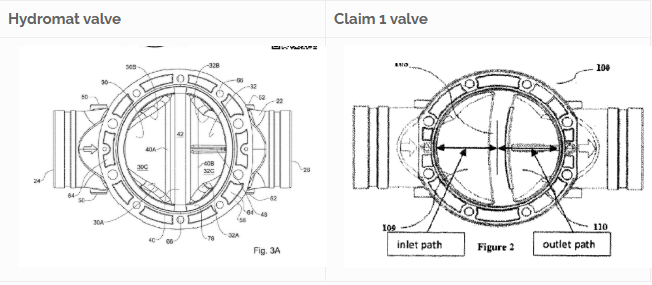
According to the DB, by ignoring this feature, the Single Judge failed to notice this more than sufficient distinction between the Claim 1 and Hydromat valves.
Conclusion
The Automat v Aquestia decision not only reinforces that claim interpretation in India must be grounded in Indian patent law, rather than on borrowed European or other foreign drafting conventions, but also it clarifies that claims must be constructed as a whole for infringement analysis and not limited to only those elements that follow the words "characterized" of a claim. More broadly, the decision is a reminder to courts that interim injunctions in patent disputes must rely on principled claim construction rather than assumed hierarchies in the language of the claim itself.
The content of this article is intended to provide a general guide to the subject matter. Specialist advice should be sought about your specific circumstances.
