Welcome to the sixth edition of the e-Bulletin (Volume VIII) brought to you by the Employment, Labour and Benefits practice group of Khaitan & Co. This e-Bulletin covers regulatory developments, case law updates and insights into industry practices that impact businesses from a sector agnostic standpoint.
In this section, we help you in understanding the developments that have taken thus far on the implementation of the 4 labour codes on wages, social security, industrial relations, and occupational safety, health, and working conditions, which received the Presidential assent between the years 2019 and 2020. The Government of India has, through a series of notifications dated 21 November 2025, brought into effect the 4 labour codes. We have covered this aspect in detail in our ERGO.
The codes consolidate and consequently replace 29 Central labour laws and bring about a more cohesive and modern framework for compliance. The consolidation exercise in the form of the labour codes does bring with it certain changes in the earlier labour law regime. The digitization of procedures (relating to registration and intimations) and the concept of deemed registration (in case authorities do not register the establishment within the specified timeline) are seen as a positive impact on the ease of commencing business as well as the ease of doing business. Similarly, the substitution of prosecution-oriented framework with facilitation process, whereby an employer would be given an opportunity to rectify any non-compliance, heralds an important change in the approach of the government.
Set out below are the updates that we have seen on the labour codes front, recently:
- Issuance of final rules and allied notifications by the Central Government: The Central Government notified and brought into effect the final rules under the labour codes on 8 May 2026. In addition, model standing orders and several other enabling notifications have been issued, including those relating to the establishment of the workers’ reskilling fund and the levy and collection of cess in respect of building and other construction activities.
- Notification of the schemes under the employees’ provident fund (EPF) regime: The Central Government on 29 June 2026 has notified the Employees’ Provident Fund Scheme, 2026, Employees’ Pension Scheme, 2026 and the Employee’s Deposit Linked Insurance Scheme, 2026, under the Code on Social Security 2020.
- Issuance of State rules: In the past year, several key industrialised states such as Haryana, Delhi, Maharashtra, Andhra Pradesh, Telangana, Tamil Nadu, Bihar, and Karnataka released draft rules under some or all of the labour codes for public consultation. As of date, only West Bengal has not released draft rules under the labour codes. Further, states such as Arunachal Pradesh, Gujarat, Lakshadweep and Puducherry have released final rules under all of the 4 labour codes, while, some states such as Rajasthan, Andhra Pradesh, Mizoram, Punjab, Sikkim, Tripura, Andaman and Nicobar have notified final rules for only 1 or 2 labour On 12 June 2026, the government of Andhra Pradesh has notified the Industrial Relations (Andhra Pradesh) Rules, 2026.
In this section, we bring to your attention, important regulatory developments in the form of notifications, orders, bills, amendments, etc. witnessed in the past one month in the context of employment and labour laws.
Maharashtra issues draft Maharashtra Employees’ Compensation Rules 2026
The government of Maharashtra issued the draft of the Maharashtra Employees’ Compensation Rules, 2026 (Draft Rules), through publication in the Official Gazette on 16 June 2026. The Draft Rules have been issued under the Code of Social Security 2020 vis-à-vis aspects concerning employee compensation. The Draft Rules comprise of procedural compliances for facilitating practical application of the provisions concerning employees compensation. This includes statutory forms required to be maintained for reporting fatal accidents, application for review of any half monthly payments, statement regarding fatal accidents, memorandum of agreement, procedure for recording memorandum of agreement and transfer of records or money, etc.
Central Government enforces the Jan Vishwas (Amendment of Provisions) Act, 2026 relating to amendments to the Apprentices Act, 1961
Through a notification in the Official Gazette on 17 June 2026, the Ministry of Skill Development and Entrepreneurship has enforced the Jan Vishwas (Amendment of Provisions) Act, 2026 (Jan Vishwas Act) which concerns amendments to the Apprentices Act, 1961, to come into effect on 22 June 2026. The Jan Vishwas Act was notified on 8 April 2026, and concern specific amendments to the penalties under the Apprentices Act 1961. These amendments introduce a graduated penalty framework whereby the first contravention results in an advisory requiring compliance within 30 days, the second contravention results in a warning requiring compliance within 15 days, and subsequent contraventions attract penalties ranging from INR 1,000 to INR 5,000. Any appeals are required to be filed within 30 days and disposed of within 60 days, and unpaid penalties may be recovered as arrears of land revenue.
Rajasthan exempts shops and commercial establishments from the provisions regulating opening / closing hours and weekly holidays
By a notification dated 19 June 2026, the government of Rajasthan has exempted shops and commercial establishments registered under the Rajasthan Shops and Commercial Establishment Act, 1958 (Rajasthan S&E Act) from the provisions regulating daily and weekly hours of work, with immediate effect. The exemption is subject to compliance with specified conditions, which include
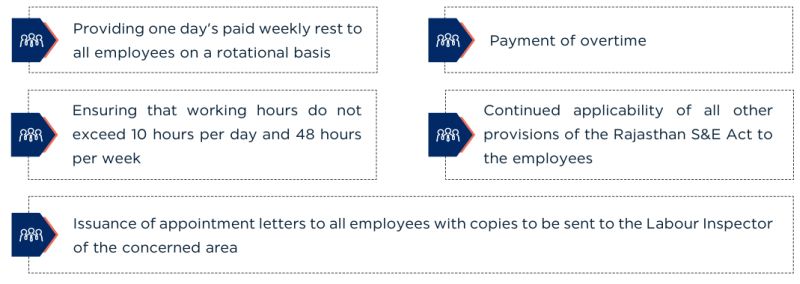
The notification further provides that in case of violation of any of the above conditions by the employer, the exemption shall be deemed to have been revoked automatically and the employer shall be liable for legal action under the provisions of the Rajasthan S&E Act and other relevant laws.
West Bengal permits shops and establishments to remain open 24x7 on all days of the year
Vide a notification dated 29 May 2026, the government of West Bengal has permitted shops and establishments registered under the West Bengal Shops and Establishments Act, 1963 (West Bengal S&E Act) and employing 20 or more persons to remain open on a 24x7 basis on all days of the year for a period of 3 years from 29 May 2026. The permission is contingent upon adherence to certain stipulated conditions, including
- Appointment of additional staff to ensure employees receive their prescribed weekly holidays
- Provision of appointment letters to all employees with copies to be furnished to the Inspector under the West Bengal S&E Act
- Display of employee details and holiday schedules at a conspicuous place in the establishment Restriction of overtime to 144 hours per quarter
- Provision of transport arrangements for women employees working in shifts Availability of adequate restroom, washroom, safety locker and medical facilities
- Constitution of an internal committee (IC) under the Sexual Harassment of Women at Workplace (Prevention, Prohibition and Redressal) Act, 2013 (POSH Act)
The notification clarifies that any violation of the statutory provisions of the West Bengal S&E Act or any other labour law will result in suspension or cancellation of the permission granted.
National Commission for Women issues advisory to all states and union territories calling for mandatory POSH audits and strengthening of workplace safety mechanisms
In a notable development aimed at bolstering workplace safety for women, the National Commission for Women (NCW) has, through a press release dated 19 June 2026, issued an advisory to all states and union territories urging immediate and effective implementation of comprehensive measures under the POSH Act.
Key recommendations of the advisory include
- The establishment of dedicated POSH monitoring cells or digital compliance dashboards at the state level to track implementation
- Mandatory annual POSH audits for all establishments employing 10 or more persons to assess legal compliance and functioning of internal committees
- Notification of District Officers as nodal authorities for implementation, monitoring, awareness generation and grievance redressal
- Universal constitution of ICs across all establishments employing 10 or more persons
- Ensuring effective constitution and functioning of local committees (LC) to address complaints from the unorganised sector
The advisory further emphasizes capacity building and sensitization through regular workshops and awareness drives, professional training for IC and LC members, effective utilization of the SHe-Box platform for online registration and tracking of complaints.
In this section, we share important judicial decisions rendered in the past one month from an employment and labour law standpoint.
Creation of a fact-finding/ad-hoc committee to decide whether a complaint should be sent to the IC/LC is impermissible in law: Delhi High Court
In Rasal Singh v. University of Delhi and Ors., 2026 DHC 3449, the Delhi High Court held that constituting an ad hoc committee to determine whether a complaint should be referred to the IC/LC violates the POSH Act and frustrates legislative intent.
The respondents filed complaints against the petitioner alleging misconduct, including sexual harassment. The Deputy Registrar, Delhi University constituted a factfinding committee (Committee) to examine the allegations. The Committee found certain instances potentially constituted sexual harassment and recommended referral to the IC. Based on the Committee’s report, a suspension order was passed against the petitioner.
Dismissal for misconduct proved through de novo proceedings before the Labour Court requires a fresh show cause notice on quantum of punishment: Supreme Court
In Surekha Domaji Bele v Executive Engineer, Testing Division, MSEDCL, 2026 INSC 639, the Supreme Court held that where a domestic enquiry is found defective and misconduct is proved through de novo proceedings before the labour court, the disciplinary authority must issue a fresh show cause notice on the proposed punishment. The appellant was dismissed from the respondent company after the labour court found misconduct proved in de novo proceedings, but the management relied on the earlier show cause notice founded on the defective enquiry.
The Hon’ble Supreme Court observed that the disciplinary authority cannot mechanically rely on the earlier defective show cause notice. The Court further held that dismissal was disproportionate, noting the misconduct did not involve corruption or moral turpitude, and the authority failed to consider lesser penalties. The dismissal was set aside, and the Court directed issuance of a fresh show cause notice considering punishments other than dismissal.
Employer justified in withholding relieving letter where employee resigns in breach of service bond executed post receiving specialized training: Bombay High Court
In Bharat Aviation Pvt. Ltd. and Another v Rahul Sudhindra Soni, Writ Petition Number 334 of 2026, the Hon’ble Bombay High Court held that an employer is justified in withholding a relieving letter where the employee resigns in breach of a service bond executed after specialized training. The respondent had executed a bond to serve 3 years after training, with an option to leave on 60 days’ notice and payment of INR 10 lakhs as liquidated damages. The respondent resigned without serving notice or paying damages.
The Court held that a trained employee who breaches the contract cannot insist the employer assist in securing employment elsewhere. Since the resignation was in breach of the agreement, the employer was justified in not accepting it and withholding the relieving letter.
Employees’ Provident Funds Organisation cannot recover provident fund amounts from an employee where employer/trust failed to transfer accumulations upon surrender of exemption: Telangana High Court
In J.V. Nrupender Rao v Regional P.F. Commissioner-II, Writ Petition Number 6276 of 2025, the Hon’ble Telangana High Court held that EPFO cannot recover provident fund amounts (PF amounts) from an employee merely because the employer/trust failed to transfer accumulations upon surrender of exemption. The petitioner served as chairman of an exempted establishment which surrendered its exemption in March 2023. The trust settled INR 2,50,33,598 towards his PF amounts, but EPFO issued a notice directing him to remit the amount with interest.
The Court observed that the statutory obligation to transfer accumulations lies on the employer and trust, not the employee beneficiary. No legal provision authorizes direct recovery from an employee. Accordingly, the notice was set aside insofar as it directed recovery from the petitioner.
IC under the POSH Act lacks jurisdiction to entertain a complaint of sexual harassment where the alleged incident did not occur at a ‘workplace’ or transportation provided by the employer: Bombay High Court
In Siddhesh Pradeep Satpute v State Bank of India and Others, Writ Petition Number 1213 of 2024, the Bombay High Court held that the IC under the POSH Act lacks jurisdiction where the alleged incident did not occur at a “workplace”. A shared autorickshaw used for commuting does not constitute “transportation by the employer”. The petitioner was travelling in a shared autorickshaw with the respondent when the alleged incident occurred, and the IC of his employer found him guilty.
The Court observed that “workplace” under Section 2(o)(v) of the POSH Act includes transportation provided by the employer, but a public autorickshaw does not qualify. The IC must first determine jurisdiction before proceeding further. Accordingly, the order was quashed on jurisdictional grounds.
The Court held that the IC must first determine whether the alleged harassment occurred at a “workplace” before proceeding further. Accordingly, the order was quashed on jurisdictional grounds.
Compensation under the Employees Compensation Act, 1923 (EC Act) can only be awarded against the employer of the deceased employee and not against a third party: Uttarakhand High Court
In Uttarakhand Power Corporation Ltd. v Smt. Bhagirathi Devi and Another, Appeal From Order Number 203 of 2014, the Uttarakhand High Court held that an award under the EC Act cannot be passed against a person who is not the employer of the deceased. Liability under the EC Act is unrelated to tort liability and can only be fastened upon the employer.
The commissioner awarded INR 4,15,480 to the appellant , and while recording that the deceased was employed by the second respondent, the commissioner held that death occurred due to negligence of the appellant and accordingly awarded compensation against the appellant.
The Court allowed the appeal and modified the order, directing that compensation be paid by the second respondent and not by the appellant. The second respondent was directed to pay the compensation with interest within 2 months.
Private establishments are bound by the non-discrimination mandate under the Rights of Persons with Disabilities Act, 2016 (Disabilities Act) and are required to provide reasonable accommodation: Karnataka High Court
In PSBB Learning Leadership Academy v. Mrs. Barnali Rout and Another, Writ Petition Number 11351 of 2020, a teacher employed with a private school sustained injuries resulting in 90% locomotor disability while saving a student at the workplace. After paying hospital bills and salary for approximately 21 months, the school issued a separation letter without exploring reasonable accommodation. The teacher filed a complaint before the State Commissioner for Persons with Disabilities, who directed reinstatement, provision of facilities, and payment of medical expenses, which was challenged by the school.
The Karnataka High Court held that while Section 20 of the Disabilities Act (prohibiting discrimination in employment) applies only to government establishments, Section 3(3) of the Disabilities Act creates a universal prohibition against discrimination applicable to all establishments, including private ones. Since “discrimination” under Section 2(h) of the Disabilities Act includes denial of reasonable accommodation, the school’s failure to explore such accommodation before termination amounted to discrimination. The Court emphasised that the teacher having acquired disability at the workplace during employment duties created a heightened responsibility on the employer, who is bound under Section 3(3) of the Disabilities Act not to discriminate on account of such disability.
In this section, we delve into interesting human resources related practices and/or initiatives as well as industry trends across various sectors in the past one month.
Building motivation and growth through continuous feedbacks: A shift from traditional appraisal practise
India Inc is increasingly moving beyond traditional annual appraisals towards continuous, development-focused performance management. There is a growing emphasis on regular feedback and meaningful performance conversations that focus on employee growth, career aspirations, and development, rather than solely on ratings and compensation.
Companies are also adopting more holistic approaches to performance evaluation by considering factors such as skills, motivation, collaboration, and future potential alongside business outcomes. These evolving practices are enabling organizations to deliver more personalized development opportunities, strengthen employee engagement, and build a culture of continuous learning and growth.
The content of this document does not necessarily reflect the views / position of Khaitan & Co but remain solely those of the author(s). For any further queries or follow up, please contact Khaitan & Co at editors@khaitanco.com.