
Liechtenstein offers an exceptionally attractive framework for the formation and development of FinTech companies.
As a business location, Liechtenstein combines access to the European single market with Swiss stability, regulatory openness to innovation with a high degree of legal certainty, and entrepreneurial freedom with an excellent reputation in the international financial environment. For FinTech companies seeking to grow in a dependable, modern and internationally connected jurisdiction, Liechtenstein therefore offers particularly compelling prospects.
Liechtenstein as a Location: Small, but Highly Connected
A key advantage of Liechtenstein as a financial centre lies in its access to the European single market through the country’s membership in the European Economic Area. This enables companies to benefit from a harmonised European legal framework and from the ability to develop their services in a cross-border market environment and expand them through the freedom to provide services and the freedom of establishment, including passporting. For FinTech companies with scalable digital business models in particular, this European connectivity is of central importance.
In addition, Liechtenstein is part of a monetary and customs union with Switzerland. Its close economic integration with Switzerland links Liechtenstein to one of Europe’s most stable and respected economic areas. The Swiss franc as legal tender stands for stability, reliability and trust. This unique combination of EEA access and Swiss integration gives Liechtenstein a distinctive position that is particularly attractive in an international comparison of business locations.
Company Formation in Liechtenstein: Tailored and Efficient
A particular strength of Liechtenstein lies in its historically established liberal company law. Liechtenstein offers business-friendly, flexible and practical legal forms that allow room for individual structuring and sustainable growth. The Liechtenstein stock corporation in particular is an attractive structure for many FinTech companies. It combines a clear corporate governance framework with strong acceptance in international business practice and is especially well suited to growth-oriented companies, participation structures and future investor processes. It therefore provides a solid yet flexible foundation for ambitious business models.
In addition, Liechtenstein offers effective and internationally recognised instruments for asset protection in the form of the foundation and the trust. These legal institutions allow assets to be structured in a legally sound, flexible and forward-looking manner and add a particular strength to the jurisdiction in the areas of asset protection, succession planning and long-term wealth organisation. For founders, investors and entrepreneurially minded families, this creates additional value where operational innovation is to be combined with sustainable wealth structuring.
Companies can be formed in Liechtenstein swiftly, in a structured manner and through dependable procedures. For founders, this means short decision-making paths, administrative clarity and a jurisdiction in which entrepreneurial projects do not fail because of unnecessary complexity. Especially in early growth phases, where speed and precision are decisive, this represents a significant advantage.
The Rule of Law in Liechtenstein: Progressive, yet Predictable
Liechtenstein positioned itself early on as an innovation-friendly legal framework for digital assets, tokenisation and new technology-driven business models. With the TVTG1, a modern and internationally recognised legal framework was created that provides the token economy with clear legal foundations. At the same time, Liechtenstein remains closely aligned with European developments and is implementing regulatory innovations such as MiCAR2 in a consistent manner. This creates an environment in which innovation is not hindered, but translated into orderly, reliable and marketable structures.
At the same time, this strategic openness is accompanied by high standards of integrity and compliance. Liechtenstein has effective mechanisms in place to combat money laundering and tax evasion and is closely integrated into international standards designed to ensure a clean and transparent financial centre. For reputable FinTech companies, this is a decisive advantage. A credible and consistently enforced regulatory framework strengthens the confidence of clients, investors, banks, business partners and authorities alike.
Liechtenstein as a FinTech and Crypto Hub
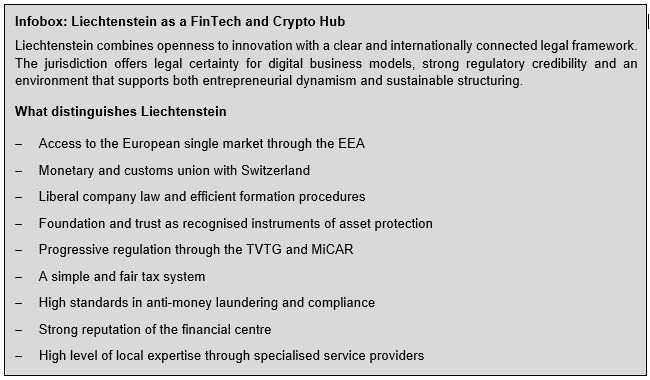
Overall, Liechtenstein combines characteristics that are rarely found in such density for FinTech formations. The jurisdiction brings together access to the European single market and Swiss stability, liberal company law, a simple and fair tax system and modern regulation, high standards of integrity and entrepreneurial freedom, as well as international reputation and first-class local expertise.
For FinTech companies aiming to grow in Europe while placing emphasis on quality, legal certainty and long-term viability, Liechtenstein is therefore a particularly convincing jurisdiction for incorporation.
The Right Service Providers: How FS+P Provides Concrete Support
As a Liechtenstein fiduciary and advisory firm, FS+P specialises in structuring wealth from a legal, tax and governance perspective in a way that remains sustainable over the long term. For individuals with a background in the crypto and FinTech space, FS+P combines the realities of digital assets with the requirements of legal robustness, regulatory compatibility and bankable documentation. In addition, FS+P relies on the legal advisory expertise of Bergt Law, particularly in relation to foundation and succession matters, cross-cutting issues of financial market regulation, and the classification of obligations arising under the TVTG and MiCAR in specific cases.
Anyone wishing to establish holding structures or to organise crypto or FinTech assets without losing entrepreneurial flexibility will find particularly effective support in this combination. An initial discussion can clarify which structural building blocks are suitable for the specific situation and which steps can achieve the greatest short-term impact.
The Authors
Dr. Marco Felder is a fiduciary, tax adviser and partner of FS+P AG in Liechtenstein. He advises high-net-worth individuals, entrepreneurs and families on structuring, asset protection, succession planning and the governance of internationally oriented wealth structures, including complex assets such as digital assets. Insofar as structuring, tax planning and asset protection are concerned, the Liechtenstein Tax Act and the Persons and Companies Act in particular constitute the central legal foundations.
Bergt Law supports FS+P as a specialised partner firm at the interface of wealth structuring, foundation and trust law, as well as financial market and compliance issues. This makes it possible to implement structuring objectives cleanly even where civil law, tax and regulatory requirements intersect.
Dr. Josef Bergt is Managing Partner of Bergt & Partner AG and acts for FS+P on a mandate basis in the legal field. He advises in particular on cross-border corporate and commercial law, foundation and trust law, and structural issues of wealth planning and asset protection. He contributes in-depth experience in the FinTech sector, particularly in the payment and crypto space.
Priv.-Doz. Dr. Thomas Stern is Legal Counsel at Bergt Law, a postdoctoral academic and a recognised expert in financial market regulation, banking supervision and cross-border matters. He brings substantial experience in the regulatory classification of FinTech and crypto business models, particularly in the context of MiCAR and its supervisory implementation within the EEA.
With this combination of fiduciary, legal and tax structuring expertise, digital asset practice and specialised legal and regulatory know-how, FS+P and Bergt Law support clients in positioning crypto assets in a way that is legally robust, tax-efficiently organised, bankable in documentation and fit for generational continuity.
Footnotes
1. Act of 3 October 2019 on Tokens and TT Service Providers (Token and TT Service Providers Act; TVTG). This Act establishes the legal framework for transaction systems based on trustworthy technologies (“blockchain”) and, in particular, governs the civil law foundations relating to tokens, the representation of rights by means of tokens and their transfer, as well as the supervision of, and the rights and duties applicable to, TT service providers.
2. Regulation (EU) 2023/1114 of 31 May 2023 on markets in crypto-assets, OJ L 150, 9.6.2023, pp. 40–205.
The content of this article is intended to provide a general guide to the subject matter. Specialist advice should be sought about your specific circumstances.