

Understanding dual-use items trade restrictions is absolutely essential for companies today. Due to the comprehensive development of new technologies and the complex geopolitical situation in recent years, the importance of products that can be used for both civilian and military purposes-so-called dual-use items-is increasing.
Trade in items, including the provision of technical assistance or brokering services, is legally restricted under EU law, specifically Regulation 2021/821, as well as Polish law. This article explains these complex regulations clearly to help you stay compliant. You will learn about precise definitions, classifications, and how export controls apply directly to your business operations.
What are dual-use items and how are they classified in Poland?
As defined in Regulation 2021/821, "dual-use items" means items, including software and technology, which can be used for both civil and military purposes. They include items which can be used for the design, development, production, or use of nuclear, chemical, or biological weapons or their means of delivery.
This strictly covers items which can be used for both non-explosive uses and assisting in any way in the manufacture of nuclear weapons or other nuclear explosive devices. According to the Polish Act on Trade, these items constitute goods of strategic significance alongside armaments and military equipment.
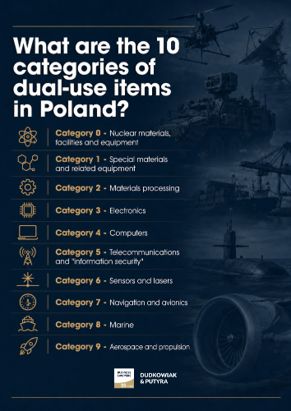
What are the 10 categories of dual-use items in Poland?
The dual-use items listed in Annex I are systematically divided into ten categories. Categories are divided into numerous subcategories, and the list of dual-use items alone is over 200 pages long. The European Commission may continuously update the list under Article 17 of the Regulation, which it recently did in Delegated Regulation 2024/2547 of 5 September 2024.
How do dual-use items trade restrictions apply to exports and transit?
Trade restrictions apply primarily to the export of dual-use goods, but also, in certain situations, to intra-EU transfer, transit, brokering, and the provision of technical assistance. For the purposes of these restrictions, export includes the transmission of software or technology via electronic means of communication, such as telephone or email, to a destination outside the customs territory of the EU. Furthermore, an export will be considered the oral transmission of technology if the technology is merely described via voice communication.
When is an export authorization required?
Export restrictions apply to dual-use items listed in Annex I to Regulation 2021/821 and other dual-use items in the cases specified in the Regulation. This applies primarily to situations where the exporter has been informed by a competent authority that the items may be intended for purposes related to the development, production, and dissemination of chemical, biological, or nuclear weapons. It also applies to items intended for military end-use if the purchasing country or destination is subject to an arms embargo. In such instances, the exporter is obliged to notify the authority, which then decides whether to subject the export to an authorisation requirement.
How does transit of non-EU goods work?
Transit is strictly defined as the transport of non-Union dual-use items entering and passing through the customs territory of the Union to a destination outside it. Such transit occurs if the items are in temporary storage and are directly re-exported, or if they enter the customs territory on the same vessel or aircraft that will then take them out without unloading. The transit of non-EU dual-use items listed in Annex I is subject to authorisation and may be explicitly prohibited if the items are intended for use connected with weapons of mass destruction or military end-use under an embargo.
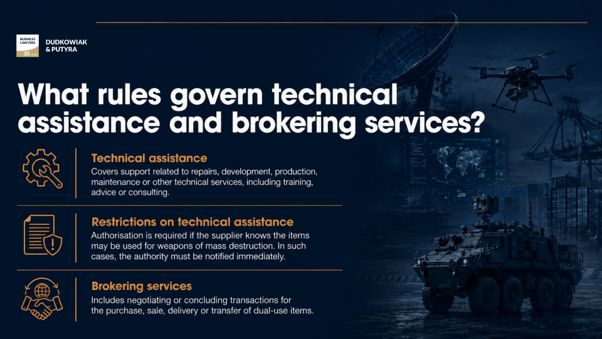
What rules govern technical assistance and brokering services?
The provision of technical assistance related to dual-use items is subject to much narrower restrictions than standard exports. Technical assistance is defined as any technical support related to repairs, development, production, assembly, testing, maintenance, or any other technical service. This assistance may take various forms such as instruction, advice, training, transfer of practical knowledge and skills, or consulting services, including electronic or verbal forms.
Are there restrictions on technical assistance?
An authorisation is strictly required for the provision of technical assistance related to dual-use items listed in Annex I if the supplier has been informed that the items may be intended for the development and dissemination of weapons of mass destruction. If a supplier offers such assistance and is aware of these potentially dangerous end-uses, it must notify the competent authority immediately. The competent authority shall then objectively decide whether such technical assistance should be subject to an authorisation requirement.
How is brokering defined and controlled?
Brokering services mean the negotiation or conclusion of transactions for the purchase, sale, or delivery of dual-use items from a third country to another third country. Ancillary services such as transport, financial services, insurance and reinsurance, advertising, or promotion are not considered services within the meaning of the Regulation. The provision of brokering services for dual-use items listed in Annex I strongly requires an authorisation if the items may be intended for weapons of mass destruction or military end-use in embargoed nations.
Intra-EU Transfer and Monitoring requirements in Poland
For certain sensitive items listed in Annex IV to the Regulation, transfer between EU countries will also require a formal license. This includes highly specialized equipment such as sounding rockets with a specific payload and range. Furthermore, Member States may, in certain situations, legally extend this license requirement to items other than those actively listed in Annex IV.
Additionally, the import or intra-EU transfer into Poland of specific dual-use items used in telecommunications or information security will be heavily monitored. This legally applies to items specified in Part 1 "Telecommunications", item 5A001a or 5A001b4, or in Part 2 "Information Security", category 5 of Annex I. This entire process is overseen by a monitoring body, which in Poland acts as the Head of the Internal Security Agency.
FAQ about Dual-use items trade restrictions in Poland
What forms of communication are restricted under dual-use items trade restrictions?
Under these trade restrictions, export includes the transmission of software or technology via electronic means of communication, such as telephone or email, and even oral transmission if described via voice communication.
How many categories exist for dual-use products?
The dual-use items listed in Annex I are formally divided into ten categories, ranging from nuclear materials to aerospace and propulsion.
Are transport and financial services considered brokering?
No, ancillary services such as transport, financial services, insurance, reinsurance, advertising, or promotion are not considered brokering services within the meaning of the Regulation.
What is considered technical assistance for dual-use items?
Technical assistance is defined as any technical support related to repairs, development, production, assembly, testing, or maintenance, taking forms like instruction, training, or consulting.
When can the transit of dual-use goods be prohibited?
Transit of non-EU dual-use items listed in Annex I may be prohibited if the items are intended for use in connection with the development, production, and spread of chemical, biological, or nuclear weapons.
Who monitors the intra-EU transfer of telecommunications dual-use items in Poland?
In Poland, the import or intra-EU transfer of certain dual-use items used in telecommunications or information security is monitored by the Head of the Internal Security Agency.
The content of this article is intended to provide a general guide to the subject matter. Specialist advice should be sought about your specific circumstances.
