

Taxpayers beware of calculating stamp duty for plant and using agreed purchase prices rather than market valuations.
Fact File
|
|
|
|
Background |
The taxpayer purchased a manufacturing business and remitted stamp duty calculated on the contract price. The Commissioner, after investigation, issued an amended assessment, particularly in respect of the plant and equipment purchased. |
|
Dispute |
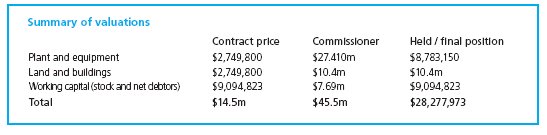
The taxpayer contended that the amended assessment was incorrect because the transaction was a bona fide commercial one negotiated at arm’s length between unrelated parties. The Commissioner argued that the amount paid for the plant and equipment and the land and buildings was undervalued and additional stamp duty was owed. The taxpayer argued that the plant and equipment should be either valued at its ‘open market value’ ($874,800) or its ‘fair market value’ (between $8,395,300 and $9,171,000 based on two independent valuations). The Commissioner demanded stamp duty based on a valuation of $27.410m for plant and equipment resulting from an investigation into the transaction. The valuation of land and buildings was agreed to be $10.4m. |
|
Decision |
Although there was no evidence of hard bargaining, the Court decided to value the plant and equipment using independent valuations disregarding the fact that the contract price was substantially less. Although the Court agreed that the transaction was conducted at arm’s length between independent and capable commercial entities and individuals, it commented that the contract price of $14.5m appeared to be inadequate when the working capital was valued at above $9m and the plant and equipment had been valued between $8m and $9m. These two items exceeded the purchase price before adding the value of land and buildings. The Court accepted the valuation of working capital but did not comment on the valuation of land and buildings. |
Taxpayers Beware
Although stamp duty no longer applies to plant and equipment, it is interesting to note that stamp duty was payable on valuations of the land and buildings and not the contract price. When the taxpayer advised the State Revenue Office (SRO) of the total consideration of the sale, it enclosed two valuations of the land (one for $13m for the purposes of security valuation and the other for $9.86m based on current use). The SRO applied stamp duty on $10.4m and not the contract price. Taxpayers should be aware when submitting documents for stamping with the SRO to include valuations that are significantly different to the contract price. The SRO is likely to consider these documents when calculating the stamp duty liability.
Furthermore, the Australian Taxation Office have generally treated the contract price as an acceptable means for calculating tax liability, except in circumstances where there has not been an arm’s length transaction between the parties where the market value will be substituted. Therefore, the cost base which ordinarily would be the consideration paid for the asset will be significantly different to the valuation on which stamp duty was paid.
It should be noted that at the time of the assessment in 2000/01, stamp duty in Victoria was payable on real property and chattels which are not trading stock used in connection with a business or in connection with the real property under Section 63(3) or the Stamps Act 1958 which has since been replaced by the Duties Act 2000.
The content of this article is intended to provide a general guide to the subject matter. Specialist advice should be sought about your specific circumstances.
