

The Windfall Gains Tax (WGT) is a Victorian tax that applies when land increases significantly in value because of a government rezoning. It commenced on 1 July 2023 and is designed to capture part of the financial benefit that can arise when land is rezoned for a more valuable use, such as from rural or industrial land to residential land.
The tax is a one-off liability and is assessed when the rezoning takes effect, not when the land is sold or developed. The owner of the land at the time of the rezoning is responsible for paying the tax.
WGT only applies where the rezoning results in a taxable increase in value of more than $100,000. The increase in value is determined by comparing the Capital Improved Value (CIV) of the land before and after the rezoning, with the valuations being undertaken by the Valuer-General Victoria.
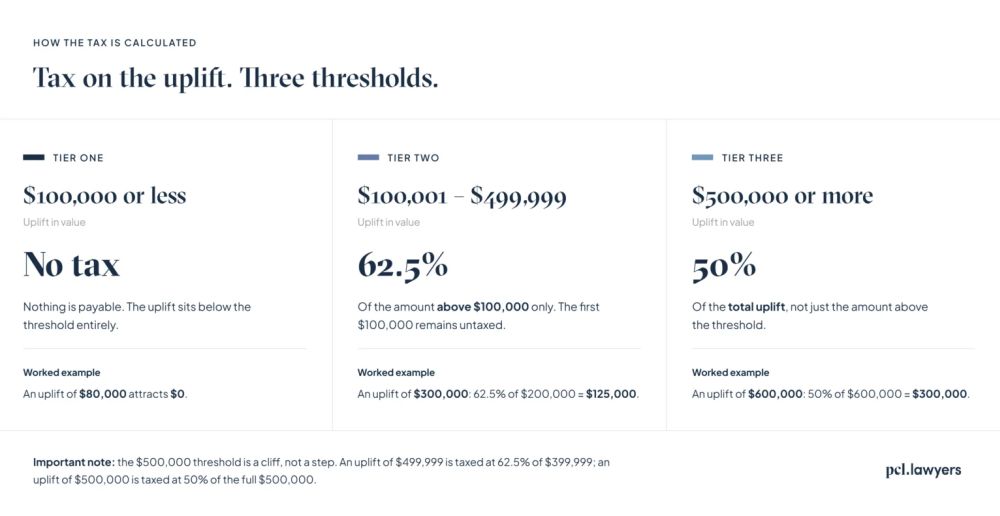
The current tax rates are:
- No tax is payable where the value uplift is $100,000 or less.
- For uplifts between $100,001 and $499,999, tax is charged at 62.5% of the amount above $100,000. For example, a $300,000 uplift would result in WGT of $125,000.
- For uplifts of $500,000 or more, tax is charged at 50% of the total uplift. For example, a $600,000 uplift would result in WGT of $300,000.
Importantly, a number of exemptions and exclusions apply. These include certain residential land of up to two hectares, some charitable land, land rezoned to particular public or rural zones, and certain transitional rezonings that were already well advanced before the tax commenced.
Recognising that landowners may have a valuable asset but limited cash flow, the legislation allows payment of WGT to be deferred. In most cases, payment can be deferred for up to 30 years or until an earlier sale, transfer or other specified transaction occurs. Interest accrues during the deferral period, and the unpaid tax is generally recorded as a charge against the land.
If a landowner disagrees with a WGT assessment, they may have rights to object, particularly where there is a dispute about the valuation of the land or the calculation of the value uplift. Given the substantial amounts that can be involved, professional advice should be obtained as early as possible when a rezoning is proposed.
For landowners, developers and investors, WGT is an important consideration whenever land may be rezoned. Because the tax can be as much as 50% of the increase in value attributed to the rezoning, understanding the potential liability in advance can be critical when assessing the viability of a project or negotiating a transaction.
The content of this article is intended to provide a general guide to the subject matter. Specialist advice should be sought about your specific circumstances.
[View Source]