
Further amendments to the National Law introduced by the Health Practitioner Regulation National Law and Other Legislation Amendment Act 2025 (Qld) (Amendment Act) came into effect in April 2026 with the aim of delivering greater public protection, public confidence and transparency.
Background
The Health Practitioner Regulation National Law and Other Legislation Amendment Bill 2024 (the Bill) was introduced into the Queensland Parliament on 12 December 2024. The Bill progresses amendments to the National Law that were agreed by Australian Health Ministers following public consultation.
As Queensland is the host jurisdiction for the National Law, the amendments must be introduced into the Queensland Parliament for review, debate and passage. The Bill was reviewed by the Queensland Parliament’s Health Environment and Innovation Committee. The Bill was debated and passed by Queensland Parliament on 3 April 2025. The Amendment Act became law on 9 April 2025.
The changes came into effect from 1 December 2025 for notifier protections, and most recently from 10 April 2026 for reinstatement orders and in respect of professional misconduct (sexual misconduct).
Notifier protections
Notifier protections have been in effect from 1 December 2025 (4 December 2025 in South Australia) as follows:
Strengthened notifier protections
A new provision is inserted into the National Law (section 237A) to strengthen protections for notifiers. It will be an offence to threaten; intimidate; dismiss; refuse to employ or subject a person to other detriment or reprisal because they intend to or have made a notification or provide assistance to persons performing functions under the National Law, including, for example, Ahpra staff investigating a concern.
The maximum penalty for an individual will be $60,000 and for a body corporate $120,000.
In practice, Ahpra will now have the power to prosecute a person for retaliatory behaviour against a notifier.
Non-disclosure agreements (NDAs)
A new provision is inserted into the National Law (section 237B) to render NDAs void to the extent they seek to prevent or limit a notifier from making a notification or from providing assistance to persons performing functions under the National Law, including, for example, Ahpra staff investigating a concern.
It will also be an offence to enter into an NDA unless the agreement clearly sets out, in writing, that it does not limit a person from making a notification or providing assistance to regulators and others performing functions under the National Law.
The maximum penalty for an individual will be $5,000 and for a body corporate $10,000.
In practice, the offence is prospective – meaning that a breach can only be prosecuted if the behaviour happened after this change starts. Ahpra will be able to prosecute a person/s should this happen. However, an NDA may be void if it includes this type of provision regardless of when the agreement was entered into.
Recent amendments
Two recent amendments are likely to have an impact upon tribunal proceedings and regulatory processes in all states and territories.
Nationally consistent process for reinstatement orders
New Division 12A of Part 8 of the National Law provides for former practitioners who have had their registration cancelled or been disqualified from applying for registration to apply to the responsible tribunal for a reinstatement order prior to making an application for re-registration.
An application for a reinstatement order must be made to the same tribunal that made the original cancellation or disqualification order. This amendment is likely to see a new form of application being made to the tribunal.
The decision to grant or deny re-registration remains with National Boards. As happens now, if a National Board decides to not re-register the practitioner, or grant registration with conditions, the person may appeal the decision.
This new Division does not apply in NSW as similar arrangements already apply in that jurisdiction.
Permanent publication of additional material for sexual misconduct
Sections 225A and 225B now apply where a National Board is satisfied that a responsible tribunal has decided that a practitioner has engaged in professional misconduct and that a basis for the tribunal’s finding was that the practitioner engaged in sexual misconduct. If the Board is satisfied, the Board is required to publish additional information on the National Register in perpetuity, subject to certain exceptions.
The legislative provision in NSW is slightly different to reflect the wording on the National Law as it applies in NSW.
National Boards are responsible for deciding if sexual misconduct was a basis for the tribunal’s finding of professional misconduct. To make this decision, Boards will rely on the Guidance on sexual misconduct and the National Law (the Guidance).
Who does the Guidance apply to?
The Guidance applies to all 16 health professions regulated by Ahpra and the National Boards. It applies nationally, including Queensland and NSW, subject to arrangements with co-regulators in those states. The law applies retrospectively to tribunal decisions from the start of regulation for each profession:
- 1 July 2010 – chiropractic, dental (including dentist, dental therapist, dental hygienist, dental prosthetist, and oral health therapist), medical, midwifery, nursing, optometry, osteopathy, pharmacy, physiotherapy, podiatry and psychology.
- 1 July 2012 – Aboriginal and Torres Strait Islander health practice, Chinese medicine, medical radiation practice and occupational therapy
- 1 December 2018 – paramedicine.
How will Boards use the Guidance?
In practice, once a practitioner has been found by a tribunal to have engaged in professional misconduct, Boards will then use the Guidance to help decide if sexual misconduct was a basis for the finding. Boards will rely on tribunal decisions and rulings to make their decision – they will not reinvestigate the matter.
Sexual misconduct is wide in scope. It covers a wide range of behaviours, including breaches of professional boundaries, sexual harassment and criminal sexual offences. It can occur inside and outside of a practice setting.
Sexual misconduct does not need to be the only or main reason for the tribunal’s finding of professional misconduct. If sexual misconduct is not specifically stated in the tribunal’s decisions and rulings, the Boards can still infer from this information that sexual misconduct was involved. There a number of relevant factors Boards may consider when deciding if sexual misconduct was a basis for the decision. These include, but are not limited to: the nature and location of contact; clinical justification and consent; any power imbalance and vulnerability; sexual intent (if evident); the context and timing of the conduct; and the nature of the relationship.
These amendments may affect the manner in which health practitioner disciplinary referrals are conducted.
What will be published?
Where sexual misconduct was a basis for the tribunal’s finding, the register will show:
- a statement that the practitioner engaged in sexual misconduct;
- any sanctions, such as a reprimand, imposition of conditions, suspension or cancellation of registration;
- a link to the tribunal decision, where available.
If a practitioner’s registration is cancelled, the register will also show whether they are prohibited from reapplying for registration, the length of that prohibition, and whether it extends to the provision of health services or the use of certain titles.
Exceptions to publication
To balance transparency with fairness and safety, information will not be published if:
- the tribunal decision is overturned or stayed on appeal;
- publishing would breach a court or tribunal order;
- conditions relate to impairment and privacy must be protected;
- publishing would pose a serious risk to the health or safety of the practitioner or their family.
Decision-making process summary
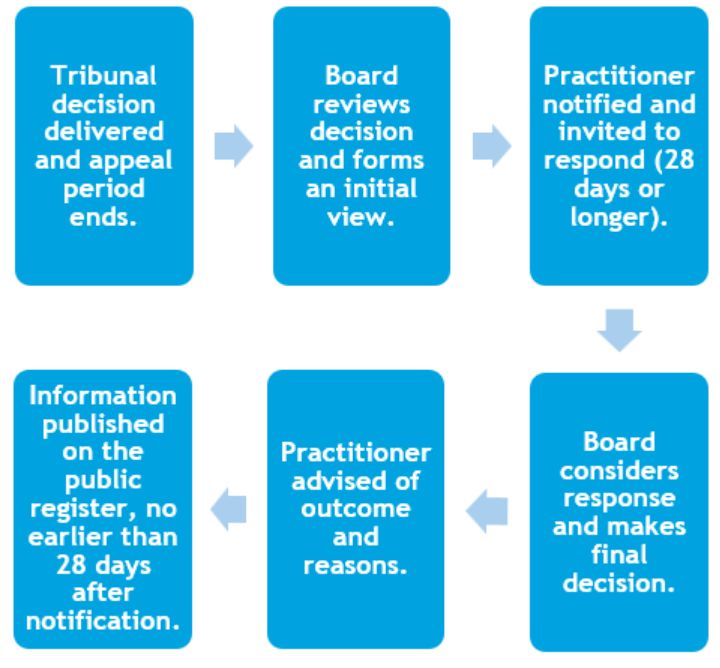
 Looking ahead
These reforms represent a clear shift toward stronger public protection and transparency, particularly through a nationally consistent reinstatement pathway and a more interventionist approach to misconduct. In practice, however, they are likely to slow the pathway back to practice, with tribunals taking on reinstatement applications in an already congested system, resulting in longer and more resource-intensive processes.
The anticipated lower threshold for misconduct findings, especially where any sexual element is alleged, will materially change how matters are investigated and defended. We expect fewer agreed outcomes at the characterisation stage, increased reliance on contemporaneous records and expert evidence, and more matters proceeding to fully contested hearings. This will likely have flow-on effects for insurers and practitioners, including increased costs, longer claim lifecycles and more complex reserving considerations.
The retrospective practical impact is also significant. Matters previously resolved on a particular basis may be reframed under a stricter misconduct lens, creating renewed regulatory exposure and complicating the management of existing complaints and notifications.
Looking ahead, regulators are likely to take a more forensic approach to complaints, with closer scrutiny of practitioner conduct, internal investigations and the use of non-disclosure agreements. In this environment, greater emphasis is likely to be placed on early identification of higher-risk complaints, maintaining comprehensive and contemporaneous records, and ensuring that settlement approaches, including the use of confidentiality provisions, are carefully considered. There may also be an increased focus on targeted training in areas such as professional boundaries and complaint handling, together with ongoing refinement of governance frameworks to meet evolving regulatory expectations.
Overall, these reforms are likely to contribute to a more complex and contested regulatory landscape, where matters are more frequently tested and resolved through formal processes, and where careful, well-informed engagement will assume increased importance.
Originally published 16/06/2026.
The content of this article is intended to provide a general guide to the subject matter. Specialist advice should be sought about your specific circumstances.
[View Source]