

Surveying across the Engineering, Procurement, and Construction (EPC) value chain
Capital is pouring into infrastructure at a pace not seen in a generation. The compelling persistence of the energy transition, an accelerated interest in reshoring, the unprecedented AI data center buildout, and continued industrial expansion are all converging to create one of the largest sustained investment cycles in decades.
But at the same time, the policy environment is not making anything easy. Rapid and often unpredictable shifts in regulations, tariffs, tax incentives, and permitting frameworks have made project execution materially harder. For the EPC sector—where spreadsheets must become physical realities—the result is a landscape defined less by optimism or caution than by sheer complexity.
To better understand how that complexity is playing out across the value chain, AlixPartners surveyed more than 200 senior executives at the start of 2026, asking financiers, project sponsors, and service providers to specify the challenges and opportunities having the greatest impacts on their businesses. By fielding the survey across segments, our goal was to identify and quantify the whole-industry dynamics that any single player in the value chain would struggle to see. This perspective reflects how we work, advising financiers, sponsors, and service providers across the capital project lifecycle.
AlixPartners surveys are designed to surface underlying tensions, and this one was no exception. What became clear from this year’s EPC Executive Survey is that capital conditions are improving, but commercial pressure on the companies that deliver projects is intensifying. The availability of capital is masking—and in some cases amplifying—growing downstream execution risk. To put it another way, abundant capital is giving sponsors abundant leverage.
What follows is our analysis of how that pressure is cascading through the value chain, and what the most effective operators are doing to manage it.
Capital is more available, but the terms are more restrictive
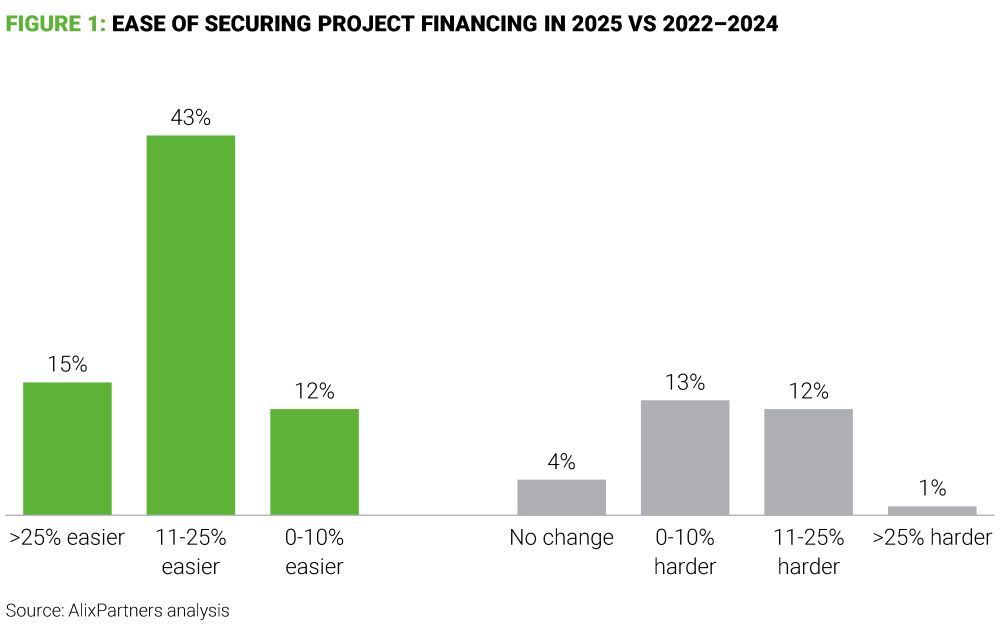
The survey’s headline indicators clearly suggest a favorable environment for EPC providers. Seventy percent of project sponsors report that securing financing had become easier by the end of 2025, compared with 2022–2024 (Figure 1).
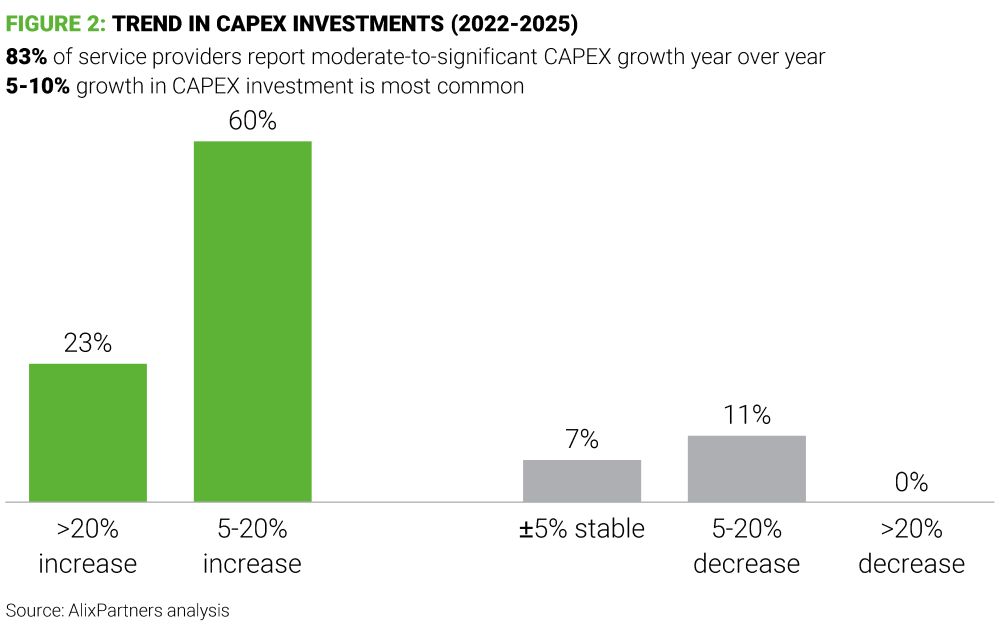
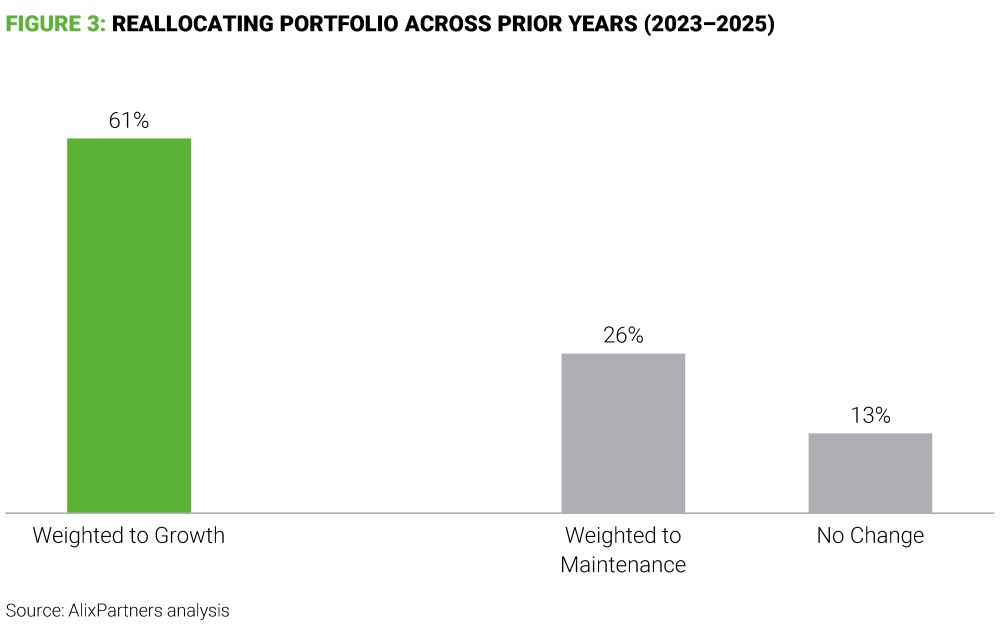
CAPEX momentum remains robust, with over 83% of respondents reporting moderate-to-significant year-over-year growth (5 to >20%) (Figure 2), and portfolios shifting decisively toward growth investments (Figure 3).
The investment pipeline reflects this momentum across several sectors. Industrial and manufacturing projects lead, followed closely by data centers—and the two are increasingly interlinked, as data center expansion is driving significant new demand for power generation and grid infrastructure. Notably, renewable energy projects continue to attract capital despite shifts in the policy landscape; the replacement of IRA provisions with the One Big Beautiful Bill Act has not slowed project activity to the extent some anticipated (largely due to the surge in AI-driven energy demand). And contrary to what the news cycle might suggest, capital is following positive project economics rather than negative policy signals.
However, the terms attached to that capital tell a more complicated story.
Financiers are lending more, but at a higher price. Risk premiums and spreads have widened, making capital more expensive even as it becomes more available. And the conditions are growing more restrictive, with new standards of deeper labor-risk diligence; increased contingency reserves; and new covenants around workforce retention.
Sponsors, benefiting from improved access to capital, are using their leverage to push harder on EPCs and service providers. The survey shows widespread requests for more favorable commercial terms (94% of all project sponsors), increased demands for transparency and guarantees, and more frequent bid revisions.
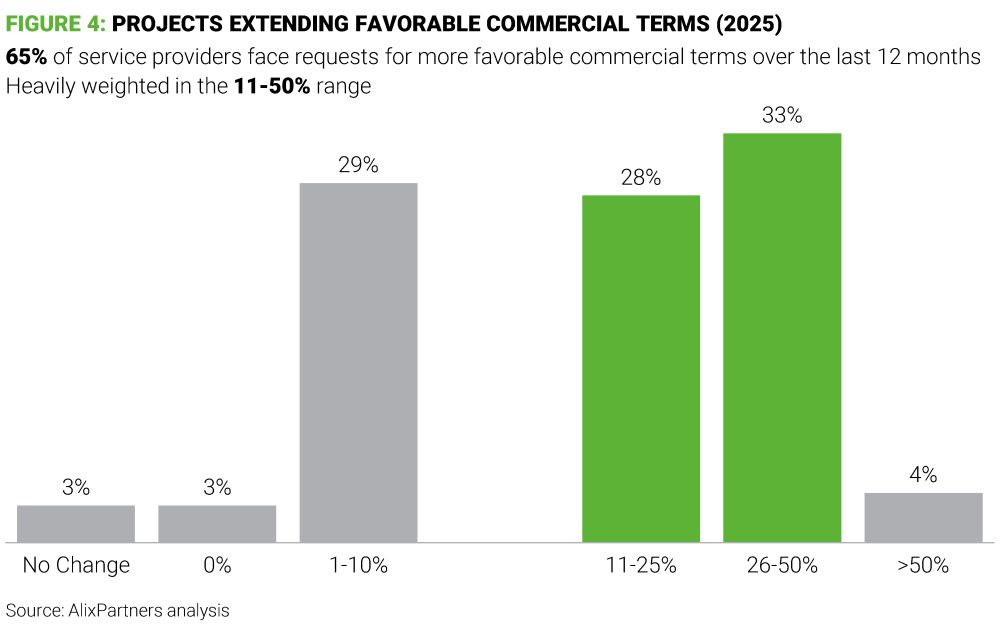
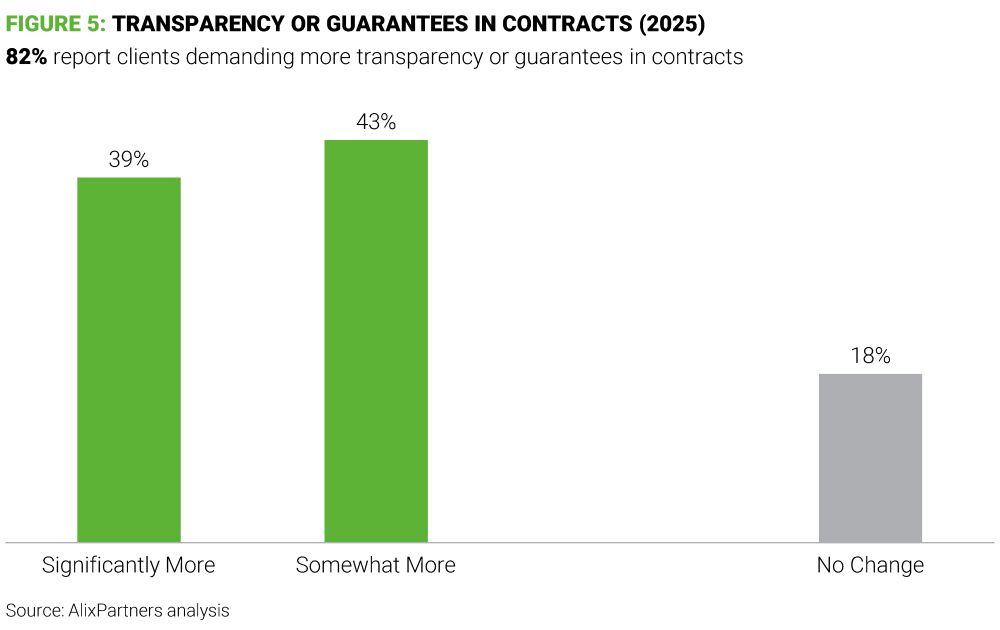
Contracting strategies are becoming more opportunistic, with sponsors selecting from fixed-price, time-and-materials, cost-plus, and alliance models on a project-by-project basis—all to shift risk in their favor. The implicit message to service providers is straightforward: if you can't deliver on these terms, someone else will.
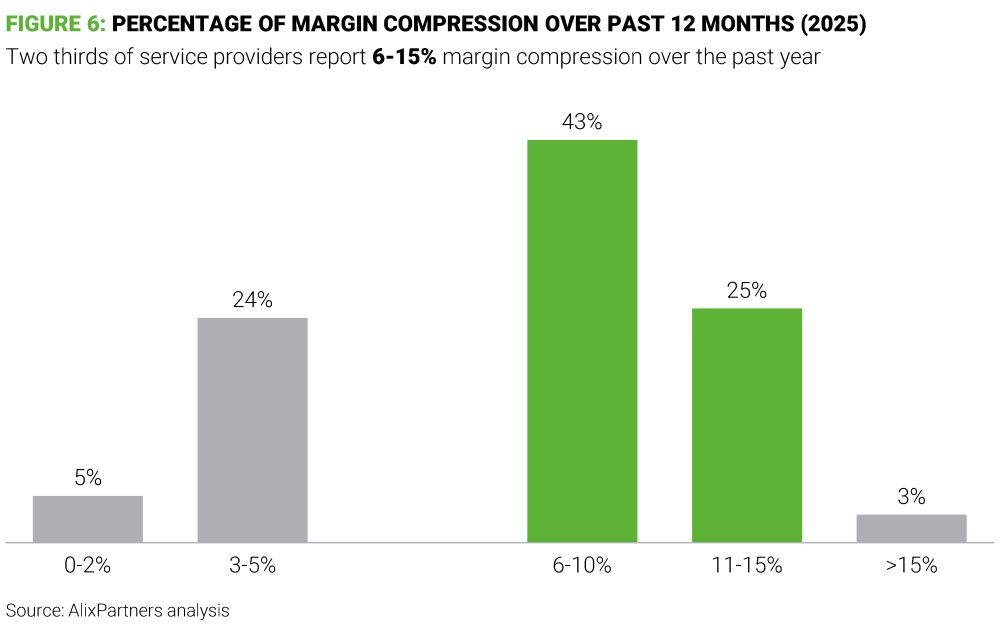
Service providers ultimately absorb the brunt of this pressure. Two-thirds report meaningful margin compression over the past year, even as project volumes remain high. (Figure 6) Fixed-price contracts are now pervasive—71% of respondents report that 40% or more of their bids are fixed price—transferring cost and execution risk to contractors at precisely the moment when labor availability, productivity, and cost volatility are most uncertain. Labor shortages, overtime as standard practice, and financing-related project delays further compound the challenge.
In our analysis, what makes this a squeeze rather than a cycle is that the structural forces are reinforcing one another. Labor markets remain tight, driving persistent cost inflation and productivity drag. Supply chains, while more stable than during peak disruption, continue to exhibit volatility in critical categories. Contracting models are lagging reality, with fixed-price structures increasingly misaligned to actual risk. And competitive pressure among EPCs to maintain backlog is encouraging aggressive bidding and risk absorption—further deepening the margin problem.
The lesson here is that if capital flows faster than execution capability evolves, then pressure concentrates at the point of delivery. EPC providers must take notice.
Addressing the squeeze requires commercial discipline
It would be a mistake to read this survey as a story about an industry under siege. Margins are getting squeezed, not because the market is bad, but because of how the industry operates. The terms of engagement have changed. Capital requirements have shifted, with lenders bringing more safeguards and conditions than they did even two years ago. Contracting flexibility has tilted towards sponsors, who demand that service providers absorb a growing share of risk. And management visibility into costs has not kept up, with too many projects priced based on assumptions that diverge from reality.
The silver lining is that these are operating-model problems rather than market problems—and operating problems can be solved. Our perspective—shaped by work across the full EPC value chain, from PE sponsors and developers to operators and service providers—is that the companies managing through this squeeze are not trying to outrun the pressure by building volume, but are instead re-engineering how they tackle each project. Rather than simply executing within existing models, they are rethinking their commercial architecture. Margin recovery becomes less about heroic execution and more about closing the gap between how projects are priced and how they are delivered.
Several key areas demand attention:
Pricing discipline. The old model of bid-once-and-hold is no longer viable in a higher-volatility environment. Validity periods are moving from months to days. Ninety-seven percent of leading organizations have built repricing triggers into contracts over the last 12-24 months and maintained real-time cost visibility to identify margin erosion early, rather than absorbing it after the fact. They are tightening labor planning, redesigning crew models, and aligning bids more closely with actual delivery economics.
Contract structuring and risk allocation. The move toward fixed-price contracts is occurring at precisely the wrong moment. Cost volatility—driven by labor shortages, supply chain disruptions, commodity price swings, and tariff uncertainty—makes a fixed-price model the riskiest for the contractor. Sophisticated operators are negotiating hybrid structures that align risk with the party best positioned to manage it.
Digital enablement. If the case for digital investment was once about improving operations, it is now fully commercial. Given that 96% of financiers report they are more likely to fund digitally integrated projects, digital capability is becoming a condition of access to capital itself. The key tools support cost visibility, schedule risk management, labor productivity tracking, and claims readiness. The objective is not digital for its own sake, but digital as a tool to re-price and manage risk in real time. We see leading performers already using automation, AI, and system integration to unlock real-time visibility into labor costs, execution risk, and productivity. But notably, these tools only create value when deployed against the right operational and commercial constraints. Without that alignment, digital investment adds complexity rather than margin.
Implications beyond EPC
For operators, sponsors, and service providers alike, the conclusion is clear: in a higher-volatility environment, value creation depends less on access to capital and more on disciplined execution, aligned incentives, and an honest pricing of risk.
The EPC value chain is where that principle becomes most visible, because it is where financial decisions become physical reality—and where the most can go wrong. But the same dynamics are playing out across every capital-intensive sector where infrastructure investment is accelerating. The companies that adapt their commercial models, contract structures, and execution playbooks to match this new reality will outperform their peers. They will also establish a template for how capital-intensive industries navigate whatever comes next.
The content of this article is intended to provide a general guide to the subject matter. Specialist advice should be sought about your specific circumstances.
[View Source]


