
ARTICLE
13 March 2026

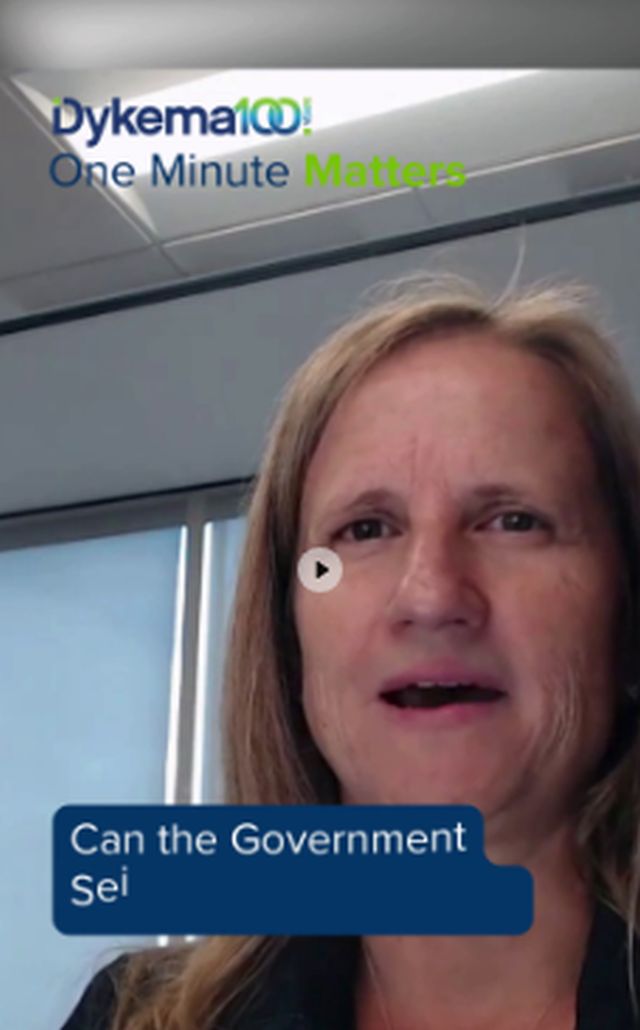
Can The Government Seize Your AI Prompts? (With Tiffany Eggers) (Video)

D
Dykema

Contributor

You should expect more from your law firm than only excellent legal counsel. Delivering for our clients also means holding ourselves to the highest standards of service, performance, and innovation.

Every client has a different vision for success, so we adapt a custom approach for each of them. We help you identify your goals to craft pragmatic, unique, and efficient solutions that deliver value the way you define it.

For nearly 100 years, we’ve served clients around the world from our strategically situated offices in Michigan, Illinois, Texas, Washington, D.C., California, Minnesota, and Wisconsin. Through our practice management structure and our focused Industry Groups, we know and understand the sectors in which our clients compete, from Automotive to Energy, from Gaming to Financial Institutions.

So… how can we deliver success for you today?

Can the government seize your AI prompts and potentially use them as evidence? Can opposing counsel force you to turn them over in discovery?
United States Technology
Tiffany H. Eggers’s articles from Dykema are most popular:
  • with readers working within the Law Firm industries
Dykema are most popular:
  • within Law Department Performance, Consumer Protection, Litigation and Mediation & Arbitration topic(s)

Can the government seize your AI prompts and potentially use them as evidence? Can opposing counsel force you to turn them over in discovery? Two federal courts answered these questions on the same day:

U.S. v. Heppner (S.D.N.Y.)

Criminal defendant argued that his Claude AI prompts were protected by attorney-client privilege and work product doctrine. The District Court Judge disagreed. Because the defendant created the prompts on his own (not at his attorney's direction) and Claude's privacy policy permits disclosure to third parties, including the government, no privilege applied.

Warner v. Gil-baro (E.D. Mich.)

The Magistrate Judge ruled that a pro se plaintiff's ChatGPT prompts were protected work product and did not need to be disclosed to the opposing party. The court noted that work product waiver only occurs when materials are disclosed to an adversary or in a way likely to get in an adversary's hand, which hadn't happened.

Key takeaways:

  • AI prompts are not necessarily privileged
  • In criminal cases, the government treats AI prompts like search engine queries (i.e., evidence that can be seized)
  • Privilege depends on who created the prompts, why, and whether counsel was involved

The government has already obtained AI prompts as evidence in cases ranging from fraud to arson. If you're using AI, understand the risks and consult counsel before assuming your prompts are protected.
1757410a.jpg

The content of this article is intended to provide a general guide to the subject matter. Specialist advice should be sought about your specific circumstances.

[View Source]

Mondaq uses cookies on this website. By using our website you agree to our use of cookies as set out in our Privacy Policy.

Learn More