

- in Middle East
- within Law Department Performance and Corporate/Commercial Law topic(s)
The Office of the U.S. Trade Representative (USTR) has announced a new Section 301 action imposing additional tariffs of 10% to 12.5% on imports from 60 economies that fail to prohibit or effectively enforce bans on goods produced with forced labor. The action covers the top 60 U.S. trading partners, representing 99.4% of U.S. imports, and took effect July 24, 2026. U.S. Customs and Border Protection (CBP) has issued entry filing guidance in CSMS #69326983, including the applicable Chapter 99 tariff headings.
Key Takeaways
- Effective July 24, 2026, USTR imposed additional Section 301 duties of 10% or 12.5% on imports from 60 economies covering 99.4% of U.S. imports, based on findings that these economies failed to adopt or effectively enforce forced labor import prohibitions.
- CBP issued entry filing instructions in CSMS #69326983, including the Chapter 99 headings (9903.05.20 through 9903.06.21), reporting sequence, and Foreign Trade Zone admission requirements.
- Goods entered duty free under USMCA (Canada and Mexico) are exempt, as are CAFTA-DR textiles and apparel, Section 232 articles, civil aircraft, pharmaceutical articles, informational materials, and donations. There is also a list of miscellaneous products exempt no matter what their country of origin.
- An in-transit exception applies to goods loaded and in transit on the final mode before 12:01 a.m. ET on July 24, 2026, and entered before 12:01 a.m. ET on July 28, 2026.
Why USTR Took Action
In March 2026, USTR launched investigations into 60 economies representing approximately 99% of U.S. imports by value.
On June 2, 2026, USTR released a report with its findings. The agency concluded that 54 of the investigated economies failed to impose and effectively enforce a forced labor import prohibition, and that six of the investigated economies failed to effectively enforce a forced labor import prohibition. USTR determined that these failures are unreasonable and burden or restrict U.S. commerce. As a result of these determinations, USTR proposed additional duties on all products of the investigated economies and initiated a public comment period, which concluded on July 6, 2026. The action represents one of the broadest uses of Section 301 in recent years, expanding its focus beyond traditional trade barriers to address human rights concerns in global supply chains.
New Tariff Structure
Under the new Section 301 action, the additional duty rate depends on each trading partner's posture toward forced labor import prohibitions:
- Trading partners that have committed to adopt and effectively enforce forced labor import prohibitions are subject to a 10% additional duty.
- Trading partners that have failed to adopt a forced labor import prohibition are subject to a 12.5% additional duty.
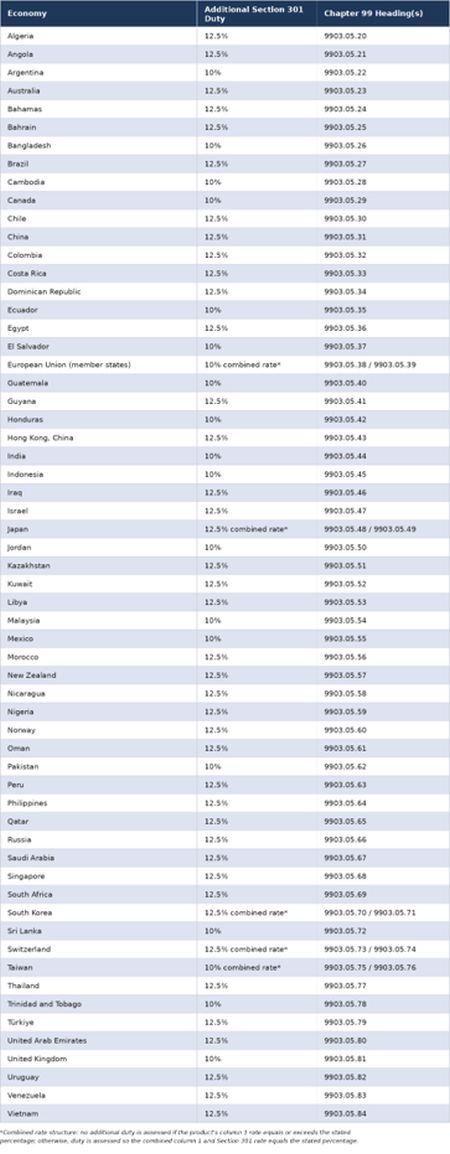
For five trading partners (the European Union, Japan, South Korea, Switzerland, and Taiwan), the action instead applies a combined rate structure. If a product's column 1 duty rate already equals or exceeds the applicable Section 301 rate (10% for the EU and Taiwan; 12.5% for Japan, South Korea, and Switzerland), no additional duty is assessed. If the column 1 rate is below that threshold, duty is assessed so that the combined column 1 and Section 301 rate equals the threshold.
The additional duties apply to goods entered for consumption, or withdrawn from warehouse for consumption, on or after 12:01 a.m. eastern time on July 24, 2026. Goods loaded onto a vessel at the port of loading and in transit on the final mode of transit before that time, and entered for consumption or withdrawn from warehouse for consumption before 12:01 a.m. eastern time on July 28, 2026, are not subject to the additional duties.
Country-by-Country Rates and HTS Headings
CBP's guidance in CSMS #69326983 assigns each economy a Chapter 99 heading, which must be reported on the entry summary in addition to the Chapter 1 to 97 classification. The rates and headings are as follows:
Exemptions
Several categories of goods are exempt from the additional duties, including:
- Products of Canada and Mexico entered free of duty under the United States-Mexico-Canada Agreement (USMCA) (headings 9903.05.93 and 9903.05.94).
- Textile and apparel goods of Costa Rica, the Dominican Republic, El Salvador, Guatemala, Honduras, and Nicaragua entered free of duty under CAFTA-DR (heading 9903.05.95).
- Articles of aluminum, steel, or copper and derivatives; passenger vehicles, light trucks, and medium- and heavy-duty vehicles and their parts; wood products; and semiconductor articles subject to Section 232 measures (heading 9903.05.90).
- Civil aircraft, their engines, parts, components, and subassemblies, and ground flight simulators (heading 9903.05.88).
- Articles for use in pharmaceutical applications (heading 9903.05.89).
- Donations intended to relieve human suffering and informational materials (headings 9903.05.91 and 9903.05.92).
- Certain additional country-specific carve-outs under headings 9903.05.96 through 9903.06.21, including products that could cause economy-wide disruptions or that cannot be grown, produced, or sourced in sufficient quantities in the United States.
- Certain listed products, the product of any country
Goods properly entered under Chapter 98 provisions are also generally excepted, except goods entered under subheadings 9802.00.40, 9802.00.50, 9802.00.60, or heading 9802.00.80, for which the additional duties apply to the value of the repairs, alterations, processing, or foreign assembly.
CBP Entry Filing Guidance: CSMS #69326983
On July 24, 2026, CBP issued CSMS #69326983 with instructions for importers, brokers, and filers. Key points include:
- The applicable Chapter 99 heading must be reported in the trade remedy sequence: Section 301 first, followed by Section 122, Section 232, and Section 201 duties and quota, before the Chapter 1 to 97 classification.
- The entered value should be reported on the Chapter 1 to 97 classification unless Chapter 98 provisions require otherwise.
- Products subject to the additional duty that are admitted into a U.S. Foreign Trade Zone on or after the effective date may only be admitted under privileged foreign status, unless eligible for domestic status.
- The new Section 301 duties are in addition to any applicable antidumping, countervailing, or other duties, taxes, and fees.
Questions on Section 301 entry filing may be directed to CBP's Trade Remedy Branch at TradeRemedy@cbp.dhs.gov.
What Importers Should Do
Importers should begin evaluating how the new tariffs may affect their supply chains by:
- Identifying products sourced from affected countries and mapping them to the applicable Chapter 99 headings;
- Determining whether products qualify for any applicable exclusions or exemptions, including USMCA, CAFTA-DR, and Section 232 overlap; and
- Assessing the potential duty impact on future imports and confirming brokers are filing the correct Chapter 99 headings in the correct sequence.
Companies should also continue maintaining robust forced labor compliance documentation, as CBP enforcement under the UFLPA and withhold release orders remains active regardless of the new Section 301 tariffs.
The content of this article is intended to provide a general guide to the subject matter. Specialist advice should be sought about your specific circumstances.
[View Source]