

- with readers working within the Property industries
- with Senior Company Executives, HR and Finance and Tax Executives
In January of this year, CBP quietly released a ruling (January 16, 2026/CEE.HQ H350722) that demarcates clear boundaries of where AI is permitted to facilitate Customs filings and where such artificial tools cross the “human-brokers-only” line.
Case Background
A foreign “Unlicensed Company” was operating an online platform and marketing to importers without seeking approval or a license from CBP. This platform offered four key services: 1) connecting importers to brokers, 2) utilizing an optical character recognition (OCR) tool to cull entry data from shipping documents, 3) generating HTSUS subheading suggestions for specific articles, and 4) submitting CBP Form 5106 on behalf of new importers. The question before CBP was whether the company is conducting customs business without a license.
CBP Ruling
In its ruling, CBP stated that the definition of “customs business” is quite broad. To that end, developers could accidentally create agentic parameters that trespass the bounds of what it means to engage in “customs business.” Here are some key takeaways from the ruling:
- “CBP cautioned that an unlicensed entity may not serve as an intermediary between a broker and importer if the unlicensed entity is actively participating ‘in decisions and activities relating to the preparation or filing of Customs documents for imported merchandise, or relating to any other action amounting to customs business.’” However, since the “Unlicensed Company was not actively participating in deciding what information must be transmitted to a broker for entry purposes, nor participating in the transmission of such documents and data to CBP, the Unlicensed Company is not impermissibly conducting customs business.”
- “Whether data is extracted manually or automatically through an OCR tool, CBP has repeatedly held that an unlicensed entity cannot decide what data should appear on an entry.” Even if “the Unlicensed Company instead contracted to utilize an OCR tool developed by another unlicensed entity as part of the Unlicensed Company’s online platform,” CBP would find it isimpermissibly conducting customs business.
- An unlicensed entity, which may incorporate an AI tool, cannot derive the HTSUS “subheadings beyond the six-digit level,” as a customs broker’s license is generally required in those instances (i.e., classification information will or may eventually be used for an entry). However, “if the Unlicensed Company’s AI classification tool only derives potential HTSUS subheadings to the six-digit level, then customs business is not being conducted.”
- Since the preparation and electronic transmission of documents, intended to be filed with CBP, is part of the statutory definition of “customs business,” then “only a licensed customs broker may complete and submit CBP Form 5106 on behalf of another party.”
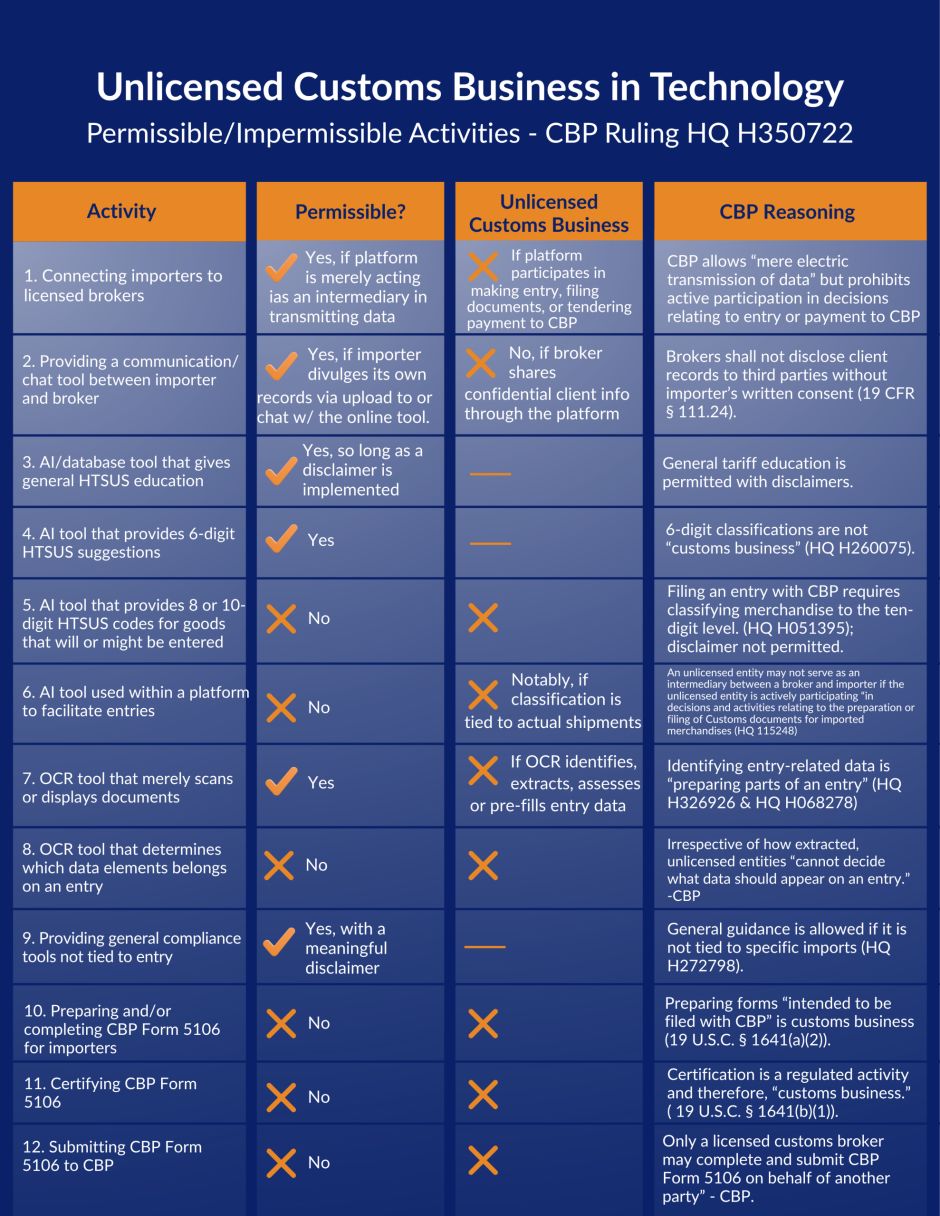
While the identity of the company remains undisclosed, we know that other AI agents currently under development and designed to automate the highly complex arena of imports will now be far more limited than they previously envisioned. CBP has defined the new digital trade world order: AI can connect humans to humans, but it cannot replace U.S. brokers – either in their administrative or analytical capacity.
Contact Diaz Trade Law for Assistance with CBP Compliance
There are many companies that offer import-related services, but not all of them are trustworthy or experts in customs law. At the end of the day, if you import products into the U.S., YOU are the responsible party. Who do you have in your corner helping ensure you are compliant with Customs’ vast laws and regulations? Diaz Trade Law can help you navigate the complex web of CBP regulations and ensure your business remains compliant.
The content of this article is intended to provide a general guide to the subject matter. Specialist advice should be sought about your specific circumstances.
[View Source]