

- in United Kingdom
- within Transport, Media, Telecoms, IT, Entertainment and Tax topic(s)
- with Inhouse Counsel
- with readers working within the Law Firm industries
The third chapter of our series assesses the challenge of ensuring new assets survive politics, economics and time
Our Resilient Infrastructure series examines how legal, regulatory and financial frameworks must evolve to deliver assets that are fit for purpose. In this article, we identify the forces that shape outcomes for project participants – and the populations they support.
Resilience isn't something that can be added late in the process: it's determined at the start through pricing, structuring, approvals and risk decisions that shape a project's entire lifecycle.
The lessons are hard earned. Every warped rail line, collapsed bridge and heat-stressed power plant offers insight about how future assets can better withstand climate shocks and rapid change in demand. Yet the challenge of resilience extends beyond engineering. Financial, political and social pressures can also undermine even the best-designed projects.
For governments in developing nations and investors wary of risk, resilience means more than weathering storms or withstanding earthquakes. It's about ensuring assets stand the test of time – economically, socially and politically. This means realistic pricing to encourage use by locals and project structures that invite participation.
Economic resilience and the price of ambition
The fastest way for a project to lose resilience is through mispriced ambition. In many emerging markets, government subsidies for infrastructure are simply not an option. Consumers often cannot afford to pay the full cost of use, and the state lacks the fiscal capacity to fill the gap. The result can be projects that overreach or overpromise.
The Nairobi Expressway shows how this plays out: a 27-kilometre toll road has transformed access to the Kenyan capital's airport but remains underused. "It's a terrific piece of infrastructure, but it's almost empty because of the toll," says Herbert Smith Freehills Kramer (HSF Kramer) partner Martin Kavanagh. "Because of that, it may not meet the resilience challenge."
Price dynamically so that you can maximise revenue, but also make the infrastructure important and useful locally.
Martin Kavanagh
Partner, London
By contrast, the Gautrain in Johannesburg, South Africa demonstrates what happens when pricing models align with local demand. Airport travellers pay at a premium and suburban commuters pay far less. "This is a good example of how you price dynamically so that you can maximise revenue, but also make the infrastructure important and useful locally," Kavanagh adds. "If you can do that, you're much more likely to have a resilient piece of infrastructure that has a long-term future."
For governments and investors alike, resilience begins with being realistic about remuneration, contract duration and risk allocation. Projects that fail to balance those elements risk never getting off the ground, defaulting, expropriation or simply falling into disuse.
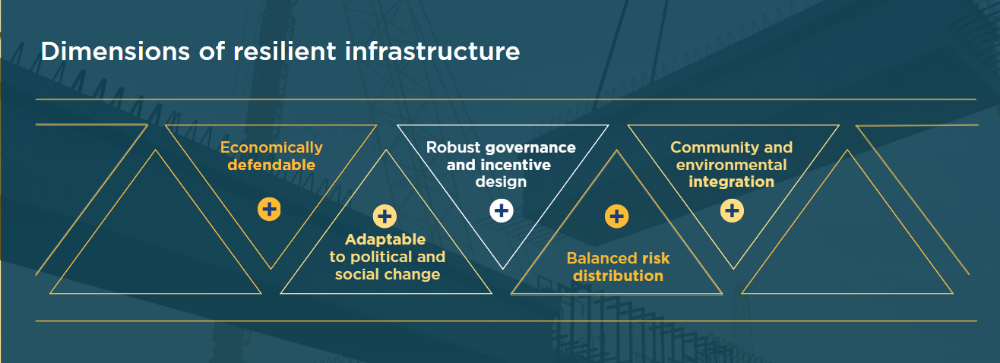
"Resilience in infrastructure means delivering things in a way where they are economically defendable, both now and in the future, when a government changes for example," Kavanagh stresses.
Risk and realism in fast-growing economies
Economic optimism often drives investment in infrastructure, but that optimism can be misplaced. In Indonesia, a decade of significant infrastructure spending under former President Joko Widodo – including a new capital city, toll roads, ports and one of the world's fastest trains, linking Jakarta and Bandung – has left a complex legacy for his successor.
It may be a case, of saying 'don't let perfect get in the way of good. Let's deliver a good project, build national capability, then make the next one better.
Matthew Goerke
Partner, Jakarta
"Most of these projects are fundamentally based on a view as to where Indonesia's economy will be in a certain period of time," notes HSF Kramer partner Matthew Goerke. "Everyone loves the high-speed train, they are so happy it's there; and yet it is not financially resilient."
The challenge, he adds, is that Indonesia's middle class has unexpectedly shrunk by about 10 million over the past three years. When economic assumptions change this dramatically, formerly promising assets can quickly become unsustainable. Developers must anticipate these in-country risks when modelling project viability.
For sponsors and lenders operating in fast‑growth markets, these pressures typically show up as:
- Volatile middle‑class purchasing power.
- Shifting government objectives and policy resets.
- IMF/World Bank influence on project repricing.
- Political cycles that outlast concession agreements
A more pragmatic approach is needed, according to Goerke: "It may be a case of saying, "don't let perfect get in the way of good. Let's deliver a good project, build national capability, then make the next one better.'"
Structuring for long-term success
The long-term success of an infrastructure asset can be influenced by how the project is structured. The overall structure needs to be sufficiently attractive to engage the supply chain, without jeopardising project appraisals, whilst striking the right balance between risk, reward and value for money.
As with any business agreement, downside risks and potential upside matter. Alliancing models – where contractors, suppliers and clients share risks and rewards – can work well on certain types of projects but remain complex to deliver.
"If contractors have equity, it means they have a longer-term interest in making sure projects are delivered in an efficient way for whole-life resilience," notes HSF Kramer partner Tim Healey. Yet because contractors depend on steady cash flow, equity-based incentives remain rare. Other financial incentives can also be outweighed by the need to protect the bottom line.
Progress depends on strengthening governance – the rule of law, risk management procedures, fair allocation of risk and reward, precision of contract terms, appropriate enforcement and regulatory stability – rather than pushing more risk onto under-resourced governments or a supply chain that may be unwilling or unable to carry it. "You can't eliminate risk," Healey says. "But you can structure it in a way that keeps both investors and societies engaged for the long term."
As a result:
- Developers must invest more in supply chain engagement to produce efficient and resilient design and delivery solutions.
- Governments must underwrite more uncertainty.
- Lenders demand clearer risk pathways to financial close.
Governments should be wary if they are pitched as generating unusually high returns. "Such promises are seldom kept," warns Kavanagh. On the other hand, early investors who deliver the first project in a country takes a large amount of risk, and they may have earned a premium. The key is what happens next: if a project succeeds, a government might agree to lower returns on subsequent projects, maintaining investor interest while building certainty and local capability.
Rethinking risk allocation
Building resilience into an asset invariably increases cost and the question of who carries that cost is becoming a defining challenge in infrastructure delivery. Contractors rarely have the capacity to absorb it and that risk eventually lands with developers or the public sector. Developers and governments will have to be more creative as to how they structure solutions that raise investment.
Governments are also experimenting with ways to stimulate investment through policy innovation. Healey points to the UK's carbon capture sector, where government-backed revenue models have encouraged development. He also notes growing efforts to support circular-economy models – such as recycling markets for construction materials like steel – as a way to reduce costs and encourage sustainability.
You can't eliminate risk, but you can structure it in a way that keeps both investors and societies engaged for the long term.
Tim Healey
Partner, London
The push for green infrastructure brings its own complications. While sustainable design is essential, truly sustainable development often proves too costly to achieve.
In the UK water sector, there has been much discussion about improving resilience to changing weather patterns but translating that sentiment into real projects is difficult. High upfront costs, pressure to keep bills affordable and constant changes in regulation mean many schemes are never finished. Even when a project is agreed and supported, shifting rules and priorities can halt progress.
"You get to a point where, when it comes to delivering it, the goal posts have already moved," laments HSF Kramer Of Counsel Joanne Holbrook.
Resilience in new infrastructure increasingly hinges on designing funding models capable of dealing with high upfront capital costs and risks the private sector cannot absorb, says HSF Kramer partner Tom Marshall. With government budgets constrained, many projects now rely on consumer-pays structures but there is still a need for the state to underwrite certain risks (for example, insufficient demand for the new infrastructure) to make investments viable. "Funding models are having to adapt in ways that take certain risks away from investors," he notes, pointing to sectors such as new nuclear and carbon capture as examples.
The cost of good intentions
It is often the case that projects in developing markets will face stricter environmental and social standards than their developed-world equivalents. While the intentions are sound, the effect can be counterproductive. Kavanagh recalls a hydro power project delayed because teams wanted to source green steel for construction. "Meanwhile, people will burn diesel or coal for an extra four or five years," he points out.
Similar tensions arise when infrastructure consumes scarce local resources. Data centres, for example, require enormous amounts of power and water but create few jobs. "Should you provide that power to run a data centre or supply it to people's houses, so they don't have to have a diesel generator outside their bedroom window?" Kavanagh asks. "It's hard to argue that's a resilient piece of infrastructure if it prevents power being provided to a school or a hospital."
Social licence and the politics of impact
Social licence is equally important in the developed world. In Australia, where renewable energy projects are proposed in regional areas far from the state capitals, governments and investors are coming up against resistance because the social impacts aren't handled early or well enough.
"The people who bear the visual, environmental or land-use impacts are often not the people who benefit from the profits," says HSF Kramer partner Kathryn Pacey. "Once community trust is lost, it's a long road to get it back."
Once community trust is lost, it's a long road to get it back.
Kathryn Pacey
Partner, Brisbane
Where engagement is weak, misinformation fills the gap. Co-ordinated campaigns targeting wind, solar and transmission projects – often technically inaccurate but politically effective – can derail projects before planning even begins, Pacey warns.
Similar dynamics are emerging in the UK, says Of Counsel Joanne Holbrook. Environmental objections and local resistance dominate headlines, while the resilience benefits of new infrastructure rarely get coverage. Some net‑zero industrial clusters have succeeded through early and sustained engagement, job creation and visible local investment, but these positive stories are not always the ones that travel.
As public scrutiny intensifies, social licence has become a critical decider of resilience. Even the best‑designed project is vulnerable to challenge and delay if the community does not see a compelling reason to host it.
The final article in our series will explore what happens when infrastructure fails and how to prevent it.
Hard questions for boards and investment committees
- How do we assess whether an asset will remain socially and financially viable over its full life cycle?
- Do our risk-allocation models recognise the limits of what contractors and governments can absorb?
- How do we ensure that the first project in a new market sets a bankable precedent?
- Are we structuring projects in ways that attract long-term capital?
- How do we integrate local partners to improve resilience and community relevance?
- Do we have a strategy for working with multilaterals when their requirements drive cost or delay?
The content of this article is intended to provide a general guide to the subject matter. Specialist advice should be sought about your specific circumstances.


