

- within Government and Public Sector topic(s)
- in China
- in China
- with readers working within the Business & Consumer Services industries
- within Law Practice Management and Insurance topic(s)
- with Senior Company Executives, HR and Inhouse Counsel
View Transcript
Ben Stansfield: Good afternoon, welcome to today's webinar delivering nature at scale biodiversity net gain for major infrastructure projects. My name is Ben Stansfield, I am a Partner at Gowling WLG, specialising in sustainability matters and I am today's chair for the webinar.
So we are going to have roughly an hour together, I hope you have got a cup of tea or coffee and a nice sandwich. We are going to spend around 40-45 minutes of your lunchtime on moderator discussion between myself and my three panellists, then that will be followed by 15-20 minutes of questions.
So at the bottom of your screens you will find a Q&A button, please do put your question in their and we will get to those either if they are absolutely on topic we will cover them as we go, or we might just leave them towards the end depending on how things pan out.
The session will be recorded and then we will circulate it so you can rewatch with your friends and family one evening and it will also live forever on the Gowling WLG website so there will be links to that as well.
Before I set the scene, I want to introduce you to my expert panel who will be guiding us through BNG for national strategy infrastructure projects. I am joined today by Tom Clancy, the Head of Environmental Delivery at National Highways, National Highways have been delivering BNG as part of their large infrastructure projects for a couple of years now, or a number of years I should say. We have got James Byrne who is the Head of Nature Markets at Plantlife International and is a leading voice in the delivery of biodiversity net gain across England and Helen Emmerson, a Partner in the real estate practice at Gowling WLG and Helen has particular expertise in energy and infrastructure projects as well as BNG in the Town & Country Planning Act world.
I am going to set the scene for a couple of minutes before we start firing our first questions to the panel. So why are we here today? Well I think on the 14th April we sent our invites to you to join us today and on the 15th, the very next day, DEFRA published the outcome of its consultation on biodiversity net gain for nationally significant infrastructure projects and that consultation confirmed that mandatory BNG will apply to all NSIP applications which are submitted on or after the 2nd November 2026, so it is a six month extension to where we thought we would be.
And I should explain we will probably be using all sorts of acronyms so please do put in the Q&A if we are using terminology that is not familiar to you, but NSIPs are Nationally Significant Infrastructure Projects, those are defined by The Planning Act 2008. They are things like power stations, overhead lines, airports, pipelines, reservoirs, railways, highways and increasingly commercial projects which might be approved by government as being NSIPs and running through the development consent order regime, so large scale data centres or multi-modal distribution centres.
So as I say we are now six months out from go live, there is a great deal for promoters, their advisers and in particular the BNG supply side, the biodiversity unit supply side to get their heads round. All of us on today's webinar I am sure have a lot of experience of biodiversity net gain from The Town & Country Planning Act regime but one of the real central threads that I want us to pull hard on today is how BNG for NSIPs will actually differ in practice from BNG under Town & Country Planning.
Just to flag a couple of headline differences before we get into the questions that I think help set the scene for today's discussions, first scope and proportionality, DEFRA has confirmed that the BNG baseline will not cover the entire redline order limits for the project, instead only habitats that are negatively impacted and that if used to deliver gains will need to be included in what is now known or will now be known as the BNG boundary.
Second there is no onsite hierarchy so unlike The Town & Country Planning Act regime there is no preference for delivering gains onsite and NSIPs can go either onsite or offsite in the first instance. That opens the door to a more strategic thoughtful landscape scale habitat delivery, but it also raises questions about whether the offsite habitat bank market is ready to absorb all that demand, we will cover that too.
And then finally temporarily used land. DEFRA has extended the reinstatement window from two years to five years for low and very low distinctiveness habitats, and it has confirmed that that reinstated land does not need to be managed for 30 years. For projects, infrastructure projects with large temporary works footprints that might be quite a major concession for us to get our heads round.
Those are the big moving parts. I have got a whole load of questions to fire at my colleagues and what I want to do in the next 40 minutes is work out what those mean in practice, so in particular for those who are designing NSIP schemes now and for the nature markets that are going to need to supply the units at a scale we have probably not seen before.
Let's begin. Helen I am going to come to you first if I may and picking up on those three points that I touched on in my introduction. The government has decided that BNG will only apply to a defined BNG boundary of impacted land, not the entire order limits. Obviously, you do a lot of energy and infrastructure projects with large cable runs and pipelines and so forth, so do you think this is the right balance between proportionality, is this showing enough ambition for nature or are the government being a little bit too pro-developer here?
Helen Emmerson: Thank you Ben. I think what is going to be vital is how these DCO requirements for defining the BNG boundary are going to be drafted, so that we have got clear, auditable, robust methodologies for calculating those baseline and then post development calculations, and that is going to be essential to making this, you know, workable and operable. There is inevitably going to be complexity around things such as temporary possession land, mitigation land, phased delivery, we will get into design iterations. So I do not think it is as simple as saying well BNG obligations are going to be reduced. I think the complexity may well create, you know, more legal practical challenges in defining that boundary, and I do wonder if we might start to see some perverse decisions being made around how those scheme boundaries are going to be drawn to try and then influence how BNG is delivered on an NSIP project.
In terms of your question has the government struck the right balance. I think overall from having looked at the outcome of that consultation, I would say the policy direction is cautious, particularly when you think about, and I am sure we will come on to talk about this more, CPO powers in particular, you know, there is no new CPO acquisition provisions for BNG. The expectation remains that compulsory acquisition is a last resort rather than a standard tool for delivery, so I do not think it is early enough yet to call whether we have got the right balance on this. What I do think is it is going to be complicated.
Ben: They might have a bit more … well Town & Country Planning have quite a lot of tinkering hasn't it, for BNG so we almost certainly need to brace ourselves for further regulatory changes as we progress.
Helen: Yes.
Ben: So James, you are obviously in the nature market space and one of the things that really jumped out at me in the government response which was published, mid April was this lack of hierarchy and something I guess that has frustrated a lot of our Town & Country Planning Act developers is that they want to go straight to units and they have had to persuade officers actually no, we cannot do it onsite and it has just been, it has made the gears for BNG under TCP a little bit sticky. I wondered whether you thought, is the glass half full or a concept that actually this is, you know, great, more strategic, more landscapes scale habitat recovery or is the glass half empty and/or crumbs we are we going to get these units because, you know, we have been selling fractional units, 10 units, 20 units and all of a sudden we are going to need bazillions for each project, so … how full or empty should our glass be on this?
James Byrne: I think our glass should be full …that is in general in my life, but yes first of all thank you, it is really great to be here and especially alongside yourselves and National Highways. National Highways have been one of the pioneers of BNG doing it well before the statutory. On the risk of defaulting to offsite, yes, under pressure programme developers will take the path of least resistance buying credits from habitat bank, but that can be much faster, much much faster than redesigning the pipeline route or negotiating with multiple landowner agreements or managing grassland for 30 years on a narrow, linear corridor.
But here is the thing, offsite can be done as well, just as well as onsite and we have proved it, kind of, the work we have done with National Highways. So that is what we call our meadow-makers programme, and there will be some links in the chat to a video that you can have a look at afterwards.
But Plantlife has sold over 700 BNG units to National Highways in Northumberland and Dartmoor National Parks, in a structured, strategic delivery model, where we worked with eight separate landowners, but National Highways did not have to deal with any of the landowners, they only dealt with us. We managed the landowners, the habitat creation, the monitoring the 30-year agreements. And National Highways only had one counterparty agreement, one single contract, a single point of accountability and so relatively simple and easy for them.
So offsite does not have to mean fragmentation or low quality, it can mean aggregation, professional management and genuine landscape delivery, landscape scale nature restoration which we have showed it with the National Parks example. S,o is the market ready to absorb that demand? Possibly. It is hard to tell but based on the National Highways model yes but with conditions.
So we are not just an ecological restoration charity, we create habitat banks by working with landowners, we have got our own bank of landowners, farmers and landscape sort of farm management companies and we can create bespoke habitat banks. But we are also a responsible body, we do conservation covenants for a lot of other people including, for example, the Environment Bank, and we are getting asked to quotes all the time. So, we know that there is a lot of supply out there, the pipeline is coming so I do think that it will be there soon if it is not already there and it is growing.
But one thing actually, a missing piece with NSIPs, could be coming to us early, so as I say, we can create bespoke habitat banks just like we have done with National Highways so if NSIPs were to come to us or habitat banks early then we can help with that pipeline, with that supply site demand.
Ben: Yes, that is a fair point isn't it. It is pretty unusual actually on the TCPO side that we get a call saying we are wanting to commence at the end of the month, can we buy some, you know, half a dozen units and we can do that but I guess the very nature of the infrastructure projects and certainly the larger TCPO schemes is that there is early thought going to that.
Tom I am obviously very curious to know how you found the process so far, which we will come on to in a moment, but just on that sort of third limb of my introduction, the sort of temporary impact reinstatement, obviously you have got some long and thin linear projects, you have got, you know, a huge number of hectares with your temporary worksite I would imagine. And I wonder if you thought that was too big a concession from government, or actually is it just pragmatic, you know, these schemes are blooming hard to do and you need that pragmatism from government. So, what is your reaction to that?
Tom Clancy: I think the latter, we need that pragmatism I think because, in fact five years might not go far enough, we have temporary a landscape that can extend for a longer period of time than that, so some of our projects will not benefit from this concession, but I think on balance it is a fair compromise and obviously only applying to low distinctiveness, it will encourage projects. I think about construction sequencing and obviously avoiding temporary land take on medium and high distinctiveness land, so I think it is a fair balance and we welcome it and it will reduce our costs across our project portfolio and obviously avoiding that, that 30 year management burden on those areas of land again will be a significant cost saving for us, so yes, on balance welcoming.
Ben: Very good, OK. I am going to poke, try and be a bit provocative and make the annoyee first Helen. We have seen a lot of tweaking to TCPO BNG, lots of government reaction and particularly when small to medium sized developers were struggling to get their heads round it and how they could deal with it, so there has been a bit of a softening from time to time and an accusation that BNG is just too expensive, you know, we want to build 1,500,000 homes in 150 infrastructure projects, so I just wondered whether you thought that sort of BNG on top of an already difficult economy was sort of this straw that breaks the camel's back, you know, do we, can we afford this?
Helen: Can we afford not to? Tom you mentioned that, you know, the concessions will have the impact in part of reducing some costs but I think you are right to say then that we cannot ignore the economic impact but, both in terms of initial provision of BNG on NSIP projects but also the ongoing monitoring and, you know, whilst again picking up on what Tom said, you know, there are strategic decisions to be made about which types of habitat might be impacted, inevitably the rural location of many NSIP projects means that we are going to be impacting high biodiversity and potentially unusual habitats.
One point I did pick up on in particular in the government response to the consultation is the basic maintenance obligation beyond 30 years for the remaining lifespan of the NSIP and you know we have only just started to think about what happens at the end of the 30 years when we are in, kind of you know, BNG as usual and I think that really brings a focus on to questions such as well how is that going to be enforced. The potential requirements for security, you know, bonds, insurance, sitting alongside delivery of BNG and, you know, then you start to think about well what is the impact that is going to have on funders when they are looking at progressing NSIP projects and I think all of that is inevitably going to push up the cost of development.
We have then go the overlay of the legal mechanics of us securing those long term obligations to factor in as well, there is a time and a cost implication and to me none of this feels particularly aligned with that government ten year growth strategy we heard about sort of this time last year didn't we, where, you know, the push for economic growth through infrastructure investment, fixing past under-investment, it will be interesting to see what evolves in terms of well how are the government contemplating that we are going to police this basic requirement beyond 30 years. Who is responsible for that? Have we got, you know, the digital infrastructure to even monitor that requirement and can we do any of that credibly at NSIP scale? I think, you know, there are so many questions that have not yet been answered on, you know, great aspiration but is it really feasible and going back to your original point Ben, you know, is it going to fundamentally affect the economics of these projects? I think it will, yes.
Ben: Yes. Tom, James, I wondered if, maybe Tom, I being naïve in thinking that the sort of rural location of some of these projects means that, you know, the types of sites they are inevitably going to be built on, the biodiversity is going to be higher, you know I know there is an argument that brownfield sites have got all sorts of amazing biodiversity because they have just been left.
Tom: They do.
Ben: So it is not an obvious thing that rural means biodiverse, urban means devoid of nature, but is there an element of, you know, infrastructure projects are probably going to have it a bit tougher, you know, housing development might say well we can avoid that field because … and we can build half a mile up the road whereas NSIPs it is very difficult to sort of, you know, they have to be where they have to be.
Tom: We have a certain amount of choice in our optioneering and where we choose our alignments on new major enhancements and I think what it has done is really encourage good design and project teams to think about this early on, so if we take our major enhancements portfolio over road period two which was 2020-2025, at the start of that it looked like a crossed out portfolio there would be quite a significant degree of loss across all of those projects. We implemented BNG very early on and that got design teams thinking about well actually does a road need to be there, could we not take that bit of habitat, do things a bit differently and the outcome by the end of road period two was that we avoided 2,000 biodiversity units worth of loss just by improving our design and thinking differently about how we deliver, so it can done differently and I think that is the biggest benefit of this, of BNG is getting a better outcome projects and that sort of obviously reputationally with statutory bodies, you know, is a great thing to do and it builds that sort of trust in what we are doing so.
Ben: Can I ask, going off our script a bit on that, 2,000 units avoided, was that, did that come out in examination, you know, is that a big flashing lights material consideration, look the reason we are having to go this route is because you know nature and biodiversity avoidance, loss avoidance and that outweighs the negative reasons of why we have gone through route, you know, were examining authorities, inspectors, are they interested in that as a plus point?
Tom: Yes very much so, I think it is part of the narrative of the project that it is, you are not just building a road, you can deliver for nature as well, so it can be a positive thing, so we have already done it on a voluntary basis so far across our portfolio, but it has been raised at examination as a point of interest so I think it, obviously when it comes into force on a statutory basis it will already much so be at forefront during examination I think.
Ben: Perfect. Tom, you have been at the meadow's edge or infrastructure and biodiversity so I have got loads of questions for you, but I wondered whether we can come to you and Helen, James do chip in once Tom has given his thoughts. But obviously with long linear projects you have got a number of local authorities and one of the outcomes of the responses, the government response was that, you know, DEFRA said that discharging authority for post consent BNG plans could be a host PA, a lead PA taking charge for everyone, it could be The Secretary of State and I wondered whether, you know, for infrastructure developers who have got projects spanning a number of authorities if you had some words of wisdom in terms of what promoters should be pushing for, what have you found works well, I guess taking into account, you know, things like local authorities not having a resource or the expertise, so if you could share your thoughts there?
Tom: Yes I think the approach of having a lead authority is the preferable one, a single point of contact the project team can deal with, I think that reduces receiving conflicting advice or delays for certain parts of the project so that would be the preference I would imagine along with The Secretary of State as a backup. I think in terms of expertise across the local planning authorities, that can be an issue in whether they are resolved and geared up to respond to the technical requirements of BNG so, I know I have worked with, we work a lot with HS2 and their model has been to fund that expertise and whether it be in the LPA or the statutory body it is funded, it is functionally separate from the project so they get independent advice, but they get the service level that they need for the project to progress. So I think that is a model that has worked well for them, and that large NSIP developers can look at as well.
Helen: Yes I would agree Tom that, you know, if you have got one host authority who has perhaps dealt with BNG under Town & Country Planning, they have got inhouse ecologists, they know how to deliver this sort of project then that is probably going to deliver a preferable result rather than having to discharge the obligations through a patchwork of authorities.
Just a point to flag really which is that you would need to be specifying your host authority or your lead authority in your pre-app stage ideally on DCO, so you want to be identifying that early on where possible. Equally, if you have got a really nationally significant, a huge transport project, I think there is a lot to be said for preferring to go to The Secretary of State, you have got the costs then being absorbed by the department rather than multiple LPAs or a central coordination headache. So I think it is worth thought early on in a project, as to which direction you want to go in, because there will certainly be dividends to be had from making a smart decision early on on this.
James: And I can tell you the former planning ecologist at the local authority, the local authorities are really really stretched. So having one lead authority you would require eventually a lot of investment into that one lead authority, new jobs including new ecologists, new planning authorities, people specifically brought in for that specific role. So, whether it is you take a lead authority and they have to have that investment and especially having ecologists which a lot of authorities do not have, or it goes to The Secretary of State and then they also need to have some, draft in some ecological expertise as well.
Ben: Perfect. Thank you. And again, Tom coming to you first on things like design flexibility obviously there is always that tension isn't there with an NSIP of crystallising what you are doing and then getting a DCO that gives you a little bit of wiggle room and I wondered if you had some views or experience you could share from BNG in that design process and may be more it is a case of, you know, as the project flexes a little bit you need to go back to the BNG and I wondered if flexibility had cropped up in your projects in the BNG space?
Tom: Yes absolutely. I think to do an engagement is key with our project teams to factor this in as early as possible in the design phase before key aspects of the project are fixed, because once you get past that point it becomes harder to incorporate your requirements, so to really engage in want we want. I think the other one would be to assume a worse case scenario at an early planning stage so that as things progress past detailed design you have got that flexibility to alter your designs and still operate within that sort of scope.
And the other thing that we are looking to do over the next road period from now until 2031, is to operate what we call a central bank of units that will serve our portfolio. So offsite is very much a key part of how we deliver BNG, so having a pipeline of units with suppliers that we can call upon should our designs flex and we can bring in that offsite supply. I think that is a really important part of the mix as well as the sort of early good design as well.
Ben: So is that you having framework agreements with leading habitat banks and saying look, when we are ready over the next five years this is my broad estimation of what I am going to want, one day I am going to phone you up and you are going to deliver, or is it you doing your own habitat banking in anticipation of a scheme?
Tom: I think it is more the former,procurement will be a key issue for us in having the right routes to markets to reach conservation charities but private organisations as well that can provide us with that supply so that is something that we are working on.
But as you say I think it is the former of those and must be really clear where are projects are, what our requirements are and then the supply chain can start to respond by knowing where their supply is that they can meet those demands.
James: Yes, I would agree with that, having trust in delivery partners who can deliver the ecological expertise, the right habit of banks, the ecological credentials as well rather than just going forward with the cheapest units or ones that are not advancing and needs restoration, I think that is really important. So, I am then trusting delivery partners would be key to all aspects.
Ben: Perfect, well that kind of segways very nicely and we have, because I was wanting to talk about the offsite market and their ability to step up and actually Phoebe Tucker from the Green Finance Institute has asked a question around this and it kind of picks up what we are about to talk about so Phoebe asked "ahead of NSIPs coming online in November and big developments going through the DCO process which might take two or three plus years how can the NSIP developers and the offsite market all work together to manage the change and how do those two groups come together".
I know when we were speaking James you were talking about almost a sort of master planning of habitat banks and or rather mapping where need was likely to come forward and I wonder if you could talk a little bit about that?
James: Well yes there are a few areas so one if, you know, NSIPs were to come to other NGOs or other habitat banks early we can help build that pipeline work where they need it which is what we have done with National Highways. Currently I am working with a lot of other NGOs to kind of create this NGO pipeline and pretend you have put that on a kind of a map so developers or NSIPs can be able to source units from NGOs including those that we are the responsible body for, for example, you know, ones potentially like the environment bank.
But also ourselves and National Highways and other NGOs and other organisations are under this umbrella called 'rebuilding nature', which is an alliance of NGOs, public bodies, private businesses like National Highways, building a UK strategic nature network that is looking to deliver on government promises of for example 30 x 30. The alliance in this is an opportunity to establish a strategic nature network across the UK using nature investment zones as building blocks for ecosystem restoration.
But its not necessarily where, eventually where the infrastructure is, it could be but if it is not that could create a tension but I think Tom can, has possibly been working on some other aspects of rebuilding nature as well but yes, there could be some pinch points and with it but they can be overcome.
Ben: Tom is that something you, is that a big part of your world pushing that forward, can you see the value in that?
Tom: Yes absolutely so you know James mentioned the nature investment zones and the concept that it could almost be like masterplans for certain regions where the supply can pool their resource but to match that we need I think better articulation from the client side, so if multiple clients can articulate their needs and those needs overlap then you have an investment zone that supplies despite anything to get behind and re-invest in. So that is the key, the bit of work that we need to do with the likes of Network Rail and National Grid is to come together and really articulate and what our project requirements will be over the next five or ten years so that we can put that ask together and then you get sort of that strategic landscape scale intervention that we are all looking for I think.
Ben: Yes, and is that, I assume that is not a closed shop for infrastructure public sector providers, you mentioned Network Rail and National Highways, a FTSE 100 housebuilder could be part of that and say well look this is my business plan, this is what I am going to need.
Tom: Absolutely yes, yes certainly not a closed shop, I think the more that comes to the table the bigger and better it becomes.
James: Yes, because, there is nature in the UK, you know, there is this massive nature finance gap and we need, you know, it is not going to be covered by government, it is not going to be covered by endurers, it is going to be covered by Plantlife, we do need private business to step up and help create these ecological 30 x 30 stepping stones and so having these nature investments at least for a lot of private businesses can come together and we as the supply side can work with them to develop these habitat banks that are actually landscape scale and having massive impact on nature restoration throughout the UK I think is going to be vital in hitting our climate goals, our biodiversity goals and our international targets.
Ben: Perfect. So, I guess that all decorates the business case isn't it for landowners deciding whether or not to put their schemes into BNG if they can say well actually there is a huge pipeline in this area and I am in the right zone to provide it without spatial risk multipliers and all that kind of stuff?
James: Good.
Ben: Perfect. Good. Is there, sorry, nature investment zones I am assuming there is websites or links we could shar with the audience afterwards?
James: Yes, there is a rebuilding nature website that we can put in the chat and in the notes after this.
Ben: Perfect, well hopefully we will not lose dozens of people now going off to Google that, so please hold back everyone. Fine, so I think may be a few more lessons around the voluntary delivery, Tom, we have asked you quite, you know, some quite specific sort of questions around, you know examination and so forth but I wondered whether you could, you know, share any of those sort of lessons learned, you know, if only I knew this when I started on a voluntary scheme. What pearls of wisdom can you give those people who are about to be doing mandatory BNG for the first time?
Tom: It's a good question. Yeah, I think we look back at the delivery that we've done over the last five years, over 7,000 biodiversity units delivered, but they're all quite sporadic in their geography. They weren't joined up or cohesive. It was probably just the way we approached it at the time is very early days. I think moving forward, to the point we've just been speaking about with rebuilding nature and joining everything up, we look to more strategic delivery at a bigger scale. We started to deliver BNG on a voluntary basis before LNRSs were in place. So that leans in to be more strategic and helping hit those central government goals.
I think another thing that we weren't considering at the start in our legal agreements with partners was climate change adaptation. So, five years ago, we didn't factor this into our legal agreements. So, what those habitats that have been delivered for us look like in 30 years and whether they're failing or susceptible to stress, is something that we need to consider much more prominently now in the legal agreements that we write going forward. So, I think climate change adaptation is becoming a much bigger, more urgent issue than we ever thought it would be five years ago. I think that's a key point to start thinking about when writing into legal agreements.
And then I think just a lesson then like we spoke about visibility to the supply chain and just giving as much certainty as possible. If clients can do that, then you sort of you improve quality and you reduce costs. Providing that visibility to the supply chain is a key component as well.
Ben: Yeah
James: I'd add to that. I mean, I'd echo all of that, but also kind of having trusted delivery partners, I think would be really useful. As I said, our national highways model is what we consider a gold standard. And NSIPs don't want to manage farmers, legal agreements, 30-year monitoring. They want to come to trusted delivery partners. Early strategic engagement. The best supply side outcomes happen when the NSIPs will come to us early before they need the units, not a DCO submission. That gives us time to recruit landowners, design bespoke habitats and secure conservation covenants. And also, long-term NSIP demand signals. When an inch of signals then need X units over X years, it helps to unlock land or investment, as we mentioned before in our rebuilding nature question. Farmers are more likely to convert low-grade farmland species into grassland, for example, if they know that there's a buyer.
But what doesn't work is last-minute credit chopping. You know, we need 300 units in three months, and that forces the NSIP to accept whatever is available, not what's ecologically the best outcome. And they might end up paying a premium for suboptimal units.
Ben: Do you think that will be a greater focus going forward that I guess in a voluntary world, anything good? And you get a sort of a pat on the back and a thank you from examining authorities and what have you.
But when it becomes mandatory, examining authorities, are they going to be looking a little bit more closely at issues like climate change adaptation, last minute purchases that aren't quite good enough?
Are they going to be looking at the detail of habitat management plans and how you're looking after your settlings and things like that?
James: Yeah, and this is where, as I mentioned before, or keep coming back to having trusted providers like Plantlife and our National Highways example will be really helpful to that process.
Ben: Perfect. So I'm going to encourage people to ask questions. We've had a few and we've covered Phoebes. I've got some interesting questions myself that I would like to ask about CPO and all that kind of stuff. But if you do have a question, put it in the in the Q&A. Please remember, I am a slow reader and a simple individual. So short questions which anyone on the panel can answer, single syllables, no long words that I don't understand. Yeah, far more likely to get your question asked.
James: To Ben, just to just I wanted to just respond very quickly to something Helen said previously. It was when you asked about affordability and of these things and Helen said, can we afford not to do these? I mean, she's completely, completely correct because not only are we in a climate and ecological crisis, and we're one of the most nature-depleted countries on Earth. If we make BNG optional, for example, it just simply won't happen, or it will be so restricted it could be meaningless. The cost of inaction, actually not doing it, is already visible. We've got floods, soil loss, pollinator decline, poor public health and obviously a loss of biodiversity. So, BNG isn't a cost, it's an investment. It creates rural jobs, it creates habitats, creates monitoring, seed collection, planting. It's a real economic activity that places NSIP, in the places that NSIPs pass through. So yeah, so I, BNG should not be optional. You said it is a straw that breaks the camel's back. It's not the straw, it's actually a new leg to the camel.
Ben: Oh I like it. Very good.
Tom: I completely agree James. I think that as I mentioned, the avoided loss that we had previously, it can absolutely drive better project outcomes. So, I think it's, you know, we cannot afford to treat this as a tick box exercise. It needs to be central to how we think about delivery of schemes.
James: And there is a mitigation hierarchy there. And that's a great example, Tom, because the mitigation hierarchy obviously says avoid the impact, minimize the impact, then restore, and then offset. And so, if you avoid the impact, then it reduces the cost of BNG delivery, etcetera. So therefore, there's a mechanism there to reduce the impact on nature in the first place. So BNG can be a win-win, so it's avoiding loss, but it's also restoring or creating a new habitat. I think there's a, it's honestly, I think it's one of the genuinely best things for nature conservation. It's one of the only markets in the world that's actually requiring nature restoration. I think it's something we can be very, very proud of.
Ben: Perfect. Well, I asked earlier about glass half oil, glass half empty, James. I think your glass is overflowing now, which is great to see.
So, before we get on to the questions, sort of classic end of an end of webinar type question in terms of just what was your, and this is to all of you, what your top tip might be for whether it's promoters, advisors, supplier side to be to be doing or thinking about in the next six months before BNG mandatory BNG goes live for NSIP. Helen, I'll come to you first.
Helen: So, I build on what both James and Tom have said in terms of don't leave this to the last minute in your project, and then suddenly realise you need a load of units tomorrow. You know, BNG is not an ecology work stream. It's part of the fundamentals of putting together your DCO application. The government response had set out its sort of process expectation. You know, developers, people taking NSIT projects forward need to be acquainted with that. We need to assume that there is going to be further information coming out from the government. There's going to be more information from Defra. We'll have secondary legislation that there's lots that is still to come. Ee are going to need to be agile. We're going to need to adjust projects that are that are up and running and being put together at the moment. So, you know, don't freeze your design point too early, perhaps. There's more guidance to come. Be agile, be flexible. It would be my sort of key to remember over the next six months. There's more to come and we don't quite know what it's going to look like.
Ben: Perfect. Good note of caution. Tom.
Tom: Yeah, I think it echoes some of those points. Early design, understanding the mix of what you can achieve on-site as well as off-site, and then knowing that you might need off-site units, then build those relationships with partners that are really going to give you that value that James spoke about. So, avoid that last minute sort of lower value unit purchase and build it into your project delivery from the off. That's what I would advise.
Ben: Great, thank you. And James.
James: For NSIPs, well, first, give me a call. Two, baseline now, don't wait for DCO preparation. Get your ecologists on site this spring, run the metric, identify the unusual habitats and the supply gaps that you have. The worst thing would be discovering an examination that you can't deliver. For BNG advisors, don't say BNG is easy, be honest about lead times, about spatial mismatches and mismatches and habitat type risks, and then for supply side, ourselves and others. Publish your forward pipeline, landowners, habitat banks, brokers, tell the market what you're building, where it is, when it is, because we need that, the NSIPs will need that transparency, otherwise they might default to poor quality spot purchases or give up on off-site entirely. So that's what I'm working with other NGOs to create a BNGO map of all our NGO sites, including the ones that we hold conservation covenants for.
Ben: Perfect, thank you. So, we've got a few questions and I'm going to go for the short ones because I did warn you. So, we've had one question from somebody saying, how can off-site providers, so people who are sort of, I guess, starting up on the BNG Habitat Bank journey, how can those off-site providers most effectively make connections with the emerging NSIPs? It may be that your answer is going to be in the rebuilding nature that we've discussed. But are there any other, and Tom, I don't want you to finish this webinar and get like 100 emails saying, I'm a habitat bank, would you like to buy some units? But what is how do you make contact with emerging aim tips?
Tom: Yeah, I think there's a gap in the market at the minute that we're not quite connecting the two sides up efficiently. So, I think initiatives like Rebuilding Nature will really help with that. So yeah, definitely advise looking into that and being part of that.
Another lesson we've learned from our road period two was that we started off with sort of bespoke legal agreements and grant agreements, but that won't serve us at scale. We do have a gap in terms of engaging with the whole range of suppliers in the market, and we are working on a procurement strategy to be able to get access to all the suppliers that we need.
So definitely, you know, it's not there at the moment. Register interest with us so we can put you on the list. And when we do our market engagement for our new procurement route and also register and be part of initiatives like Rebuilding Nature that are seeking to build it and bring everyone together.
Ben: Yeah. And we've had another question that are related to this, which I'm sorry to you, James, that we've obviously talked a lot about NGOs and the Wildlife Trust or what have you doing, BNG, but there is a substantial private sector market there. And just giving some reassurance, I guess, that the private sector Habitat bank market still has a very important role to play with NTIPs and obviously BNG generally, but there's nothing is there in policy or legislation which says NTIP should favour a particular type of Habitat bank provider. It's an open free market and it's those who've just got to sort of promote themselves as loudly as they can.
James: Yeah, and as I say we're a responsible body, so we do conservation covenants and we do conservation covenants for the most part for private habitat banks. So yeah, so it's obviously private habitat banks are really important and when we're doing conservation covenant, we've got what we call our plant life standard and it's effectively creating a high, a high bar. So, you know, if there's a conservation covenant with us, it's what we would call high integrity biodiversity net gain. So, and that's going to a lot of, you know, private providers. And so, yes, biodiversity net gain, habitat banks from commercial providers are going to be very important for NSIPs and other developers.
Ben: Perfect, thank you. Then there's a technical question around land use frameworks and there's sort of someone suggesting is that questioning whether there's much coordination between or where these biodiversity corridors that sort of link habitat banks and nature and what have you to, I guess, to enable migration and so forth. And the question whether there's the land use framework offers much hope in terms of those coordinating those biodiversity corridors and linking, I guess, NSIPs to other areas of nature. Do you think the land use framework is likely to be a solution here or is that sort of almost a little bit advanced for the BNG market? And actually, the real answer is in the rebuilding nature investments.
James: Yeah, I think the rebuilding nature will be very important, but also the LNRSs, the Local Nature Recovery Strategies, they've been in part designed to help with the nature corridors and obviously nature recovery. So, and they are linked into kind of the BNG arena. So yeah, so they will be an important document when they're finally finalised.
Ben: Perfect, thank you. The question around CPO and compulsory acquisition of land, there's power saying, yes, you know, CPO is open, the compulsory acquisition for land for BNG is possible. This was sort of pre-emptive. And I wondered if you thought that CPO for BNG is a non-runner, whether it's ever going to happen or whether because there's always a unit you can buy in the market. Tom, sorry, I hadn't worked out how to put that too, but do you think compulsory acquisition for BNG is just too tricky to be such that it's a non-starter?
Tom: I'm not sure if it's a non-starter. I mean, to know that it's fair is good, but I think the way we've delivered so far has been through good design, through agreements, you're working with partnerships. So, I would very much see that that continues to be the levers that we pull rather than defaulting to CPO and I'm not sure that's a route that we would prioritise.
Ben: Yeah. Technical question from Jack at Wild Capital, who reminds me actually, we sort of talked about that temporary impact exemption and going from two years to five years and Jack reminds us that the five-year exemption is actually only where the whole application is temporary rather than just bits of it. And whether that's going to drive people to submit different, basically chop up their applications. Or whether that has the optics of gaming systems and all that kind of stuff. And Tom, when National Highways are doing a DC application, I'm working on the basis they have one application and they're not sort of being too cute with chopping up to suit regulation.
Tom: Yeah, we certainly don't. I think salami slice is the term we use, but no, we shouldn't. I don't think we would look to do that just to get around this. We do sometimes have early enabling works, so I don't know if this approach could be tailored for some of those works that are genuinely needed to get things going ahead of main construction. So, there's a bit of detail to look through there, I think.
Ben: Perfect, okay. I think with five minutes to go, I'm going to wrap things up.
First of all, I want to thank you, Tom, James and Helen for sharing your knowledge and for sharing your expertise with folk. We really appreciate that.
Thank you to the audience for registering, for logging on, for listening and or asking questions.
As Helen said, there's a lot more. The six months are going to be busy with draft regulations, and we'll be looking at them, I'm sure, in the coming weeks and months and saying, well, that's not quite what the response, government response said.
So, there'll be, lawyers will be getting excited, I'm sure, over the coming weeks.
As I said at the beginning, the recording and the transcript will be emailed to attendees shortly, and we'll put that on the website as well.
Tom, Helen, James, thank you so much, and thank you to the audience for joining us. Goodbye.
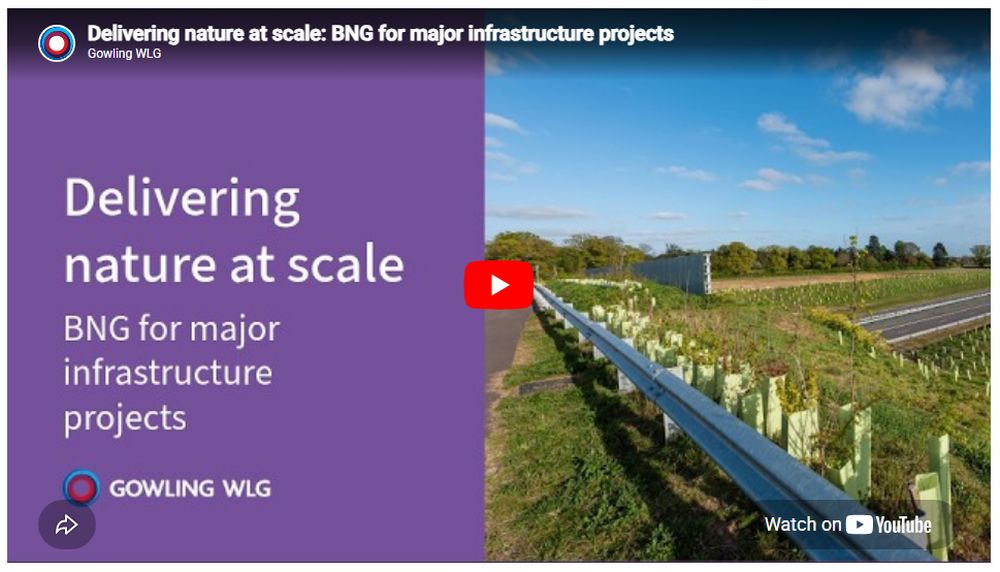
As mandatory Biodiversity Net Gain (BNG) extends to nationally significant infrastructure projects (NSIPs) from 2 November, what challenges and opportunities does this present? The Government's consultation outcome, published on 15 April, updates the implementation timeline and refines proposals to help organisations prepare for the changes ahead.
This webinar moved beyond the basics to explore how BNG will be delivered across major infrastructure projects. Our panel shared practical and legal insights into the complexities of large, linear schemes, cross-boundary delivery and habitat creation, alongside lessons learned from early adopters. We also considered how BNG for infrastructure differs from residential and commercial development, and what effective, scalable delivery looks like as the new regime comes into force.
Discussion topics included:
- How BNG will apply to major infrastructure projects.
- Challenges for long, linear schemes.
- Insights from organisations already delivering BNG voluntarily.
- On-site vs off-site habitat solutions.
- Scaling biodiversity units for large, complex developments.
- Key considerations in preparing for the changes coming into effect from 2 November.
Read the original article on GowlingWLG.com
The content of this article is intended to provide a general guide to the subject matter. Specialist advice should be sought about your specific circumstances.
[View Source]
