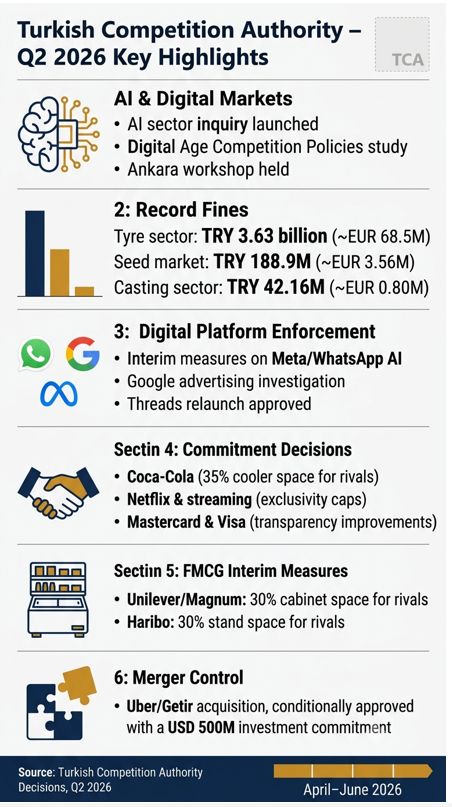
The second quarter of 2026 marked an exceptionally dynamic period for Turkish competition law enforcement. The Turkish Competition Authority (“TCA”) intensified its focus on artificial intelligence and digital markets through landmark sector inquiries and policy studies, whilst delivering record-level fines in the tyre and casting sectors and concluding high-profile investigations through commitment and settlement procedures. The quarter was further characterised by the TCA's continued scrutiny of global technology platforms, with interim measures imposed against Meta and binding commitments accepted from multiple digital market participants, as well as notable interventions in the FMCG sector, including interim measures requiring Unilever and Haribo to allocate freezer cabinet and stand space to competing products, and a comprehensive commitments package accepted from Coca-Cola addressing exclusivity and foreclosure concerns.
This bulletin surveys the principal developments of Quarter 2 of 2026, examining regulatory reforms, notable enforcement decisions, and emerging priorities that will shape the Turkish competition landscape in the months ahead.
Regulatory & Policy Developments
The TCA Launched a Sector Inquiry on Artificial Intelligence
On 7 April, the TCA launched a comprehensive sector inquiry into artificial intelligence, aiming to identify structural and anti-competitive risks at an early stage. The inquiry focuses on how early access to critical inputs, such as data, computing capacity, technical expertise, and funding enable certain undertakings to entrench their position across the AI value chain. General-purpose AI models are identified as strategic bottlenecks raising concerns around entry barriers, ecosystem lock-in, and restricted access to essential inputs. The TCA also highlights risks arising from AI integration into large digital platforms' products and services, including self-preferencing, tying, and exclusion, and signals that AI is increasingly central to its merger control assessments.
Following the announcement of the AI sector inquiry, on 14 April, the TCA launched a comprehensive study titled "Competition Policies in the Digital Age," reflecting its increasing focus on building a robust and forward-looking policy framework for digital markets in Türkiye. The study aims to systematically assess the effects of digitalisation on competition law and policy, identify existing and potential competition issues in digital markets, and contribute to policy-making processes. The TCA acknowledges that traditional ex-post competition law enforcement may not always be sufficient to address the rapid and dynamic nature of digital markets. In this context, the study will comparatively examine ex-ante regulatory approaches adopted by jurisdictions including the EU, the UK and Germany alongside existing ex-post tools, assessing the effectiveness of different regulatory models in light of each country's economic, institutional and legal structure. The study also emphasises the need for more flexible and adaptive regulatory frameworks, incorporating continuous monitoring and feedback mechanisms. The main output of the study will be the "Competition Policies in the Digital Age Report," an updated and expanded continuation of the TCA's earlier "Reflections of Digital Transformation on Competition Law" study.
As part of these initiatives, on 26 June 2026, the TCA hosted the "Competition Policies in the Digital Age Workshop" in Ankara, bringing together academics, public institutions, civil society organisations and industry stakeholders to examine the implications of digitalisation and artificial intelligence for competition policy1. The Workshop was opened by TCA President Birol Küle, who emphasised the need for competition policies to evolve in line with the economic dynamics shaped by digitalisation, followed by remarks from Minister of Trade Prof. Dr. Ömer Bolat highlighting the growing contribution of the digital economy to Türkiye's growth performance and the necessity of a fair and effective competitive environment. Across three sessions, participants discussed ex-ante versus ex-post regulatory approaches to digital markets, the role of data and algorithms in competitive dynamics, dark pattern practices, and the reshaping of competition by artificial intelligence across the value chain — from cloud infrastructure and data access to the structural asymmetries between large-scale incumbents and smaller entrants. The Workshop underscored that regulatory approaches to digital markets cannot be reduced to a single formula and that Türkiye has the potential to develop a flexible, forward-looking policy framework tailored to its own conditions.
Amendments to the Merger Control Guidelines
As part of the legislative update process concerning the merger control regime, following the substantial revision of Communiqué No. 2010/4 Concerning the Mergers and Acquisitions Calling for the Authorization of the Competition Board ("Merger Communiqué"), various amendments were published to the related merger control guidelines. While certain amendments are technical in nature and merely reflect the new rules introduced by the Communiqué, others bring substantive innovations. In particular, the concrete determination as to the activities whose turnover will form the basis for calculating the TRY 250 million threshold for technology undertakings, the confirmation that Türkiye sales will be expressly included in the calculation of worldwide turnover, and the framing by reference to specific examples of cooperative effects between parent undertakings in joint ventures are amendments capable of producing significant practical outcomes.
Cement Sector Inquiry
The TCA also launched a sector inquiry into the cement industry during the quarter, building on Türkiye's position as the fifth largest cement producer globally and the industry's structural characteristics including high concentration levels and product homogeneity. The inquiry aims to identify sector-specific competition concerns and analyse regional competition dynamics.
Notable Decisions
Investigations and Decisions Concerning Anticompetitive Agreements
The second quarter of 2026 saw significant activity in the enforcement of rules against anti-competitive agreements.
Among the newly launched investigations, the most significant concerns the health insurance market. On 6 April, the TCA initiated a comprehensive investigation into multiple undertakings operating in this market, as well as private healthcare providers and service companies providing technical and operational support, to assess potential violations of the Competition Act. The investigation targets alleged coordination among insurance companies on premiums (including price fixing, increases or stabilisation), possible market allocation, and exchanges of competitively sensitive information. It also covers potential exclusionary agreements between insurance companies and private healthcare providers.
Turning to concluded investigations, the TCA imposed fines on undertakings operating in the hybrid industrial gherkin seed and hybrid vegetable and fruit seeds markets. During the investigation, 12 undertakings (including Bayer, Syngenta, Rijk Zwaan and Nunhems) applied for settlement, admitting to exchanging competitively sensitive information, with Nunhems and Rijk Zwaan additionally admitting to jointly determining sales prices. All 12 received a 25% fine reduction as a result of the settlement procedure, with total administrative fines amounting to TRY 188,921,100.24 (approximately EUR 3.56 million).
The quarter's most significant enforcement outcome in terms of fines concerned the tyre production and distribution sector2. The TCA concluded its investigation into multiple undertakings, finding violations of Article 4 of the Competition Act involving concerted practices on pricing, resale price maintenance, region and customer restrictions on dealers, discriminatory practices, non-compete obligations, anti-competitive information exchange, and no-poach agreements. The majority of distributors within the scope of the investigation settled, while the remaining undertakings, Brisa Bridgestone Sabancı, Goodyear, Hankook, Michelin, Pirelli, Prometeon and Otomotiv Lastikleri Tevzi, were fined through the full investigation process, with total fines of approximately TRY 3.14 billion (approximately EUR 59.2 million). Combined fines across all parties reached approximately TRY 3.63 billion (approximately EUR 68.5 million). The Board also imposed behavioural obligations on all producer/supplier undertakings to prevent indirect information exchange through dealers, including watermarked price announcements specific for each distributor, individual distributor portal communications, and contractual penalty clauses prohibiting dealers from sharing future pricing information with competitors.
Another notable conclusion involved the entertainment markets. The TCA found that the Casting Agencies Association and a large number of undertakings operating in the casting agency and management markets had violated Article 4 of the Competition Act through collective determination of agency commission rates and service terms, and exchange of competitively sensitive information3. Total fines of approximately TRY 42.16 million (approximately EUR 0.80 million) were imposed on 36 undertakings and the Association. In addition to fines, the Board imposed structural and behavioural remedies requiring that casting direction and casting agency/management activities must not be conducted within the same economic unity, that production and casting agency/management activities must not be conducted within the same economic unity, and that the appearance of a talent in content must not be made conditional upon the appearance of other talents.
Investigations and Decisions Concerning Abuse of Dominance
The TCA's dominance enforcement during the quarter was equally intense, featuring a combination of newly launched investigations accompanied by interim measures and concluded cases resolved through commitment procedures. Notably, the Board demonstrated a willingness to impose interim measures at the outset of investigations where it identified serious and immediate risks to competition, particularly in digital markets and the FMCG sector.
In the digital advertising space, the TCA launched a formal investigation into Google to assess whether its invoicing practices in online advertising constitute an abuse of dominance under Article 6 of the Competition Act. The investigation focuses on whether Google's cross-border invoicing structure, through separate legal entities (Google Ireland vs. Türkiye), creates unequal cost burdens for similarly situated customers due to divergent withholding tax obligations.
Perhaps the quarter's most forward-looking enforcement action concerned artificial intelligence integration in messaging platforms. The TCA opened an investigation into Meta to determine whether integrating Meta AI into WhatsApp and blocking third-party AI providers from the platform violates Article 6 of the Competition Act. Finding that Meta's conduct constitutes a serious competition violation, the Board imposed an interim measure requiring Meta to establish conditions enabling third-party generative AI chatbots and assistants to offer services through WhatsApp without de facto or economic impediments.
Turning to concluded dominance cases in digital markets, the TCA approved Meta's application to relaunch its Threads application in Türkiye, confirming compliance with the commitments previously rendered binding by the Board. The TCA had initiated a preliminary examination into Meta in August 2023 over allegations that Threads was unlawfully tied to Instagram in violation of Article 6 of the Competition Act. The investigation was concluded in November 2024 with binding commitments requiring Meta to enable users to use Threads without an Instagram account and to choose whether to link their profiles or keep them separate. The TCA found Meta's relaunch structure compliant with these commitments, clearing the way for Threads to return to Türkiye.
The streaming sector also saw resolution through commitments. The TCA terminated its investigation into Netflix, BluTV, Disney, Amazon Prime, Exxen and Gain concerning exclusivity practices in agreements with content owners, producers and talent, as well as allegations of discriminatory producer selection and unfair contractual terms by Netflix. All parties committed to capping exclusivity periods for both branded and non-branded content, introducing revenue-sharing mechanisms in favour of producers, and refraining from talent exclusivity arrangements and non-compete or blanket exclusivity obligations in agreements with Turkish producers and distributors. Netflix additionally committed to allocating a portion of its branded Turkish content to producers that have not previously worked with Netflix, organising annual Presentation Days for at least 80 new producers, directors and screenwriters, and evaluating project applications within 120 days with reasoned written feedback.
The FMCG sector also attracted significant enforcement attention4. The TCA initiated a full-fledged investigation into Unilever / Magnum, active in the production and sale of industrial ice cream, on suspicion of violating Articles 4 and/or 6 of the Competition Act, as well as non-compliance with interim measures set out in the TCA's earlier decision dated 18 March 2021. The TCA not only opened a direct investigation but also imposed interim measures requiring that, within one month of notification, at sales points with a closed retail area of 100 m² or below where no freezer cabinet other than a Magnum-branded cabinet is accessible to consumers, and Magnum must allocate 30% of the total capacity of each such cabinet to rival products, accompanied by a label reading "This space is reserved for rival products." Where no rival products are present, the designated 30% area must be left empty, and where the retailer so requests, the allocation may be increased up to 50%.
A similar commitment regarding allocation came from Coca-Cola. One of the quarter's most comprehensive packages accepted by the TCA includes key elements such as: 35% of Coca-Cola-owned coolers must be allocated to competing products, physically separated and clearly labelled; Coca-Cola must submit independent third-party measurement reports to the TCA upon request, with warnings and order reductions for non-compliance; the minimum annual purchase volume requirement for cooler supply has been terminated; outlet investment supports must be granted independently of product purchase agreements; and discounts must be determined on a per-product-category basis and must not be tied to purchases in another category.
Mirroring the Magnum and Coca-Cola approach, the TCA announced interim measures imposed on Haribo within the framework of an investigation initiated to determine whether Articles 4 and 6 of the Competition Act had been violated in the soft candy market. The interim measures require that, in all traditional outlets with an area of 200 square metres or less, a space corresponding to 30% of the volume of all Haribo stands must be allocated to competing brand products which do not have soft candy stands at the relevant outlet. This space must be placed on the visible side of all Haribo stands on the vertical plane and in a single block, together with a label including the phrase "This space is allocated to competing products." Implementation is required within one month following the notification of the reasoned decision. The investigation remains ongoing.
Finally, in the payment systems sector, the TCA concluded its investigation into Mastercard and Visa by rendering binding a set of commitments submitted by the parties. Both Mastercard and Visa committed to making their discount and incentive structures more transparent, objective, and proportionate, and to improving interchange commission rates applicable to cross-border transactions. Mastercard additionally committed to revising its product positioning and campaign terms in its relationships with merchants receiving digital wallet services, with a view to ensuring that rival digital wallet providers are visible to consumers on payment screens under fairer competitive conditions. The TCA found the commitments to be proportionate to the competition problems identified, sufficient to resolve those problems, and effectively implementable in the short term. While the precise scope of the interchange fee commitments remains to be detailed in the reasoned decision, the improvements to cross-border interchange rates may have material implications for non-domestic issuing banks operating in Türkiye, potentially altering the competitive dynamics for foreign-licensed payment institutions active in the Turkish market.
Merger Control Decisions
The TCA's merger control practice during the second quarter of 2026 featured a notable conditional clearance decision. The TCA authorised Uber Technologies’ acquisition of sole control over Getir Perakende (i) online food ordering and delivery services business and (ii) online fast-moving consumer goods ordering and delivery services business, subject to a commitments package presented by Uber. The commitments include a total investment of USD 500 million to be made by Uber in Türkiye, which is expected to support highly qualified employment, strengthen local engineering capabilities, and contribute positively to the development of Türkiye's digital and technological infrastructure.
Conclusion
The second quarter of 2026 reflects several overarching themes that practitioners and businesses operating in Türkiye should carefully monitor. The TCA's launch of a sector inquiry into artificial intelligence and a comprehensive study on digital age competition policies along with the significant decisions and newly launch investigation into the big digital platforms signal that AI and digital markets will remain at the forefront of enforcement and regulatory priorities in the coming period.
The record-level fines imposed in the tyre sector, totalling approximately TRY 3.63 billion (approximately EUR 68.5 million), together with the successful application of the settlement procedure in the seed market investigation, demonstrate the TCA's continued willingness to impose substantial sanctions whilst incentivising cooperation through procedural mechanisms.
The quarter's commitment decisions, involving Coca-Cola, Mastercard, Visa, Netflix and other streaming platforms, illustrate the TCA's increasing reliance on the commitment procedure as a tool for resolving complex competition concerns, particularly in markets characterised by exclusivity and foreclosure risks.
The interim measures imposed against Meta in relation to WhatsApp AI integration, alongside the Unilever/Magnum freezer cabinet measures, underscore the TCA's readiness to intervene swiftly where it identifies serious risks to competition. The conditional clearance of Uber's acquisition of Getir's business lines further highlights the TCA's evolving approach to merger control in digital platform markets, with investment commitments serving as a novel remedy tool.
Footnotes
1. Please see for detailed remarks about the Workshop: https://www.rekabetregulasyon.com/7911/
2. For detailed analysis please see: https://www.mondaq.com/article/index/1811628
3. For detailed analysis please see: https://www.mondaq.com/turkey/antitrust-eu-competition/1811620/when-your-competitors-infringement-decision-rewrites-your-business-model-tcas-sector-wide-structural-separation-order-in-the-casting-industry
4. Please see for a detailed analysis: https://www.mondaq.com/article/index/1813784
The content of this article is intended to provide a general guide to the subject matter. Specialist advice should be sought about your specific circumstances.