

Patent applicants are often surprised to learn that there is no single "world patent" or "international patent" that offers protection worldwide. Patents are territorial rights, so protecting an invention internationally involves using multiple filing systems and procedures, with all the associated costs. Fortunately, this is where the PCT system can assist, as Stéphane Roux describes.
Contrary to popular belief, there is no such thing as a "world patent" or an "international patent". A patent is always a national or regional title and only protects an invention in the country (or region) in which it was granted. To be protected in France, the United States and China, three separate patents are required.
This reality has a direct consequence on time and resources, since protecting an invention internationally involves multiplying the procedures and costs. This is where the Patent Cooperation Treaty (PCT) system comes in.
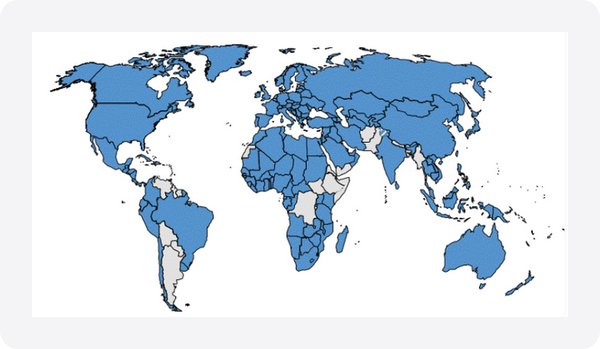
The PCT: A gateway to more than 150 countries
Filing an international application using the PCT system considerably streamlines procedures when protection in several countries is desired.
The principle is simple: A single application, in one language, to a single IP office. This application "reserves" rights in all 158 contracting states. Applicants can later select the countries where they actually wish to obtain granted patents at the end of the "international phase".
During the international phase, an international search report is filed citing prior art documents relevant to the patentability of the invention.
No patents are granted at the end of the international phase. Therefore, it is necessary to "enter the national phases" to transform the international application into multiple national applications after the international phase.
What strategy should you choose to protect an invention in multiple countries?
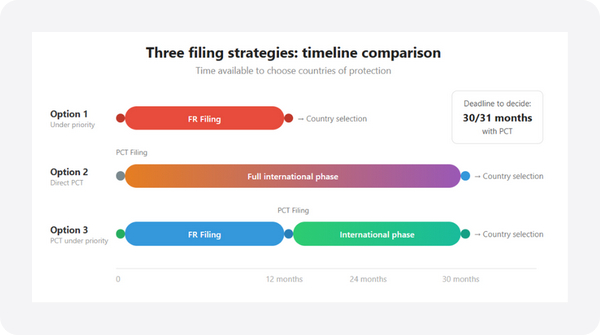
Patent applicants have three options:
1 Direct national route
Applications are filed at the IP office of each target country, without going through the PCT system. This approach is appropriate when markets are certain and fewer in number. The procedure is faster and less expensive overall, but the financial commitment is immediate since official fees must be paid in each country.
2 Direct PCT filing
The PCT application is filed directly as the first application, without prior national filing. The maximum duration of the international phase of 30-31 months is launched from the outset. This option is suitable if you have an international vision from the outset, but with target markets not yet defined.
3 PCT filing under priority
This is the most common strategy. A national filing first occurs (in a specific country or region, such as France or Europe), then a PCT application is filed within the 12-month priority period of the first filing. This approach makes it possible to secure a filing date early enough in the development process and obtain a first overview of patentability at a lower cost, thanks to the search report prepared in the national (or regional) procedure, while also allowing time to consider international expansion and retaining the possibility of making amendments to the application.
The choice depends on several factors: the maturity of the project, the available budget, the clarity of the geographical strategy, and the possible need to obtain a title quickly (for fundraising or negotiation, for example).
Created by Stéphane Roux/Claude AI
Key advantages of choosing the PCT route
- The PCT's first advantage is that it provides time to decide
This is the major advantage of the PCT for decision-makers
A first filing at a national office (e.g., France) launches a time limit (known as the priority period) of 12 months to file the same application in other countries. Without the PCT system, this period may be too short for applicants if the main markets and/or partners have not yet been identified.
With the PCT, however, this period is increased to 30-31 months, providing an additional 18-19 months to refine the strategy, identify target markets, find partners or investors, observe the competition, and move forward with product development.
In other words, the PCT keeps all doors open without premature commitment.
- The PCT's second advantage is that major expenses are deferred
Protecting an invention internationally is expensive since you must pay official fees, translation costs and procedural costs in each country.
In the case of a PCT international application, not all fees become due at the same time, allowing costs to be spread over several years and deferring the most important expenses.
Filing a PCT application under the system is relatively cost-effective: in the range of 4,000 to 6,000 euros (excluding the costs of drafting the patent application). The significant expenses occur later, during the "national phase entries", ie, when the procedures are launched in each designated country. At this stage, national fees must be paid, patent application documents translated, and local correspondents must be appointed. The bill can reach 3,000 to 15,000 euros per country to obtain a patent in each of the chosen countries.
The PCT system allows for the deferral of these major investments from 18 to 19 months. If in the meantime the invention loses its commercial interest or if the strategy changes, it is possible to abandon some countries – or all of them – without incurring unnecessary costs.
For an SME or a start-up, this flexibility in cash management is invaluable.
- A key decision-making tool: the international search report
During the international phase, a specialised office carries out a prior art search to identify close prior inventions and provide an initial opinion on the chances of obtaining a patent.
This international search report is a valuable tool. It allows for an assessment of the strength of the application before committing large national phase budgets. If the report reveals major obstacles, it is possible to amend the claims or decide not to proceed with the patent application, with full knowledge of the facts.
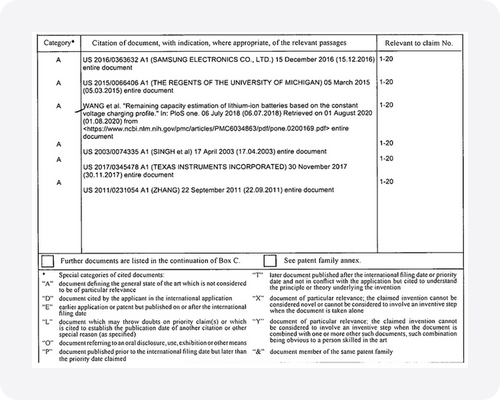
Example of an international report referring to prior art documents.
- The chance to anticipate objections
Another benefit of the PCT system is that it offers options to strengthen an application prior to entry into the national phase.
With the PCT Direct route, it is possible to respond to the objections in the search report of the request for priority as early as the international phase. The arguments and amendments are then transmitted to the examiner at the international phase stage, which can allow the procedure to advance and have a faster grant in the national phases.
In addition, the international search report, which is communicated during the international phase, is accompanied by a notice of patentability in which the examiner may accept the patentability of the international application, or more often mention objections to its grant.
Informal comments may be made on these objections. These observations are recorded in the patent application file and communicated to the national offices during the national phase. They are "informal" because they do not amend the international application and are not considered by the examiner who prepared the international search report.
In addition, the possibility exists to request an international preliminary examination. This is an opportunity to obtain a second opinion after amending the international application in response to the international search report, and to enter the national phase with a stronger filing. However, this procedure does not always give good results and is only recommended in special cases.
These options are not mandatory, but they can be useful depending on the situation.
In summary
The PCT is not a worldwide patent. It is a strategic management tool that brings three concrete benefits: time to refine the strategy, a postponement of major expenses, and reliable information on the chances of success.
The content of this article is intended to provide a general guide to the subject matter. Specialist advice should be sought about your specific circumstances.
[View Source]