

Introduction
On 18 June 2026, the Honourable Minister of Finance and Coordinating Minister of the Economy, pursuant to the powers conferred under the Nigeria Tax Act, 20251 (the “NTA”) and the Nigeria Tax Administration Act, 20252 (the “NTAA”), issued the General Transition Guidelines for the Tax Acts 2025 (the “Guidelines”). The Guidelines set out the framework for the transition from the repealed tax legislation to the new tax regime introduced by the Tax Acts 2025.3
Specifically, the Guidelines provide rules governing the treatment of transactions, accounting periods, tax incentives, disputes, and compliance obligations arising around the commencement of the new tax laws. They apply to tax returns due from 1 January 2026 and are binding on all relevant tax authorities, with the objective of promoting a coordinated and consistent approach to implementation across Nigeria’s tax system.
The Guidelines address several critical areas of transition, each carrying direct implications for tax compliance, financial planning, and transaction structuring. We discuss some of these below.
Key Provisions of the Guidelines
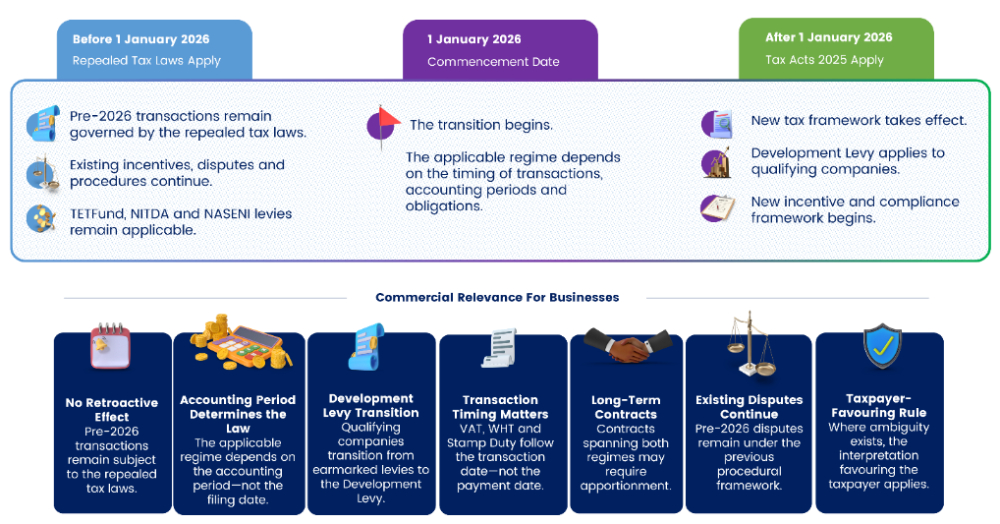
(a) No Retroactive Application
The Guidelines confirm that the Tax Acts 2025 apply prospectively from 1 January 2026 (the “Commencement Date”).4 Transactions, supplies, disposals, and tax liabilities occurring before the Commencement Date continue to be governed by the repealed legislation.5
Additionally, penalties, interest, and administrative procedures are determined by the law in force at the time the liability arose.6 The new tax laws will therefore not apply retrospectively to pre-commencement transactions or defaults.
This provides clarity with respect to ongoing audits, investigations, assessments, objections, and disputes relating to pre-commencement periods and significantly reduces concerns around retrospective application of the new legislation.
(b) Filing Obligations and Accounting Periods
The Guidelines distinguish between accounting periods ending before and after the Commencement Date. For companies, accounting periods ending before 1 January 2026 will continue to be assessed under the repealed laws even where filing and payment obligations fall due after the Commencement Date.7 Conversely, accounting periods ending on or after 1 January 2026 are subject to the new regime.
Businesses may need to assess the impact of their accounting periods, as this may impact on the applicable tax rates, thresholds, reliefs, incentives, and compliance requirements.
(c) Transition for Earmarked Taxes and Development Levy
The Guidelines confirm that earmarked taxes – namely – the Tertiary Education Trust Fund(“TETFUND”) levy, the National Information Technology Development Agency (“NITDA”) Levy, and the National Agency for Science and Engineering Infrastructure (“NASENI”) Levy will no longer apply to accounting Periods ending after the Commencement Date. Instead, qualifying companies8 will be subject to the Development Levy under the new regime.9
However, pre-commencement liabilities under the earmarked taxes remain payable.
(d) Transaction Taxes
The Guidelines also provide clarity on the transitional treatment of transaction taxes such as Withholding Tax (“WHT”), Value Added Tax (“VAT”), and stamp duties. The determining factor is the period in which the underlying transaction occurred, rather than when payment is ultimately made.10
Accordingly, goods supplied or services rendered on or before 31 December 2025 will continue to be subject to the repealed tax laws even where payment is received after the commencement of the new regime. Conversely, transactions occurring on or after 1 January 2026 will be subject to the new tax framework. An exception applies, however, where payment was made in advance before the Commencement Date — in which case the repealed laws will continue to govern the transaction.
This clarification is particularly relevant for businesses with outstanding invoices, deferred payment arrangements, milestone-based contracts, and long-term service agreements, as it provides certainty on the applicable transaction tax treatment during the transition period and helps mitigate the risk of disputes arising from timing differences between performance and payment.
(e) Transitional Transactions Spanning Two Regimes
The Guidelines adopt an apportionment approach for contracts entered before the Commencement Date but executed (in whole or in part) after it.11 The new Acts apply only to the portion of the contract executed after 1 January 2026. Sums received before commencement are taxed under the repealed law; sums received after commencement are taxed under the new Acts.
This is particularly relevant for businesses with long-term contracts, phased projects, milestonebased arrangements, and ongoing service agreements, as such arrangements may be treated partly under the old tax laws and partly under the new regime, which could affect pricing, invoicing, and tax obligations.
(f) Incentives, Exemptions, and Reliefs
Existing tax incentives granted under the repealed laws are preserved until their scheduled expiration.12 However, pending and new applications will be considered under the new framework13, specifically the Economic Development Tax Incentive regime provided in the NTA.14
(g) Disputes and Appeals
Objections and appeals filed before 1 January 2026 will continue under the procedural rules of the repealed legislation.15 Proceedings initiated after commencement are governed by the new procedures, regardless of the assessment year in dispute.16
For taxpayers, this approach promotes continuity and minimizes disruption to ongoing proceedings while ensuring a smooth transition to the procedural framework established under the NTAA.
(h) Conflict Resolution – Taxpayer Favouring Rule
The Guidelines provide that where inconsistencies arise within the new tax framework, such inconsistencies are to be resolved in favour of the taxpayer.17 This provides taxpayers with a useful interpretive tool where ambiguities arise under the new regime.18
Practical Recommendations for Businesses Going Forward
In light of the Guidelines, businesses should consider taking the following practical steps:
- Review accounting periods and filing obligations: Taxpayers should assess whether their accounting periods fall under the old or new regime and ensure that returns are filed using the appropriate forms and procedures.
- Assess existing contracts and ongoing projects: For contracts entered before 1 January 2026 but with continuing obligations or payments due after that date, taxpayers should apply the apportionment approach to determine the correct tax treatment for each portion.
- Revisit existing incentives and pending applications: Businesses benefiting from existing incentives should note their preserved status, whilst those with pending or contemplated applications should assess eligibility under the new Economic Development Tax Incentive framework.
- Review the tax treatment of outstanding transactions and deferred payments: Given that the applicable tax treatment depends on when the underlying transaction occurred, rather than when payment is made, the treatment of existing contracts, outstanding invoices, and deferred payment arrangements will be determined by the timing of the underlying supply or service for WHT, VAT, and stamp duty purposes.
Conclusion
Prior to the issuance of the Guidelines, the NRS had directed that the Rev360 platform19 be configured to administer filings for the 2026 year of assessment under the new Acts. The Guidelines, which are binding on all relevant tax authorities, clarify, however, that the applicable tax treatment is determined by the relevant basis period, rather than the year of filing. Accordingly, a company with an accounting period ending in December 2025 but filing in 2026 remains subject to the repealed laws, notwithstanding that the Rev360 platform has been configured to operate under the new regime.
The Guidelines provide welcome clarity on several of the key issues arising from the transition to the new tax framework and establish important principles for determining the applicable legal regime during the transitional period. Nevertheless, taxpayers should carefully review their tax positions, compliance processes, contractual arrangements and reporting obligations to ensure that the correct legislative framework is applied in each case. Given the complexity of the transitional rules and the potential compliance implications of applying the wrong regime, early engagement with tax advisers and the relevant tax authorities may be prudent to mitigate implementation risks and ensure a smooth transition to the new tax landscape.
Footnotes
1 Section 200 (2)(c) of the NTA.
2 Section 144 of the NTAA.
3 The Tax Acts 2025 comprise the Nigeria Tax Act, 2025, the Nigeria Tax Administration Act, 2025, the Nigeria Revenue Service (Establishment) Act, 2025, and the Joint Revenue Board (Establishment) Act, 2025.
4 Paragraph 5 (1) of the Guidelines.
5 Paragraph 10 (1) of the Guidelines.
6 Paragraphs 5 (2) (3) and 10 (2) of the Guidelines.
7 Paragraph 10.1.2 (1) of the Guidelines.
8 The companies subject to the development levy are companies with an annual gross turnover of ₦100 million or more and total fixed assets exceeding ₦250 million.
9 Paragraph 10.1.2 (2) of the Guidelines.
10 Paragraph 10.2.1 of the Guidelines.
11 Paragraph 10.2.2 of the Guidelines.
12 Paragraph 8 (1) of the Guidelines.
13 Paragraph 8 (2) of the Guidelines.
14 See the Tenth Schedule to the NTA.
15 Paragraph 7 (1) of the Guidelines.
16 Paragraph 7 (2) of the Guidelines.
17 Paragraph 14 (3) of the Guidelines.
18 It should however be noted that where there are identified inconsistencies not addressed by the Guidelines, such an inconsistency should be referred to the relevant tax authority for resolution, (Paragraph 15 (1) of the Guidelines).
19 Nigeria Revenue Service’s integrated digital tax administration platform used for taxpayer registration, filing, reporting, and compliance management.
The content of this article is intended to provide a general guide to the subject matter. Specialist advice should be sought about your specific circumstances.
[View Source]
