

- within Energy and Natural Resources topic(s)
- within Energy and Natural Resources topic(s)
- with readers working within the Property industries
FOREWORD
Nigeria's petroleum landscape witnessed a slew of regulatory reforms and private sector commercial realignments in 2025. The year was marked by increased policy and investment activities across the upstream, midstream, and downstream segments. Notably, indigenous players assumed increased control over upstream assets, while international oil companies recalibrated their portfolios in response to evolving regulatory and market dynamics. The year also featured a pronounced shift in investments in natural gas and deep offshore projects, driven largely by fiscal incentives introduced in 2024 through executive orders.
Increased participation by indigenous operators and targeted investment incentives should drive significant investment into the upstream. However, the trajectory of the sector in 2026 will be measured increased hydrocarbon production and the progress or otherwise of the critical gas infrastructure projects currently under development.
In this annual roundup of The Conduit, which we launched as our monthly newsletter in 2025 to track developments across the sector, we consolidate our insights on the sector into a comprehensive review. We discuss regulatory developments, notable transactions and projects across the hydrocarbon value chain, and the key challenges that constrained performance during the year. We conclude with an assessment of the market trends that are likely to shape the sector in 2026.
We hope that this publication provides context, clarity and insights for investors, operators and policymakers engaging with Nigeria's oil and gas landscape.
1. PRODUCTION AND PRICING TRENDS
1.1 2025 Hydrocarbon Production Data
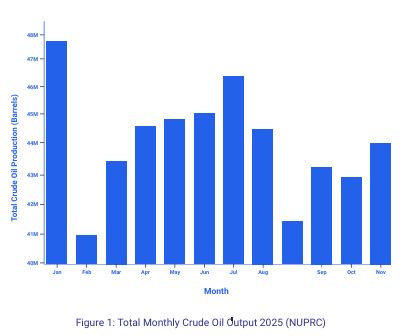
The year 2025 was characterized by volatility in upstream output, with production figures oscillating in response to operational challenges.
Crude production commenced with a strong output of approximately 47.7 million barrels in January but experienced a sharp decline to 41 million barrels in February. Production stabilized mid-year, peaking in July at 46.7 million barrels, before dipping again in September to 41.7 million barrels and rebounding to 44.1 million barrels by December.1 According to the OPEC Monthly Oil Market Report, Nigeria’s crude oil production averaged 1.5 mmbpd in December 2025 based on secondary sources, achieving Nigeria’s OPEC quota of 1.5 mmbpd.2
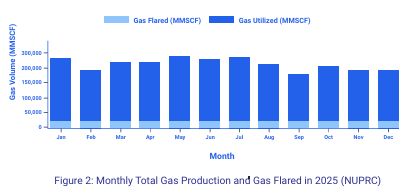
Gas production mirrored the volatility observed in the oil sector. According to NUPRC’s gas production data, total gas production for the period of January to October 2025 stood at approximately 2.71 tcf. Production peaked in July at 250.8 bscf but recorded a significant contraction in September to 198.3 bcf.3 With respect to gas flaring, the gas sector maintained a high gas utilization rate, averaging 92.4% for the year. October data specifically showed a 92.7% utilization rate. However, flaring persists in spite of the apparently high utilisation. In September 2025, the flare rate spiked to 9.05% (17.9 bsf flared), before moderating to 7.55% in October. The 9% flare rate in September represents a material environmental liability and suggests potential operational inefficiencies that could attract regulatory sanctions.
Despite these production challenges, the domestic economy showed resilience, with inflation moderating to 15.5% in December from 20.1% in August, partly attributed to a steadier Naira and falling local fuel prices.4
1.2 PMS Pricing Trends
According to data provided by the NBS5 the year commenced with high fuel retail costs, as the average price in January 2025 stood at N1,258.34, representing a substantial 88.29% year-on-year increase from January 2024. This upward trend persisted, with prices reaching an average of N1,261.65 in March 2025, marking an 81.07% increase compared to the corresponding period in the previous year. These figures suggest that the market was still grappling with the aftershocks of price adjustments witnessed in the prior year.
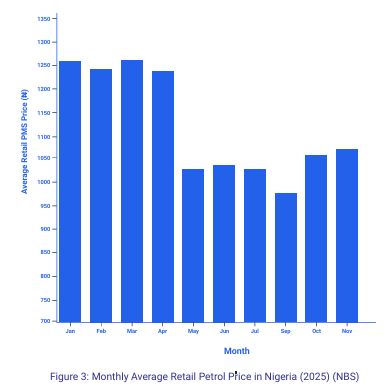
A pivotal shift occurred in the second quarter of 2025. While April 2025 maintained a high average of N1,239.33, May 2025 witnessed a significant downward adjustment, dropping by 17.07% month on month to an average price of N1,027.76. By June 2025, prices stabilized with a marginal 0.96% increase to N1,037.66.
The second half of the year demonstrated relative stability compared to the first. In July 2025, the price decreased by 1.22% to N1,024.99. Notably, data from November 2025 highlights a reversal in the year on-year inflationary trend; the average price of N1,061.35 represented an 12.59% decrease compared to the value recorded in November 2024, which was N1,214.17. This indicates that while fuel prices remain high relative to historical data, the acute spike experienced in late 2024 had begun to recede by late 2025.
2. REGULATORY & POLICY DEVELOPMENTS
2.1 Upstream
This section provides an overview of various regulatory activities initiated by the Nigerian Upstream Petroleum Regulatory Commission (NUPRC) and consequent compliance requirements for the relevant stake holders.
Regulatory Instruments
NUPRC issued a number of regulations in 2025, each of which are described below:
- The Nigerian Upstream Petroleum (Commercial) Regulations, 2025, which regulates commercial activities in the oil and gas sector, focusing on Field Development Plans and annual work programmes. It applies to all upstream licences and leases, and is geared towards ensuring that economic viability standards are met.
- The Upstream Petroleum Fees and Rents (Temporary) Regulations, 2025, which establishes a temporary fiscal framework for fees and rents applicable to upstream petroleum licences, leases, and operational permits.
- The Nigerian Upstream Advance Cargo Declaration Regulations, 2024, which creates a transparent export regime to prevent crude oil theft, illegal top ping, and under-declaration. It creates a framework for exporters to submit a declaration and obtain a unique identification number (UIN) for each vessel. To operationalize the regulation, the NUPRC issued the Guidelines for the Operationalisation of Advance Cargo Declaration Regulations, 2025, which outlines procedures for obtaining the export permits, vessel clearances and the UINs.6
- Acreage Management and Petroleum (Drilling and Production) Regulations, 2024, which provides the framework for the allocation, administration, and management of upstream petroleum licences and leases under the PIA. Additionally, the regulations provide the framework for licence or lease holders to develop renewable energy or provide carbon capture and storage services within their licence and lease areas.7
- Nigerian Upstream Petroleum (Assignment of Interest) Regulations, 2024, which provides a structured legal procedure for the transfer of inter ests and the creation or enforcement of security within the upstream sector. The regulations also outline the procedure and requirements for obtaining the consent of the Minister or approval of the NUPRC as applicable.
- Upstream Petroleum Environmental Remediation Regulations, 2024, which was issued to support the establishment of the Environmental Remediation Fund as a dedicated source of funding for the rehabilitation and management of negative environmental impacts resulting from upstream operations.
- Upstream Petroleum Safety Regulations, 2024, which apply to upstream licensees and lessees and companies providing services to licensees or lessees under a licence or permit issued by the NUPRC. It introduces key compliance obligations for operators such as the requirement that pipelines must be designed, constructed, and maintained in accordance with relevant international standards (e.g., ANSI, ASME, NACE).
The 2025 Licensing Bid Round
On December 1, 2025, the NUPRC launched the 2025 Licensing Bid Round Portal and published the 2025 Licensing Round Guideline (the “Licensing Guidelines”) alongside the model contracts for 50 PPLs to be awarded. The licensing round represents the third in a series of bid rounds conducted under the framework of the PIA. According to the Licensing Guidelines, the bidding process follows a two–stage bidding system comprising a Qualification Stage followed by a Bid Stage. The NUPRC evaluates submissions based on the pre–qualification criteria (financial, technical, legal,
2.2 Midstream & Downstream
This section highlights the various regulatory actions and initiatives undertaken by the Nigerian Midstream Downstream Petroleum Regulatory Authority (NMDPRA).
Regulatory Instruments
NMDPRA issued the following regulation regulations and guideline, each of which are described below:
- Midstream and Downstream Petroleum Operations Regulations, 2025, which provides a comprehensive framework for midstream and downstream petroleum operations. It repeals earlier regulations such as the Midstream and Downstream Petroleum Oil and Gas 2025 Review | 2026 Outlook Operations Regulations 2023 and the Midstream Gas Flare Regulations 2023.
- Guidelines For Management of Fugitive Methane and Greenhouse Gases Emissions, which aims to reduce Greenhouse Gas and methane emissions in midstream and downstream petroleum operations. Operators are required to track and reduce emissions from gas flaring, venting, and equipment leaks and maintain a GHG Management Plan.
Establishment of the 2025 Domestic Base Price
In April 2025, the NMDPRA announced the 2025 Domestic Base Price (DBP) set at US$2.13/MMBTU alongside the applicable wholesale price of natural gas for the power, commercial sector, and gas-based industries. Accordingly, the wholesale price of market able natural gas was set at US$2.13/MMBtu for the power sector, US$2.63/ MMBtu for the commercial sector while the floor price for gas-based industries was set at US$0.9/ MMBtu with a ceiling of US$2.13/ MMBtu. The 2025 DBP reflects a reduction from the 2024 DBP which was set at US$2.42/ MMBtu.
The 15% Import Duty on Fuel
In October 2025 President Bola Tinubu approved a 15% import duty on petrol and diesel to protect domestic refineries and curb imports. However, the policy faced backlash from some stakeholders, who warned it would hike pump prices and worsen economic hard ship. The NMDPRA then announced the implementation was no longer in view to prevent hoarding and price escalation. The President deferred the policy to Q1 2026, following a request by the Chairman of the Federal Inland Revenue Service for more consultations.
NMDPRA Licences Africa's First Gas Trading Platform
In June 2025, the NMDPRA in conjunction with the Securities and Exchange Commission issued a licence to JEX Market to establish and operate a Gas Clearing House and Settlement Authorisation Platform which would serve as a commodity exchange platform where natural gas and its derivatives would be traded in Nigeria.8
The gas trading platform which was formally launched on December 1, 20259 is an outcome of the PIA which mandates a formal framework for wholesale gas trading and settlement. The regulatory parameters governing this exchange are delineated within the Gas Trading and Settlement Regulations, 2023. The exchange is designed to generate a credible, market driven Nigeria Gas Price Index that accurately reflects real domestic supply and demand.
2.3 Other Regulatory & Policy Developments
New Leadership for the NUPRC and the NMDPRA
December 2025 saw the appointment of Oritsemeyiwa Amanorisewo Eyesan and Saidu Aliyu Mohammed by the President as the chief executives of the NUPRC and NMDPRA respectively. These appointments follow the resignations of Farouk Ahmed and Gbenga Komolafe who were the inaugural chief executives of the NUPRC and the NMDPRA respectively in 2021. Following these appointments, the President nominated Executive and non-executive commissioners for the two agencies, including Senator Magnus Abe, a former member of the board of NNPC, as chairman of the board of the NUPRC. The President also nominated ‘Gbite Adeniji, a lawyer with over 30 years of experience in energy and natural resources, and the Managing Partner of ENR ADVISORY, as the chairman of the NMDPRA board.
NNPC’s New Senior Management Team and Board
On April 2, 2025, President Bola Tinubu appointed Bashir Bayo Ojulari as the new Group Chief Executive Officer (GCEO) and Ahmadu Musa Kida as the chairman of a reconstituted 11-member board of NNPC Limited. This follows the removal of Mele Kolo Kyari as the GCEO and Chief Pius Akinyelure as the board chairman.10 Prior to his appointment, Bayo served as the Executive Vice President and Chief Operating Officer of Renaissance Africa Energy Company.
Subsequently, the NNPC Limited announced a new 8-man senior management team headed by the GCEO, Bayo Ojulari, and includes Rowland Ewubare as Group Chief Operating Officer, Adedapo Segun as Group Chief Financial Officer, Olalekan Ogunleye as Executive Vice President Gas, Power & New Energy, and Adesua Dozie as Company Secretary & Chief Legal Officer.11
FG Legacy Gas Debts Offset with Royalty Credits
In a significant fiscal intervention, the Federal Government of Nigeria authorized a mechanism to address the liquidity crisis plaguing the domestic gas sector. In December 2025, President Bola Tinubu approved the settlement of N185 billion in legacy debts owed to natural gas producers through a royalty-offset arrangement.12 Under the royalty credit mechanism, the legacy debts owed to gas producers are offset against their royalty liabilities. This creates a closed-loop settlement system, effectively bypassing the bureaucratic bottle necks often associated with direct cash appropriations for debt servicing.
The PIA Amendment Bill 2021
Amendments were proposed by the executive branch of government to the PIA following the listing of the PIA Amendment Bill (the “Bill”) at the Nigerian House of Representatives and the Senate in 2025. The Bill proposes replacing NNPC Limited with the NUPRC as the concessionaire in all subsisting PSCs, profit sharing contracts, and risk service contracts. The Bill also proposes a new framework for the governance of integrated operations by the NUPRC and the NMDPRA.
The New Tax Laws
On 26 June 2025, President Bola Ahmed Tinubu signed four tax reform bills into law. These laws are the Nigeria Tax Act (NTA), the Nigeria Tax Administration Act, the Nigeria Revenue Service Act and the Joint Revenue Board Act. The NTA repeals the Petroleum Profits Tax Act and the Deep Offshore and Inland Basin Production Sharing Contracts Act, and amends the PIA, effectively making the NTA the central legislation for petroleum sector's taxes, levies, and royalties with effect from January 1, 2026.13 Key proposals by the NTA relevant to petroleum operations include the shift to cash-based royalties, the economic development tax credit, consolidation of incentives for deep offshore operations and gas investments, and unified tax administration under the Nigerian Revenue Service.
The NCDMB Compliance Certificate
The NCDMB unveiled plans to mandate an NCDF Compliance Certificate for all operators starting 1 January 2026. This certificate will be a prerequisite for obtaining key permits and approvals, ensuring that companies comply with the 1% remittance obligations to the NCDF pursuant to Section 104 of the Nigerian Oil and Gas Industry Content Development Act.
Issuance of Flare Gas Permits under the NGFCP
On 12 December 2025, the NUPRC issued Permits to Access Flare Gas to 28 successful companies under the Nigerian Gas Flare Commercialisation Programme (NGFCP), a framework designed under the Petroleum Industry Act to enhance the commercial viability of natural gas in Nigeria.14 The 28 firms that received the permits were those that had fully executed the required suite of commercial agreements, including connection agreements, milestone development agreements, and gas sales agreements.
2.4 Host Community Obligations
Growth of the Host Community Development Trust Fund
The NUPRC reported that the Host Community Development Trust (HCDT) Fund grew to N373 billion as of October 13, 2025.15 According to the NUPRC, at least 536 community projects were initiated across various regions. A major highlight was the Obagi Pilot Phase in Rivers State, operated by TotalEnergies, which saw the delivery of over ten projects, including a remodelled cottage hospital, a diagnostic centre, a water bottling factory, and fully furnished classroom blocks. The NUPRC further stated that these projects were developed based on the specific needs and priorities defined by the communities, in accordance with the PIA.
Court Upheld Host Community Liability Provisions
In December 2025, the legal framework governing host communities was further clarified when the Federal High Court in Warri dismissed a suit challenging the constitutionality of the host community liability provisions of the PIA.16 The court upheld sections of the PIA that impose liability on host communities for acts of vandalism and sabotage affecting petroleum infrastructure within their territories. In its judgment, the court ruled that the National Assembly acted within its legislative competence and that the plaintiff failed to prove the provisions on liability of host communities in the PIA were unconstitutional or discriminatory.
To read this Newsletter in full, please click here.
Footnotes
- https://www.nuprc.gov.ng/wp-content/uploads/2026/01/JAN-TO-DEC-2025-PRODUCTION-002.pdf
- https://publications.opec.org/momr/FileDownload/150/momr/327
- https://www.nuprc.gov.ng/wp-content/uploads/2025/11/2025-Monthly-Gas-Data-for-Publication_October-2025.pdf
- https://www.cbn.gov.ng/rates/inflrates.html
- https://microdata.nigerianstat.gov.ng/index.php/catalog/157/related-materials
- Paragraph 3 of the Advance Cargo Guidelines
- Section 37(2), Acreage Regulations
- https://guardian.ng/news/nmdpra-awards-gas-trading-clearing-and-settlement-licenses-to-jex-markets/
- https://africa.businessinsider.com/local/markets/nigeria-digitises-gas-trading-in-bid-to-attract-top-investors/d8701nr
- https://www.premiumtimesng.com/news/top-news/785190-breaking-tinubu-sacks-kyari-as-nnpc-chief-removes-board-members-appoints-replacements.html?tztc=1
- https://nnpcgroup.com/insights/nnpc-ltd-announces-new-senior-management-team
- https://www.channelstv.com/2025/12/09/fg-begins-%E2%82%A6185bn-gas-legacy-debt-repayment/
- Section 197, NTA
- https://www.nuprc.gov.ng/nuprc-issues-permit-to-28-firms-for-flare-gas-utilisation-projects-2bn-investments-i00000-jobs/
- https://www.nuprc.gov.ng/host-community-fund-rises-to-n373bn-as-nuprc-oversees-536-projects/
- https://thenationonlineng.net/court-upholds-pia-host-community-liability-provisions/
The content of this article is intended to provide a general guide to the subject matter. Specialist advice should be sought about your specific circumstances.


