

In this edition, we conclude our analysis of the 16 Guides published by the Spanish Artificial Intelligence Supervisory Agency (AESIA) to support compliance with the European Artificial Intelligence Act (AI Act).
On this occasion we take a look at the key aspects of the final two Guides in the series:
Guide 15: "Technical documentation"
Guide 15, entitled "Technical documentation", -the last of the second set of Specialised Technical Guides,- is aimed exclusively at AI system providers, as the parties ultimately responsible for preparing the AI system’s technical documentation.
The technical documentation itself is composed of all the information necessary to assess whether the AI system complies with the relevant requirements and to enable post-market monitoring. This information must include: the system’s general characteristics, capabilities and limitations and the algorithms, training, testing and validation data and processes used, together with documentation on the risk management system, drawn up in a clear and comprehensive manner.
The Guide summarises, in diagram form, the technical documentation requirements imposed by the AI Act:
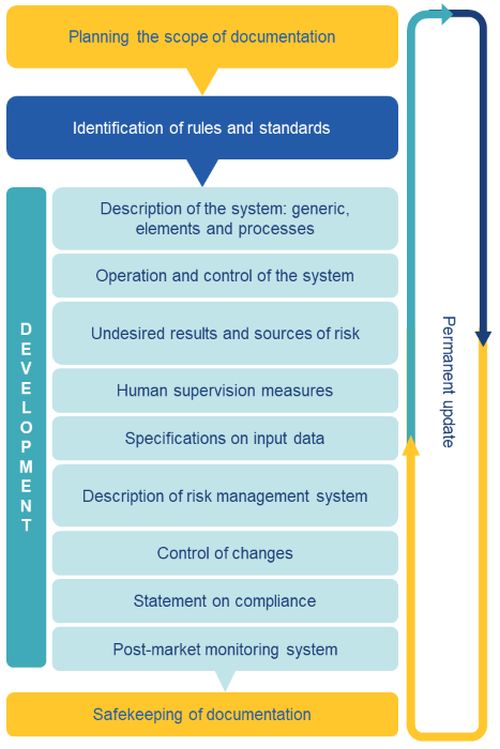
Illustration. '‘Technical documentation’. Source: Guide no. 15.
The following must be taken into account throughout the technical documentation process:
- The technical documentation must be complete before the AI system is placed on the market and put into service.
- To ensure the documentation remains up to date throughout the AI system’s lifecycle, the provider must take measures such as: within the AI system’s management processes, establishing a procedure for tracking changes that triggers updates of the documentation; establishing a chain of responsibility (or appointing a person responsible for managing changes to the system who is tasked with updating the documentation accordingly); or establishing, defining and scaling a document management system or equivalent technical solution, enabling the provider to ensure custody and updating of the documentation.
- The documentation must be retained for a period of 10 years from the date on which the AI system is placed on the market. The provider must have the technical measures in place to keep this documentation and ensure there is no risk of it being lost.
Thus, to assist AI system providers, the Guide sets out the structure that the technical documentation must follow to comply with the minimum content requirements set out in Annex IV of the AI Act. Among other things, it must include the following: a general description of the AI system, including the intended purpose (description of the use for which it has been designed, context of use of the system, and terms and conditions of use), the name of the provider and the version of the system; the manner in which the AI system interacts or can be used to interact with hardware or software, as well as with other AI systems, which are not part of the AI system itself; or general-purpose user guides intended for the deployer and installation instructions.
Guide 16: "Checklist User Manual"
Guide 16, entitled "Checklist user manual", is intended to enable companies to conduct a self-assessment on their compliance with all the requirements set out in the AI Act for high-risk AI systems and to design a plan to adapt their systems to the requirements established in it.
This tool is an Excel document composed of nine tabs, of which: five are informative tabs containing instructions for use and contextual information, and four are operational tabs requiring information to be entered.
The five informative tabs are:
- “Cover”: containing a mandatory confidentiality reminder.
- “Introduction”: providing a summary of steps and what the tool can do.
- "AI Act Article": identifying the sections of the article of the AI Act regarding which the organisation will conduct a self-assessment.
- "Guide Measures (GM)": setting out the detailed explanatory measures as contained in each one of the guides. In addition, a set of guidance questions is included per measure with the aim of providing context so that the answers to the questions can offer an idea of whether or not the system already complies with the measure in question.
- "GM-Section relationship": summarises the potential application of the measures set out in the "Guide Measures" tab to each of the sections of the article.
The four operational tabs are:
- "GM Self-Assessment": this allows the user to identify both the maturity level of the proposed measure’s implementation within the system and the perceived level of difficulty in carrying it out. Once the tab has been completed, an Adaptation Plan is generated. If the company considers that a measure could be applied to an additional section, this may be indicated at the end of the pre-populated rows, with two columns to be completed regarding the perceived level of difficulty and maturity level.
- "Additional Measures (AM)": the assessment included in this tab, together with the following two, consists of information from organisations regarding the measures they themselves propose as possible means of complying with the AI Act; the suitability of those measures is assessed by SEDIA. The company must indicate the measures which, in its experience, enable compliance with sections of the article. To this end, it must add a row per measure, providing a brief description of the measure and the file name.
- "AM-Section Relationship": provides a concise summary of the potential application of the measures reported in the previous tab to each of the sections of the article.
- "AM Self-Assessment": this tab appears automatically, pre-populated with a row for each of the relationships described in the previous tab.
Related links
- 'New AESIA Guidelines to support compliance with the AI Act' (02 February 2026)
- AESIA introductory guides: Guides 1 & 2
- AESIA's Specialised Technical Guides: Guides 3 & 4 | Guides 5 & 6 | Guides 7 & 8 | Guides 9 & 10 | Guides 11 & 12 | Guides 13 & 14
The content of this article is intended to provide a general guide to the subject matter. Specialist advice should be sought about your specific circumstances.
[View Source]
