

The Supreme Court, in Shakuntala & Ors. v. Robert Anthony & Ors. (Civil Appeal arising out of SLP(C) No. 9449 of 2020, judgment dated 30 July 2026), has held that where immovable property is purchased and registered in the joint names of two wives of a common husband, the property vests in the two wives themselves, and Section 33 of the Indian Succession Act, 1925 (“the Act”) which governs succession to the estate of a male intestate survived by a widow and lineal descendants cannot be applied to the entirety of such property merely because the husband had provided the purchase consideration. The Court set aside the concurrent (and mutually inconsistent) findings of the Trial Court, First Appellate Court and the High Court of Chhattisgarh, and worked out the succession afresh by applying Sections 33, 35 and 38 of the Act separately to each wife's share.
Background:
One Mattus Anthony (“MA”) had two wives, Filomina and Shyam Bai. In 1959, MA purchased a parcel of land for a consideration of INR 300 in the joint names of his two wives. Filomina had three children (the plaintiffs), while Shyam Bai had one son, John Anthony, who predeceased her in 1985 leaving behind his widow and four children (defendant Nos. 1 to 5). Filomina died in 1985, MA died intestate in 1991, and Shyam Bai died in 2000. In 2002, defendant Nos. 1 to 5 (the widow and children of John Anthony) sold half of the property, i.e., their understood share, to defendant No. 6. The plaintiffs, contending that the property was joint ancestral property in which they too had a share, challenged the sale as void.
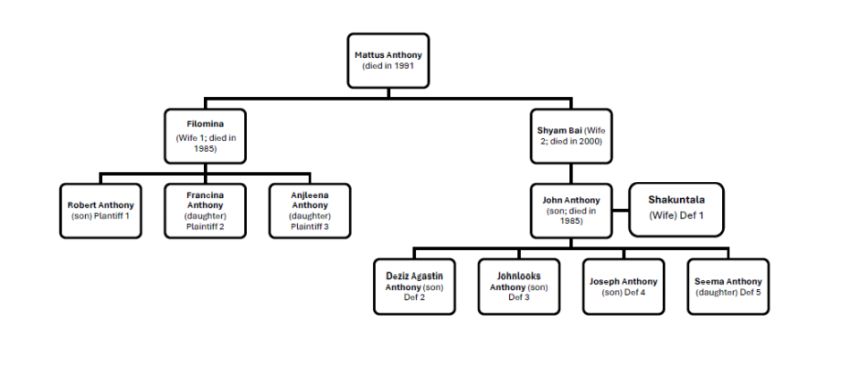
Figure: Family Tree of Mattus Anthony and the parties to the litigation
Family Tree:
The Trial Court decreed the suit, holding the sale deed invalid for want of consent of all co-owners and granting the plaintiffs a one-fourth share. The First Appellate Court reversed this, holding that each wife independently held a half share in the property (since it was purchased in their joint names), that the defendants, as legal heirs of John Anthony, were entitled to Shyam Bai's half, and that the 2002 sale deed was accordingly valid. The High Court, in second appeal, took yet another view: applying Section 33 of the Act on the footing that MA had died intestate leaving behind two widows and lineal descendants, it held that both widows, together, were entitled to one-third of the property, while the plaintiffs – treated as MA's only “lineal descendants” because John Anthony was held not to qualify as such – were entitled to the remaining two-thirds.
Issue Before the Court:
The principal question before the Supreme Court was whether Section 33 of the Act, which applies to the estate of a male who dies intestate, could be applied to property that was purchased in the joint names of MA's two wives, or whether the property had to be treated as belonging to the two wives themselves, with succession to each wife's share being worked out independently.
Key Findings of the Court:
The Court held that Section 33 of the Act, on its plain text, applies only to the property of a deceased male intestate. Since the property in question was purchased and registered in the names of MA's two wives, it was, in law, their property and not MA's, notwithstanding that MA had provided the consideration. The High Court's application of Section 33 to the entire property was accordingly held to be misconceived, since it proceeded on the incorrect premise that the property vested in MA and passed on his death to his widows and lineal descendants.
Having held that the property vested independently in the two wives, the Court worked out succession separately to each half. As Filomina predeceased MA, the Court applied Section 35 of the Act (which gives a surviving husband the same rights over his intestate wife's property as a widow would have over her intestate husband's property). Applying Section 33 through the mechanism of Section 35, MA became entitled to one-third of Filomina's half share, with the remaining two-thirds devolving directly upon her children (the plaintiffs). On MA's own death intestate in 1991, the one-third share he had inherited from Filomina devolved equally upon all four of his children through both wives the three plaintiffs and John Anthony as tenants-in-common, there being no concept of joint family property, as under Hindu law, applicable to succession under the Indian Succession Act.
As regards Shyam Bai's half share (together with the portion she in turn received through MA), the Court held that since Shyam Bai's own son, John Anthony, had predeceased her, the property devolved on her surviving grandchildren (defendant Nos. 2 to 5) under Section 38 of the Act, which governs the case of an intestate survived by grandchildren but no surviving child. On this basis, the defendants' entitlement was confined to Shyam Bai's share (as enlarged by the portion received through MA), and did not extend to any part of Filomina's share, contrary to the High Court's view that the two widows' shares should be pooled together and treated as a single one-third block.
Treatment of Ancillary Contentions:
The Court noted two further contentions that were not seriously pressed by the parties and did not call for detailed adjudication. First, on the question of benami, reliance was placed on Valliammal v. Subramaniam (2004) 7 SCC 233, for the proposition that intention and source of funds are relevant to a benami transaction; however, since it was undisputed that MA had purchased the property in the names of his two wives out of love and affection, no case of benami arose. Second, the validity of MA's second marriage to Shyam Bai was not in dispute between the parties, who were agreed that the controversy was confined to the extent of inheritance rights and not the existence of Shyam Bai's status as MA's widow.
MHCO Comment:
This decision offers useful guidance on succession disputes arising out of property held in the names of multiple wives of a common husband under the Indian Succession Act, 1925. The Court's central holding that property registered in the name of a person is that person's property in the eyes of the law, irrespective of who funded the purchase (absent a proven case of benami) reaffirms settled principles of ownership and cautions against conflating source-of-funds with title. Equally significant is the Court's demonstration of how Sections 33, 35 and 38 of the ISA interact and must be applied sequentially, and separately, wherever succession opens up more than once within the same family (here, on the deaths of Filomina, MA and Shyam Bai in turn), rather than being collapsed into a single, composite application of Section 33 to the family's property as a whole. The decision will be of particular relevance in estate planning and succession litigation involving Christian families with blended households, where property is often held jointly in the names of multiple spouses, and underscores the importance of tracing title and the chain of succession event-by-event rather than treating the ultimate distribution as a single-step exercise.
The content of this article is intended to provide a general guide to the subject matter. Specialist advice should be sought about your specific circumstances.
[View Source]
