

January 2026 – On 13 January 2026, the National Bank of Ukraine (NBU) announced a new package of updates to the existing currency (FX) restrictions that were introduced in February 2022 in response to Russia's full-scale invasion.
The regulatory changes are aimed at further developing the incentive-based FX liberalisation framework gradually implemented by the NBU since 2025, as well as better supporting Ukrainian businesses operating under martial law.
The key amendments entered into force on 14 January 2026 and include:
1. Dividend payments, repayment of "old" loans and other transactions within the "loan limit"
The cornerstone of the new package is the introduction of a so-called "loan limit", a special mechanism enabling Ukrainian residents to carry out certain FX transactions that otherwise remain generally restricted.
Under the new rules, after 1 January 2026, Ukrainian borrowers are permitted to carry out the following transactions when receiving funds via loans from non-residents:
- repayment of "old" loans and borrowings obtained before 20 June 2023;
- payment of dividends abroad in excess of the general dividend caps;
- settlements for the import of goods received before 23 February 2021;
- refunds to non-resident buyers of advance payments made before 23 February 2022 for goods that were not delivered;
- financing of company own foreign branches in excess of the applicable limits.
Crucially, "loan limit" is calculated as the outstanding principal amount of the given external loan. Accordingly, once the principal is repaid, the available limit is reduced. At the same time, repayment of the principal under such a loan is permitted only in an amount reduced by the value of transactions already carried out within the "loan limit".
The following specific features of "loan limits" should also be taken into account:
- all transactions within the loan limit must be processed exclusively through the bank servicing the payments under the relevant loan agreement with the non-resident lender;
- loan limits do not apply to loans involving international financial institutions acting as lenders, guarantors, or sureties.
These reforms mean that Ukrainian companies now have an additional tool for the restructuring of "old" debt, which should help them to attract new financing from foreign creditors.
2. Refunds to individual consumers
Ukrainian sellers and manufacturers are now permitted to refund payments in cases of returned goods or non-delivery, in accordance with the Law of Ukraine "On Consumer Protection", to a consumer's account opened with a foreign bank.
Such refunds are permitted only:
- to an individual consumer account (not a business entity); and
- using the details of the electronic payment instrument originally used to pay for the goods.
3. Additional exceptions to FX settlement deadlines
The NBU has also eased FX supervision with respect to settlement deadlines for certain export transactions. In particular, new exemptions apply to:
- the export of goods under foreign trade contracts where the right of claim has been assigned to the Export Credit Agency (ECA), up to the amount of insurance compensation paid by the ECA to the given exporter;
- the export of insurance services.
These reforms mean that the NBU has aligned the FX regulation of insurance operations with the regime applicable to other financial services not subject to settlement deadlines.
In conclusion, the adopted measures signal a gradual and well-calibrated normalisation of Ukraine's FX regime. The NBU continues to introduce targeted easing measures and regulatory instruments that, on the one hand, support Ukrainian businesses and improve conditions for capital flows, while, on the other hand, preserving the safeguards necessary to maintain macroeconomic and financial stability. This balanced regulatory approach is expected to enhance the financial attractiveness of Ukrainian borrowers, facilitate access to cross-border financing, and strengthen confidence among foreign lenders and investors, thereby laying the groundwork for further FX liberalisation.
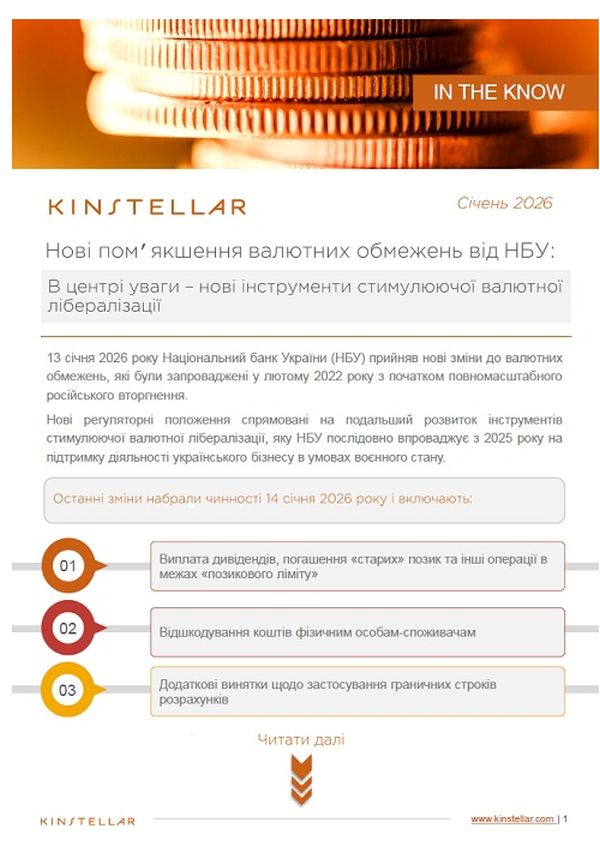
Click on the image below or use this link to read the article in Ukrainian.
The content of this article is intended to provide a general guide to the subject matter. Specialist advice should be sought about your specific circumstances.


