

Indonesia's new Criminal Code ("New Criminal Code") that was passed as law on 2 January 2023, will be effective starting 2 January 2026. The New Criminal Code will revoke the existing criminal code, Law No. 1 of 1946 on the Indonesia Criminal Code. The New Criminal Code is also accompanied by the new criminal procedure code through the Draft Bill on the Criminal Procedure Code ("New Criminal Procedure Code"), which will govern the new procedural steps and rules on criminal investigation, prosecution, rights of the related parties, and other criminal procedural matters. Like the New Criminal Code, the New Criminal Procedure Code will be effective starting 2 January 2026.
The key takeaway of the New Criminal Code is the recognition of criminal liability of corporations, not regulated under the existing criminal code. Corporate crime provisions were regulated under various sectoral laws such as, the anti-corruption, anti-money laundering, data protection, environmental, consumer protection, and manpower laws.
In light of the recognition of the corporate liability under the new criminal law regime, we provide, in this article, an overview of the legal standing and position of corporation, particularly on (i) Corporate Criminal Liability; (ii) Criminal Sanctions for Corporations; (iii) Criminal Procedures for Corporations; and (iv) Transitional Period.
1. Corporate Criminal Liability
Under the New Criminal Code, a corporate crime is defined as criminal action committed by:
- any member of the corporation's management that has a functional role within the structure;
- any person that has a working relationship or any other relationship that allows him/her to act on behalf of the corporation;
- anyone acting in the corporation's interest;
- any individual, within the corporation, who is eligible to order/instruct the crime; or
- controllers or beneficial owners of the corporation.
(the "Corporate Responsible Parties")
Furthermore, a corporation may be held liable if the act:
- falls within the corporation activities as determined in the articles of association or other applicable provisions;
- unlawfully benefits the corporation;
- is accepted as corporation's policy;
- is considered as the corporation's failure to prevent or mitigate violations or ensure legal compliance; and/or
- is allowed to occur by the corporation.
If any of the above conditions are met, the criminal liability shall be imposed on the corporation, with such liability attributed to and borne by the responsible Corporate Parties. (Articles 46 – 49 of the New Criminal Code jo. Article 326 of the New Criminal Procedure Code)
2. Criminal Sanction for Corporations
The New Criminal Code introduces sanctions applicable to corporations. Similar to the imposition of criminal sanctions on individuals, the New Criminal Code applies a mechanism of main and additional criminal sanctions against corporations (Article 118 of the New Criminal Code).
a. Main Criminal Sanction: Generally, the main criminal sanctions in the form of fines are classified into 8 categories, each with the corresponding maximum imposable fine (Article 79 of New Criminal Code). When a criminal act is punishable by imprisonment and is attributed to a corporation, the sanctions shall be converted into a fine, subject to the length of the imprisonment term (Article 121 of New Criminal Code).
For ease of reference, kindly refer to the table below on the applicable sanctions categories for the corporation fines threshold:
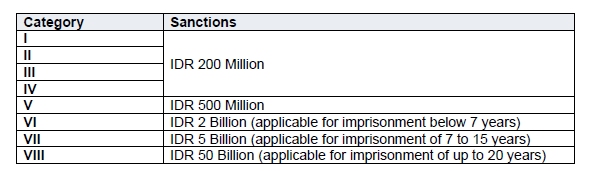
For instance, Article 486 of New Criminal Code stipulates the crime of embezzlement punishable by up to 4 years imprisonment or a category IV fine. In this case, the corporation may become subject to the minimum criminal fine of category IV or the maximum fine of category VI, whichever the court judges deem acceptable.
b. Additional Criminal Sanctions: A court may decide that the corporation be imposed with additional sanctions, particularly if the main criminal sanction is considered insufficient. This sanction is not mandatory and may only be imposed at the discretion of the judges. The additional criminal sanctions for corporations are as follows:
- payment of compensation;
- remedy for the consequences of crimes;
- implementation of obligations which have been neglected;
- fulfilment of customary obligations;
- financing of job training;
- confiscation of goods or profits obtained from the crimes;
- announcement of court decision;
- revocation of certain licenses;
- permanent ban on certain actions;
- the closure of all or part of the corporation business and/or activities;
- suspension of all or part of the corporation's business activities; and
- dissolution of corporations.
(Article 120 (1) of New Criminal Code)
The maximum time limit to meet the demands of additional criminal sanctions of license revocation, closure, or suspension is 2 years. If the corporation fails to comply with the penalties under the additional sanctions (letters (a) – (e)), the corporation's assets and revenue may be seized by the prosecutor (Article 120 (2) and (3) of New Criminal Code).
To view the full article please click here.
The content of this article is intended to provide a general guide to the subject matter. Specialist advice should be sought about your specific circumstances.


