

I. Introduction
On May 30, 2025, the Act on Contracts for Security Interest by Assignment and Retention of Title (the "Act") was passed. The Act was promulgated on June 6, 2025 and will take effect within two years and six months from the said date of promulgation or on December 6, 2027. The Act will apply to all agreements for the assignment of security interests and retention of title, whether concluded before or after the date of its enforcement. Prior to the Act, Japan had no law governing the assignment of security interests or the retention of title. Such arrangements relied solely on court precedents and industry practice. The Act will be the first law to clarify and regulate such agreements.
II. Background of the Act
The need to enact rules concerning the assignment of security interests and the retention of title has long been the subject of debate. The reasons for enacting the Act are as follows:
- To codify and clarify the rules for the assignment of security interests and retention of title;
- To promote loans that do not rely on real estate collateral or personal guarantees; and
- To improve the evaluation of Japan's collateral laws by the World Bank.
III. Overview of the Act
The key provisions of the Act are as follows:
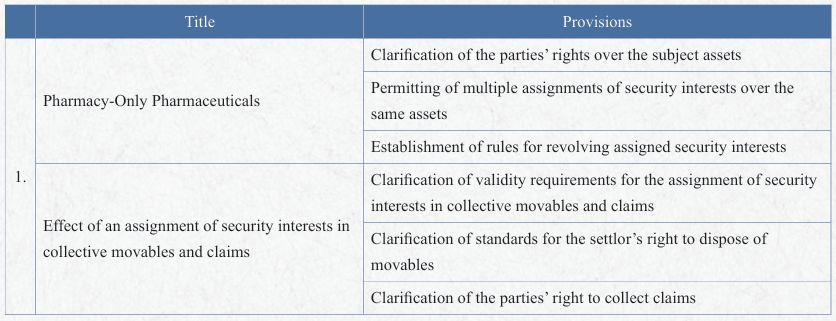
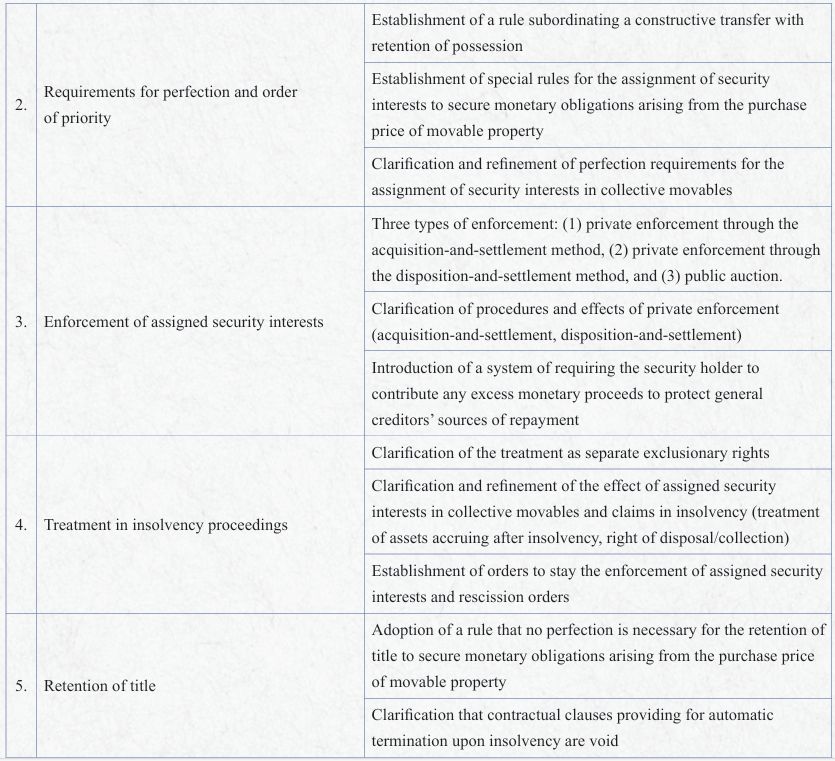
IV. Main Provisions of the Act
- Effect of assigned security interests
- Parties' rights
The Act provides that a security holder may not transfer the subject assets except through the enforcement procedure for assigned security interests (Article 5). However, the Act permits the settlor to validly transfer the subject assets to a third party (Article 6).
- Multiple security interests (subsequent security interests)
The Act explicitly permits the establishment of multiple assigned security interests where the subject assets retain the capacity to provide further security after the creation of the initial security (Article 7), taking into account the existence of demand for additional financing. The Act also establishes rules for lower-ranking assigned security interests, including registration and private enforcement.
- Effect of assigned security interests in collective movables
The Act states that an agreement assigning security interests in collective movables is valid if it specifies the following matters (Article 40):
- The types of movables subject to the security assignment; and
- Other matters that specify the movables subject to the security assignment, such as the location
Location is mentioned as an example of what needs to be specified but it is not an essential element for validity per se. For a security assignment agreement over collective movables to be valid, it must allow new movables to be added to the subject pool of movables in the future.
- Perfection and order of priority of assigned security interests
- General rule: priority for earlier rights in case of conflicting security rights
When multiple security rights have been established over the same assets, their priority must be determined. The Act has codified the rule that when there are conflicting assigned security rights, priority is determined by the order in which the requirements for perfection have been satisfied (Articles 32, 49, 55, etc.). The method of satisfying the perfection requirements for a security assignment involving movables is "delivery," and the Act now considers a constructive transfer with retention of possession as a form of delivery.
- Exception: subordination of constructive transfers with
retention of possession
- Provisions of the Act
A constructive transfer with retention of possession is one method of satisfying the perfection
requirements for a security assignment involving movables, but this form of delivery is conceptual because the existence of the security assignment is not patently evident. Since a constructive transfer with retention of possession is not clearly obvious to third parties, its adequacy as a method for satisfying the perfection requirements has been criticized.
Accordingly, although the general rule is that priority among competing assigned security rights is determined by the order in which they have satisfied the perfection requirements, the Act has adopted an exception where an assigned security right that was perfected by a constructive transfer with retention of possession will be subordinate to other consensual security rights (including a security transfer registration) that have been perfected other than by a constructive transfer with retention of possession (Article 36(1)). In other words, under this subordination rule of a constructive transfer with retention of possession, even if the perfection requirements were satisfied by such constructive transfer with retention of possession at an earlier date, if later assigned security rights are perfected by a method other than a constructive transfer with retention of possession, the later assigned security rights will take priority over the earlier assigned security right that was perfected by a constructive transfer with retention of possession.
The relationship between the methods of perfection for assigned security rights and priority can be summarized as follows:
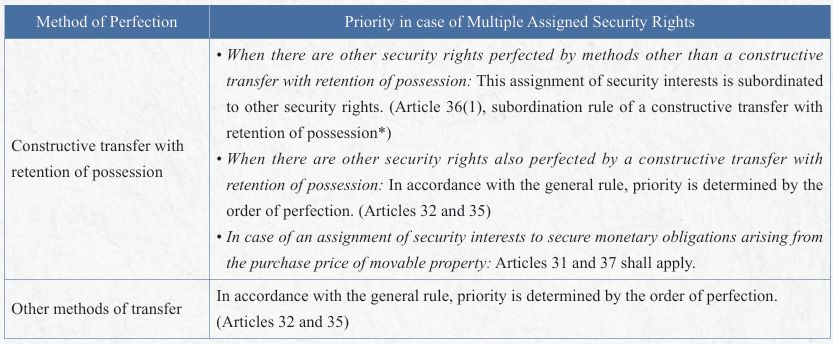
Note: The exception applies to movables where the method of perfection is registration/entry (e.g., registered automobiles) (Article 46).
- Practical impact and considerations
Prior to the Act, it was possible to preserve priority for assigned security rights by a constructive transfer with retention of possession. Under the Act's subordination rule concerning a constructive transfer with retention of possession, such constructive transfer will not always be given such priority, so the practical impact on security practices will be significant. Nevertheless, a constructive transfer with retention of possession retains certain advantages, such as convenience (no fee) and confidentiality, compared with security transfer registration, so parties may still choose such constructive transfer with retention of possession depending on the circumstances. Also, a constructive transfer with retention of possession retains the following benefits despite the subordination rule under the Act:
- Ability to assert rights against third parties (e.g., transferees of the subject assets or trustees in case of bankruptcy of the settlor);
- Priority over other competing security rights also perfected by a constructive transfer with retention of possession; and
- For an assignment of security interests to secure >monetary obligations arising from the purchase price of movable property (Articles 31 and 37), priority over subsequent security rights.
- Enforcement procedures
- Provisions of the Act
- Movables
- Provisions of the Act
The Act allows private enforcement (acquisition- and-settlement method, disposition-and-settlement method) and public auction as enforcement methods for assigned security interests in movables. The Act prescribes concrete procedures for private enforcement: specifically, after non-performance of the secured claim, the security holder must notify the settlor of either an acquisition-and-settlement or disposition-and-settlement transfer; from the time of that settlement notice, two weeks must pass before enforcement takes effect (such as acquisition of ownership of the subject assets or extinguishment of the secured claim) (Articles 60(1) and 61(1)). If prior to that two-week period the security holder (or a third party who received a disposition-settlement transfer) has taken delivery of the subject assets, the enforcement will take effect at such time of very. Key points of this enforcement process are that the Act requires a settlement notice and that, as a general rule, enforcement shall not take effect until the lapse of a uniform two-week period from the settlement notice.
- Collective movables
- Rules for enforcement
To enforce assigned security interests in collective movables, the security holder must notify the settlor of the enforcement (Article 66(1)). That notice delineates the range of collective movables subject to the security, and movables that newly join the specified range of collective movables after the notice are not covered by the assigned security interests in collective movables (Article 66(2)). Also, the notice affects the settlor's right of disposal; after the notice, the settlor loses the right to dispose of the movables within the specified range of collective movables (Article 66(3)). These rules determine which movables are subject to enforcement.
- Obligation to contribute monetary excess
If the security holder of assigned security interests in collective movables enforces the security and insolvency proceedings commence with respect to the settlor within a certain period after such enforcement, and the recovery amount from the enforcement exceeds a certain threshold, the Act newly requires that the excess be contributed to the trustees in bankruptcy of the debtor (Article 71). The rationale for this system of contribution is that the wide scope of assigned security interests in collective movables may markedly reduce the assets available for the repayment of general creditors, and because maintenance or enhancement of the value of the subject movables may require the cooperation and contribution of general creditors, including employees. In other words, the system limits a security holder's priority recovery to protect general creditors. In broad terms, the conditions that trigger the above excess contribution obligation are: (x) a temporal limitation, and (y) a recovery amount requirement. Specifically, regarding item (x), there must be a decision to commence insolvency proceedings against the settlor; however, if the security was enforced more than one year before the insolvency filing, then such enforcement of the security is excluded from contribution. Regarding item (y), if the recovery amount of the secured claim exceeds the larger of the following amounts, the excess must be contributed: (aa) nine-tenths of the value of the movables subject to the assigned security interests; and (bb) the sum of the costs of enforcing the assigned security interests in collective movables and the aggregate principal amount of the secured claims of the assigned security interests in collective movables with the highest priority.
When calculating the contribution amount, item (bb) ensures that if the security with the highest priority cannot cover the full principal, then there will be no contribution obligation. Item (bb) accounts for the impact on collateral valuation at the time of lending and recognizes that the principal portion of the loan directly contributes to the settlor's assets.
- Claims
The Act provides that upon the default of a secured claim, the security holder will acquire the right to directly collect the subject claim (Article 92(1)). In addition, enforcement by acquisition-and-settlement or disposition-and-settlement is permitted (Article 93).
- Collective claims
- Rules for enforcement
In respect of assigned security interests in collective claims, the settlor may collect individual claims within the range of collective claims if so stipulated by the contract (Article 53(1)). When a secured claim within the collective claims subject to security interests is in default, the security holder acquires the right to collect the subject claim (Article 92(1)). The settlor, upon notice from the security holder, loses the right to collect (Article 94). However, since third-party debtors may not be aware of such notice, absent notification to the third-party debtor, the settlor's loss of the right to collect cannot be asserted against that third-party debtor (Article 94).
- Obligation to contribute monetary excess
The Act similarly establishes an excess monetary contribution system for collective claims subject of assigned security interests, consistent with the rules for collective movables (Articles 95 and 71).
- Practical impact and considerations
For movables subject of assigned security interests, as noted above, a two-week period is generally required from the settlement notice to the effect of enforcement, during which time the value of the subject movables may change. The settlement notice must state an estimated value of the subject movables at the time of acquisition/disposition settlement calculated by a reasonable method and the basis for that calculation (Articles 60(1)(ii), 60(2), 61(2)(ii) and 61(3)). If the estimated value
is grossly unreasonable, the settlement notice (and thus the enforcement of the assigned security right) may be invalidated. Further, for secured collective movables, the enforcement notice has a cut-off effect, and movables added to the pool of movables after the notice are not covered and are excluded from enforcement (Article 66(2)). In light of these provisions, prompt valuation and establishing a monitoring and appraisal system during normal times are becoming increasingly important in practice so that notices can be given at a time when the security holder's priority recovery amount is maximized.
V. Conclusion
Although assignments of security interests and title retention have been widely used in practice in Japan, they lacked explicit statutory provisions and had to rely on case law and judicial interpretation. With the enactment of the Act, these arrangements now have statutory bases, thereby enhancing the legal stability and predictability of such secured transactions, which will likely increase their use. I hope this article aids in the promotion and understanding of various practical matters concerning agreements for the assignment of security interests and retention of title.
The content of this article is intended to provide a general guide to the subject matter. Specialist advice should be sought about your specific circumstances.
