Australia’s federal budget, handed down this week, contains a significant package of immigration reforms touching on everything from skilled worker selection to property ownership rules for temporary visa holders. Here is a breakdown of what is changing and what it means in practice.
Migration numbers are coming down, but slowly
Net overseas migration, which measures the difference between people arriving and departing, peaked at around 550,000 in 2022-23 following a post-pandemic surge. That figure has since fallen, dropping 44 per cent to approximately 310,000 in 2024-25.
However, the government’s own Treasury forecasts now project a slower return to pre-pandemic levels than previously anticipated. Net overseas migration is forecast at 295,000 in 2025-26 and 245,000 in 2026-27, both revised upward from earlier estimates. The key drivers are fewer temporary migrants choosing to leave Australia and increased movement of New Zealanders taking up work here, partly influenced by a 2024 policy change that made it easier for New Zealanders to apply for Australian citizenship.
For context, Australia’s pre-pandemic average sat at around 230,000 per year.
The permanent migration cap stays at 185,000
The overall permanent migration program remains capped at 185,000 places, unchanged from previous years. Within that figure, however, the composition is shifting.
At least 71 per cent of places will be allocated to skilled applicants, up from the current mix. Significantly, 70 per cent of all permanent visas will go to migrants already living in Australia on temporary visas, rather than new arrivals from overseas. This approach has a smaller net effect on overall migration numbers because those people are already counted as residents.
The remaining offshore places will be directed toward high-skilled migrants identified as meeting Australia’s long-term workforce needs.
The points test is getting its first overhaul since 2012
The points test, which governs how the majority of skilled permanent migrants are selected, has not been updated in 13 years. The government has committed to reforming it to better favour younger applicants, those with higher levels of formal education and workers with in-demand skills.
The Grattan Institute estimates the revised test will affect the selection of around 800,000 skilled migrants over the coming decade. The specific occupations and qualifications that will attract higher points are yet to be confirmed.
Australia’s net overseas migration, 2019 to 2027
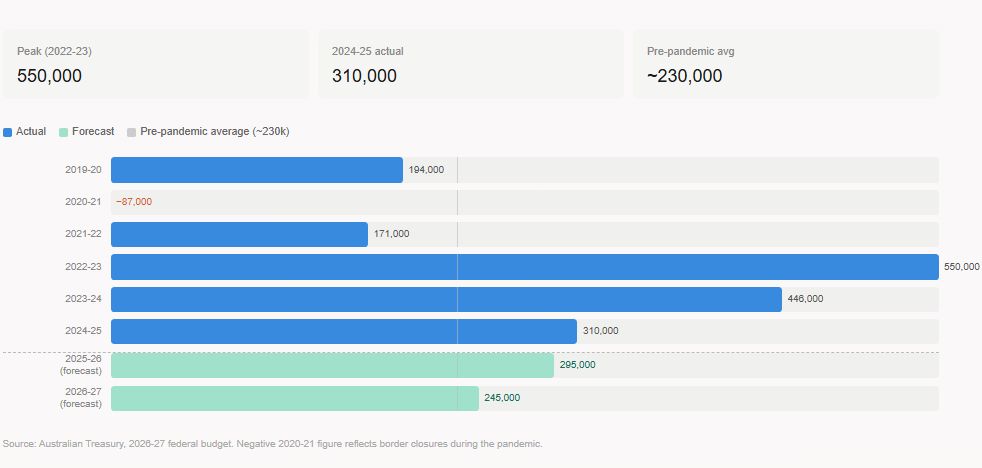
Source: Australian Treasury, 2026-27 federal budget. Negative 2020-21 figure reflects border closures during the pandemic.
Faster pathways for trades workers
The budget allocates $85.2 million to speed up skills assessment and occupational licensing for migrant tradespeople. The government says this could shave up to six months off the time it currently takes a qualified migrant tradesperson to enter the workforce, and could bring up to 4,000 additional skilled trades workers, primarily in construction and electrical, into employment each year.
A new skills assessment program specifically for onshore visa holders will be run through Trades Recognition Australia.
The property purchase ban is extended
Temporary migrants remain prohibited from purchasing established residential properties in Australia. That ban, introduced after the 2025 election, has been extended by a further two years and will now remain in place until June 2029. New construction is not affected by the ban.
Changes to working holiday visas
The Working Holiday Maker program will see adjustments aimed at managing overall numbers more actively. Ballots, which randomly allocate a capped number of visa spots among applicants, will be expanded as a tool to limit intake from participating countries. The government says the changes are also designed to reduce barriers to work once holders arrive.
English language support is being reformed
The Adult Migrant English Program, which provides free English tuition to eligible new arrivals, will be replaced from 2029 with a redesigned program. The new model will offer more flexible delivery and additional support services, targeting those considered most in need. The Treasurer acknowledged English proficiency as important for workplace participation and broader social connection.
Visa integrity spending
The budget sets aside $19.8 million over four years for closer scrutiny of student visa applications, covering both onshore and offshore processing. A further $27 million over two years will fund education programs for migrant workers on their workplace rights and protections under Australian law.
What it adds up to
Taken together, the budget represents a recalibration rather than a dramatic reduction in immigration. The government is seeking to slow the pace of arrivals at the margins while steering the permanent program toward skilled, onshore applicants who are seen as more directly addressing workforce gaps. The overhaul of the points test is likely to be the most consequential long-term change, given the volume of people it will affect over the coming decade.
The content of this article is intended to provide a general guide to the subject matter. Specialist advice should be sought about your specific circumstances.
[View Source]