
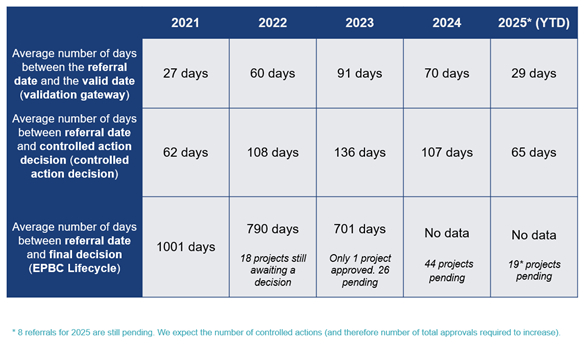
Our analysis of the Environment Protection and Biodiversity Conservation Act 1999 (Cth) (EPBC Act) Public Portal has shown improvements in the timeframes for controlled action decisions, for renewable energy projects located in New South Wales, Victoria and Queensland (136 days in 2023, compared to 65 days in 2025).
Despite faster referral processing times, assessment and approvals timeframes under the EPBC remain lengthy. For renewable energy projects in New South Wales, Queensland and Victoria referred since 2023, which require assessment and approval under the EPBC Act, only 1 has received a final decision.
The overview
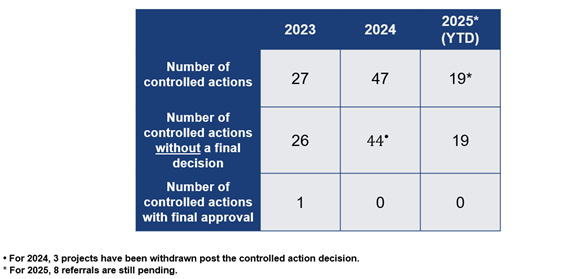
- 1 for 89. For the 89 renewable energy projects in NSW, Victoria or Queensland referred since 2023, which require assessment and approval under the EPBC Act, only 1 has received a final decision from the Federal Minister.
- For projects referred in 2025, 13 of the 19 controlled actions are located in New South Wales.
- We have seen a significant improvement in the timeframes for the initial validation gateway and the controlled action / not a controlled action decisions.
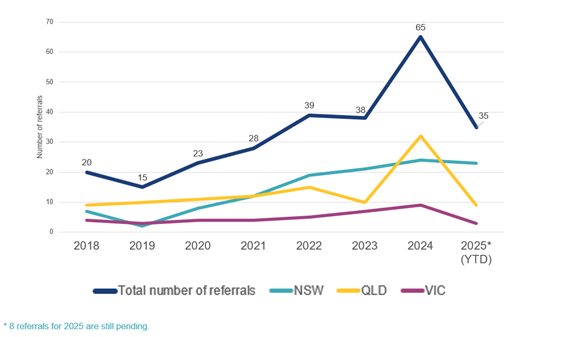
- Victoria and Queensland have seen a drop in the number of renewable energy project referrals over the last 12 months.
The data
Scope: Referrals on the EPBC Public Portal listed with industry type "Energy Generation and Supply (Renewable) between 2018 to 2025.
These include solar farms, wind farms, separate battery energy storage systems, and associated transmission infrastructure located in New South Wales, Queensland, and Victoria.
Number of Renewable Energy Referrals in NSW, Qld and Vic
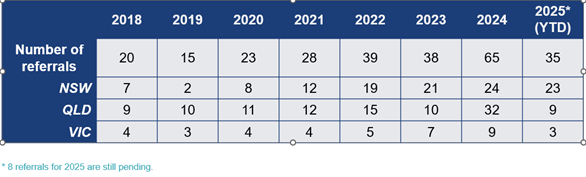
Number of Renewable Energy Referrals in NSW, Qld and Vic
Number of Controlled Actions in NSW, Qld and Vic
A 'controlled action' requires further assessment and approval under the Environment Protection and Biodiversity Conservation Act 1999 (Cth).
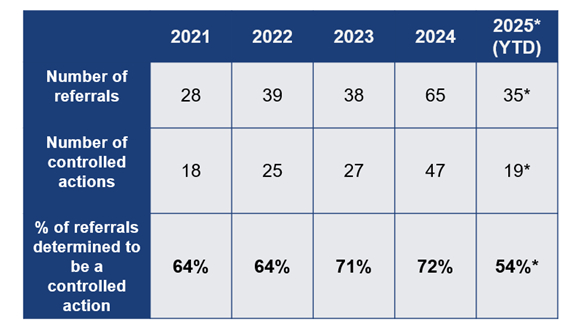
* 8 referrals for 2025 are pending.
Number of Approval Decisions
1 for 89. For projects referred in the last three years, which are controlled actions, only one project has received a final decision.
Timeframes for Decision Making
Our analysis of the analysis ...
It is well understood by both government and industry that the current environmental approvals system needs improvement to support faster and more efficient delivery of clean energy projects.
And the Commonwealth Government has prioritised this by introducing changes to the EPBC Act to Parliament, which is welcomed among industry. One of the key changes introduced as part of these reforms is the "streamlined assessment" framework.
Government should expect that the first few projects through streamlined assessment will be watched closely to see how timeframes are met and how the more subjective elements of the new reforms are implemented.
New South Wales
13 of 19 controlled actions referred in 2025 are in New South Wales. New South Wales currently holds the record for the longest timeframe for a renewable energy project to receive a final decision (taking 1999 days being over five years).
Our recent NSW pulse survey on clean energy project approvals also suggests State processes are causing considerable delays, with two thirds (67%) having identified assessment under the SSD planning framework–the primary approval pathway for major clean energy projects in NSW–as a greater source of delay compared to referral and approval under federal EPBC.
What's next
The EPBC Bill will continue to be debated in the Senate during Parliament's final sitting week next week. The Minister for the Environment and Water, Murray Watt has communicated that the government aims for the bill to be passed this year.
While the proposed laws will help to streamline processes for future projects requiring approval under the federal system, there are a number of non-legislative changes that could be considered to coincide with the EPBC laws to support existing clean energy projects.
Read our coverage of the proposed EPBC Act reforms: Turning over a new leaf: what you need to know about the EPBC Act amendments
Read our ten recommendations: https://www.hsfkramer.com/notes/environmentaustralia/2025-posts/epbc-act-is-up-for-review
Read our NSW Planning Approvals for Clean Energy Projects pulse report: https://www.hsfkramer.com/insights/2025-10/a-pulse-on-nsw-planning-approvals-for-clean-energy-projects
The content of this article is intended to provide a general guide to the subject matter. Specialist advice should be sought about your specific circumstances.