

Article Summary
Bankruptcy does not automatically prevent most Australians from keeping their job, earning an income, operating a business as a sole trader, or continuing their professional career. However, for many regulated professions, the real legal consequences arise not from bankruptcy itself but from separate licensing laws, disclosure obligations, fit-and-proper-person assessments, and restrictions on company directors.
Whether bankruptcy affects your employment depends on your occupation. While teachers, tradespeople, healthcare workers and most employees can usually continue working without interruption, lawyers, financial advisers, company directors, tax practitioners, insolvency professionals and other regulated professionals may face additional reporting obligations, regulatory scrutiny or restrictions under profession-specific legislation.
This guide explains how bankruptcy affects employment across Australia, identifies the professions most likely to be impacted, examines the disclosure obligations that may arise, explains the rules governing sole traders and company directors, and outlines what happens after discharge from bankruptcy. It also addresses common misconceptions that often lead people to make costly mistakes before obtaining legal advice.
If you are considering bankruptcy or have recently become bankrupt, understanding your legal obligations early can help you protect your employment, preserve professional licences where possible, comply with disclosure requirements, and avoid unnecessary regulatory or disciplinary consequences.
How Bankruptcy Affects Professional Licenses and Employment in Australia
Bankruptcy and employment issues are often misunderstood because bankruptcy does not automatically stop most people from working, earning income, operating as a sole trader, or continuing their professional career. The real question is usually whether bankruptcy triggers disclosure obligations, licensing reviews, fit-and-proper-person assessments, company director restrictions, or profession-specific regulatory consequences.
For employees, business owners and regulated professionals, the impact can vary significantly depending on the role, industry and legal framework involved. This article explains whether you can keep your job after bankruptcy, which professions face the greatest risk, how bankruptcy may affect professional licences, what must be disclosed to employers or regulators, whether you can continue operating a business, and what happens after discharge from bankruptcy.
If you are facing bankruptcy proceedings and require legal assistance, contact one of our experienced team of insolvency professionals today for a free consultation and let us help you protect your rights.
What Happens to Your Employment When You Become Bankrupt?
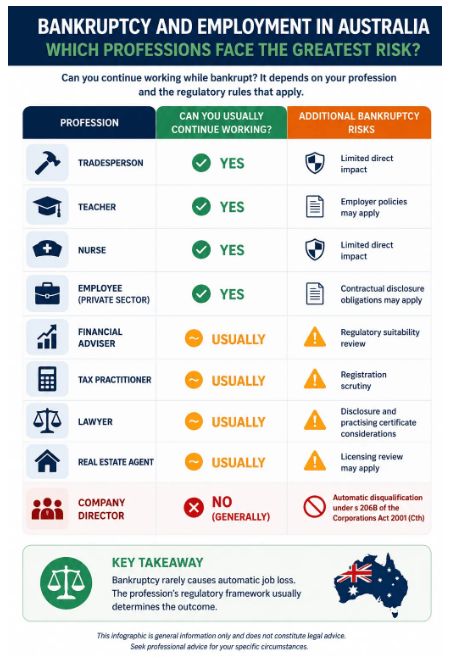
One of the most common concerns people have when facing bankruptcy is whether they will lose their job. In reality, bankruptcy rarely prevents a person from working, but the answer can vary significantly depending on the profession involved. This infographic provides a quick-reference guide to how bankruptcy affects employment across common occupations and helps answer one of the highest-intent search queries in this area.
Why Bankruptcy and Employment Do Not Automatically Conflict
The Bankruptcy Act 1966 (Cth) does not generally prevent a bankrupt individual from working. Bankruptcy is a legal process for dealing with financial insolvency, not a finding of criminal wrongdoing. Accordingly, most bankrupt employees remain entitled to continue their employment and perform their ordinary duties.
For the majority of private sector workers, bankruptcy causes little or no direct disruption to day-to-day employment. Tradespeople, teachers, healthcare workers, labourers, consultants, and many salaried employees commonly continue working throughout the bankruptcy period. Consistent with guidance published by the Australian Financial Security Authority (AFSA), bankruptcy does not usually prevent a person from earning income or holding a job.
When Bankruptcy and Employment Issues Can Affect Your Job
Although bankruptcy itself rarely results in automatic job loss, certain positions attract greater scrutiny because of the nature of the role. Employers may become concerned where an employee handles client funds, operates trust accounts, exercises significant financial authority, holds a senior financial management position, requires a security clearance, or occupies a government role involving financial probity.
In most cases, any employment consequences arise from employment contracts, regulatory obligations, licensing requirements, or internal employer policies rather than from the Bankruptcy Act 1966 (Cth) itself. One common mistake is assuming that bankruptcy and employment are governed by the same legal framework. Often, the bankruptcy creates a disclosure obligation, while the employment consequences arise under a completely separate regulatory regime.
Practical Example
An electrician, teacher, nurse, or tradesperson will often experience little direct employment impact from bankruptcy. By contrast, a financial adviser, trustee, insolvency practitioner, or person responsible for managing client funds may face additional regulatory review, disclosure obligations, or suitability assessments.
Professions Most Affected by Bankruptcy and Employment Rules
Bankruptcy and employment risks are not the same across every profession. Some workers may experience little practical disruption, while others may face licensing reviews, disclosure obligations, suitability assessments, or restrictions on holding regulated roles. The key issue is usually the profession’s regulatory framework, not bankruptcy alone.
Financial Services and Credit Industry Professionals
Some of the most significant employment consequences arise within the financial services and credit sectors. Under the Australian Financial Services Licence (AFSL) regime established by the Corporations Act 2001 (Cth) and the Australian Credit Licence (ACL) framework under the National Consumer Credit Protection Act 2009 (Cth), regulators place considerable emphasis on competence, integrity, and financial suitability.
Bankruptcy does not necessarily prevent a person from being employed in the financial services or credit industries. However, it may affect whether the person can be relied upon as a responsible manager, remain within the group of persons assessed as fit and proper, obtain or retain particular authorisations, or participate in the management of a licensed business. The consequences depend on the person’s precise role and the applicable licensing regime. In the credit licensing context, ASIC expressly identifies bankruptcy as a matter capable of supporting a conclusion that an applicant is not fit and proper. Accordingly, the fact of bankruptcy, as well as the circumstances that produced it, may require careful regulatory consideration.
Lawyers and Legal Practitioners
For legal practitioners, bankruptcy can trigger specific and time-sensitive disclosure obligations under the legal profession legislation applying in the relevant state or territory. For example, in Queensland bankruptcy is a “show cause event”. A local legal practitioner must ordinarily notify the relevant regulatory authority within seven days and provide a written statement within 28 days explaining why, despite the event, the practitioner remains a fit and proper person to hold a practising certificate. Bankruptcy may therefore result in regulatory review, although it does not automatically prevent the practitioner from continuing to practise.
The importance of financial integrity within the legal profession was emphasised in New South Wales Bar Association v Cummins [2001] NSWCA 284; (2001) 52 NSWLR 279. That case did not establish that bankruptcy, by itself, makes a practitioner unfit to practise. It concerned prolonged failures to lodge tax returns and comply with taxation obligations. It nevertheless demonstrates that serious financial misconduct, dishonesty or persistent non-compliance outside legal practice can bear upon professional fitness and public confidence in the profession.
The court found at [19-20]:
Honesty and integrity are important in many spheres of conduct. However, in some spheres significant public interests are involved in the conduct of particular persons and the state regulates and restricts those who are entitled to engage in those activities and acquire the privileges associated with a particular status. The legal profession has long required the highest standards of integrity.
There are four interrelated interests involved. Clients must feel secure in confiding their secrets and entrusting their most personal affairs to lawyers. Fellow practitioners must be able to depend implicitly on the word and the behaviour of their colleagues. The judiciary must have confidence in those who appear before the courts. The public must have confidence in the legal profession by reason of the central role the profession plays in the administration of justice. Many aspects of the administration of justice depend on the trust by the judiciary and/or the public in the performance of professional obligations by professional people.
The consequences of bankruptcy vary between jurisdictions and depend on the relevant admission, practising certificate, and trust account framework operating in each state or territory.
Accountants, Tax Practitioners and Insolvency Professionals
The consequences differ between accountants, registered tax practitioners and insolvency professionals because these categories are not governed by a single licensing regime. The general description “accountant” does not, by itself, identify a particular statutory registration. Registered tax and BAS agents are regulated by the Tax Practitioners Board under the Tax Agent Services Act 2009 (Cth), while registered liquidators and registered bankruptcy trustees are governed by separate statutory regimes. Bankruptcy may be relevant to ongoing fitness, propriety, registration or disciplinary assessments under those regimes. The Tax Practitioners Board states that becoming an undischarged bankrupt, or having held that status within the preceding five years, may affect continued registration.
Real Estate Agents and Other Licensed Occupations
Many licensed occupations operate under state-based legislation containing eligibility, character, suitability, disqualification and notification requirements. Whether bankruptcy is itself a disqualifying event, a matter that must be disclosed, or merely information that may be considered depends upon the wording of the particular legislation, regulations, licence conditions and approved forms. Real estate agents and other property professionals should therefore check the requirements applying in their own state or territory rather than assume that a uniform national rule applies.
The outcome is highly jurisdiction-specific. Each state and territory maintains its own occupational licensing frameworks, and even within one jurisdiction the effect of bankruptcy may differ between licence categories. The practical consequences therefore depend upon both the occupation and the place in which the person is licensed.
Can You Continue Operating a Business While Bankrupt?
The relationship between bankruptcy and employment becomes more complex where a person operates their own business. A bankrupt person may still be able to earn income, trade as a sole trader, or work within a business, but different rules apply where company management, business assets, credit arrangements, or professional licensing obligations are involved.
Sole Traders
Bankruptcy does not prevent a person from working for themselves or earning income as a sole trader. Many bankrupt individuals continue operating trades, consulting businesses, or service-based enterprises throughout the bankruptcy period. The Bankruptcy Act 1966 (Cth) is concerned with the administration of a bankrupt’s financial affairs rather than prohibiting productive work.
However, specific disclosure obligations apply when an undischarged bankrupt carries on business under an assumed name, another person’s name or a firm name. In those circumstances, the bankrupt must disclose their true name and the fact that they are an undischarged bankrupt to the persons with whom the business deals. AFSA also advises sole traders that, if the business name does not contain their full name, they must tell the people with whom they do business that they are bankrupt. Income earned during bankruptcy may also give rise to compulsory income contributions if the applicable after-tax income threshold is exceeded.
Quick Answer: Can a Bankrupt Person Run a Business?
Yes. A bankrupt person can generally continue operating as a sole trader and earning income. The major restriction is not on working, but on managing companies and complying with disclosure and bankruptcy administration requirements.
Company Directors
The position is significantly different for company directors. Under s 206B of the Corporations Act 2001 (Cth), a person who is an undischarged bankrupt is automatically disqualified from managing corporations unless permission is obtained from the Court.
This restriction applies automatically upon bankruptcy and does not require any separate decision by a regulator or court. A common mistake is for business owners to assume they can continue performing the same management functions after bankruptcy simply because they remain involved in the business. The legislation focuses on whether the person is managing the corporation, not merely their job title.
Failure to comply can have serious consequences. Section 206A of the Corporations Act 2001 (Cth) makes it an offence for a disqualified person to manage a corporation unless the person has permission to do so and acts within the terms of that permission. The prohibition extends beyond formally remaining listed as a director and can apply where the person participates in substantial business decisions, significantly affects the corporation’s financial standing, or exercises the type of influence described in the legislation.
For business owners considering bankruptcy, director disqualification is often the most immediate and commercially significant consequence affecting their ongoing business activities.
Professional Licensing Bodies and the “Fit and Proper Person” Test
Bankruptcy becomes relevant to many professional licensing bodies because regulators are responsible for protecting the public rather than simply assessing technical competence. As a result, financial circumstances can sometimes be considered alongside a person’s conduct, integrity, and ability to fulfil professional responsibilities.
Why Bankruptcy and Employment History Matter to Regulators
Regulators commonly examine whether bankruptcy raises concerns about financial management, integrity, risk to clients, protection of trust monies, or public confidence in a profession. This is particularly important in occupations where practitioners control client funds, manage trust accounts, provide financial advice, or occupy positions of significant responsibility.
The connection between financial conduct and professional suitability has long been recognised by professional regulators and courts. In New South Wales Bar Association v Cummins [2001] NSWCA 284; (2001) 52 NSWLR 279, the Court considered conduct demonstrating qualities incompatible with the standards expected of legal practitioners, emphasising the importance of public confidence and professional integrity. Spigelman CJ stated at [56]:
Conduct of a legal practitioner which demonstrates that the practitioner is not a fit and proper person to be entrusted with the duties and responsibilities belonging to the profession may constitute professional misconduct although it is not done in the course of practice. The test is whether the conduct manifests the presence or absence of qualities which are incompatible with, or essential for, the conduct of practice.
The significance of this principle is that regulators may consider conduct connected with a person’s financial affairs where that conduct reveals dishonesty, persistent non-compliance or another quality relevant to professional fitness. It does not mean that financial hardship or bankruptcy, without more, necessarily demonstrates professional misconduct or unfitness.
Bankruptcy and Employment Suitability Is Usually Profession-Specific
Importantly, bankruptcy is rarely treated as an automatic finding of unfitness. Most licensing authorities assess the surrounding circumstances rather than focusing solely on the existence of a bankruptcy.
This distinction is critical. Financial difficulty does not necessarily indicate professional misconduct. Bankruptcy can arise in circumstances that do not involve dishonesty, professional misconduct or incompetence. Regulatory attention will therefore usually focus on the facts that produced the bankruptcy, the person’s candour and compliance with disclosure obligations, and whether the surrounding conduct reveals qualities relevant to the statutory suitability test.
Accordingly, the key question is usually not whether a person became bankrupt, but whether the circumstances surrounding the bankruptcy affect their ongoing suitability to hold a licence, registration, or position of trust.
Common Bankruptcy and Employment Mistakes
Bankruptcy and employment problems can arise when people act on assumptions before checking the rules that apply to their specific role. Common mistakes include unnecessary resignation, delayed disclosure, misunderstanding professional licensing obligations, and continuing to manage a corporation despite being disqualified.
Assuming Bankruptcy Means Immediate Job Loss
One of the most common misconceptions is that bankruptcy automatically ends a person’s career. As a result, many clients delay obtaining advice, avoid speaking with employers, or make unnecessary decisions about resigning from positions they could lawfully retain. In reality, most employees continue working throughout bankruptcy, and the real issue is usually understanding any profession-specific obligations that apply.
Bankruptcy and Employment Disclosure Obligations by Industry
Another frequent mistake is focusing exclusively on the bankruptcy itself while overlooking disclosure requirements. Depending on the profession, a person may be required to notify regulators, employers, licensing authorities, professional associations, or insurers.
A failure to disclose can create a separate and potentially more serious regulatory issue where a notification obligation exists. Non-disclosure may raise concerns about honesty, candour and compliance independently of the circumstances that caused the bankruptcy.
Bankruptcy and Employment Risks for Company Directors
Business owners regularly misunderstand the difference between continuing to work in a business and continuing to manage a corporation. Bankruptcy does not prevent a person from being employed by a business, but it can prevent them from managing a company under the Corporations Act 2001 (Cth).
A common mistake is to focus on preserving day-to-day operations while overlooking the separate issue of corporate management authority, creating avoidable compliance risks.
Waiting Until a Licence Renewal Is Due
Another practical problem arises when professionals postpone dealing with bankruptcy until a licence renewal, practising certificate application, or annual declaration is due. Early preparation allows the person to identify applicable deadlines, provide an accurate and complete disclosure, and assemble material relevant to ongoing suitability. Where notification is mandatory, delayed disclosure may itself become an additional compliance issue, particularly if the regulator discovers the bankruptcy before receiving the required notification.
What Must You Disclose After Becoming Bankrupt?
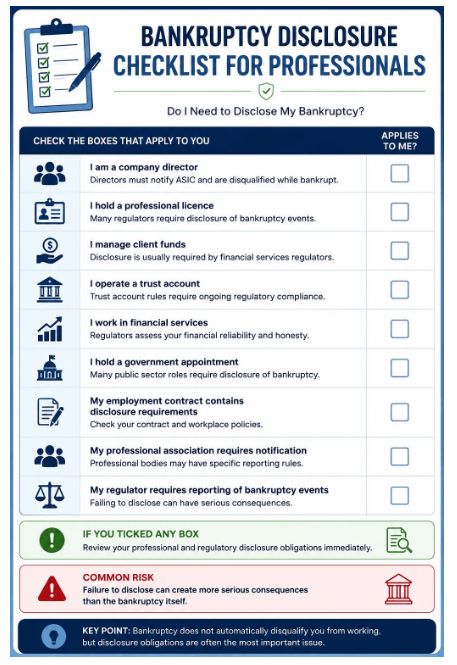
Many of the most serious problems arising from bankruptcy occur not because of the bankruptcy itself, but because a required disclosure was missed. Different professions impose different reporting obligations, making early compliance critical. This infographic provides a quick-reference guide to common disclosure triggers.
There is no single disclosure rule that applies to every bankrupt individual. Disclosure obligations depend on the person’s employment contract, professional rules, licensing conditions, and any statutory reporting requirements that govern their occupation.
For some professionals, disclosure is mandatory and may be subject to a short statutory deadline. Legal practitioners may be required to notify the relevant legal profession authority and provide material addressing their continuing fitness to practise. Financial services and credit industry participants must consider the obligations arising under the applicable licensing framework, authorisation arrangements and employer compliance policies. Separately, an undischarged bankrupt is automatically disqualified from managing corporations under the Corporations Act 2001 (Cth) unless the Court grants leave. Registered tax practitioners, registered liquidators, registered bankruptcy trustees and other regulated fiduciaries must consider the particular notification, registration and suitability provisions governing their roles.
The content of this article is intended to provide a general guide to the subject matter. Specialist advice should be sought about your specific circumstances.
[View Source]