

- within Intellectual Property topic(s)
- with Inhouse Counsel
- in Australia
- with readers working within the Retail & Leisure industries
Key Takeaways:
- The U.S. Patent and Trademark Office (USPTO) has implemented a Continuation Application Fee (CAF) for certain continuing applications filed more than six or nine years after their earliest benefit date.
- Biotech and life sciences applications, particularly in Art Unit 1600, are more likely to trigger the fee due to long pendency and continuation-heavy strategies. If the CAF isn't paid on time, priority claims may be silently lost, with no notice from the USPTO.
- Practitioners and applicants should closely review the timing of any planned or recently filed continuations to preserve the full priority claim.
A series of procedural changes at the USPTO is influencing strategy for biotech and life sciences applicants. Over the past year, the agency introduced two new fees and launched a streamlined examination pilot, each with implications for how and when applications are filed. This alert focuses on the newly implemented CAF, which may pose particular challenges in Art Unit 1600 — where longer pendency and continuation-heavy strategies are common.
Here, we outline the new fee structure, its potential risks for preserving priority claims and key considerations for adjusting prosecution strategy.
New Continuation Fee Tied to Earliest Benefit Date
Effective Jan. 19, 2025, the USPTO implemented the CAF for certain continuing applications "to ensure a sustainable funding model into the future." In announcing the CAF, the USPTO indicated that the "volume and rapid increase of continuing applications negatively impacts the USPTO's workload and docketing practices." The CAF applies to utility, plant and design continuing applications filed more than six years after their earliest benefit date (EBD) — the earliest filing date for which a priority benefit is claimed (i.e., to a prior-filed nonprovisional application, international application (e.g., PCT), or international design application under 35 U.S.C. § 120, § 121, § 365(c), or § 386(c), and 37 C.F.R. § 1.78(d)). While the EBD is determined on an application-by-application basis, it cannot be the filing date of a foreign priority application or a U.S. provisional application. For a utility application, the EBD is the patent term filing date (i.e., the date from which the 20-year patent term is calculated).
Fee Amounts and Entity Impact
As of October 2025, the CAF for an application filed more than six years after the EBD is $1,080 for a small entity and $2,700 for a non-small entity. The CAF for an application filed more than nine years after the EBD is $1,600 for a small entity and $4,000 for a non-small entity.
The USPTO does not believe that the CAF disproportionately impacts small or micro entities. Pointing to data from the 2022 fiscal year, the USPTO noted that about 70% of the applications that had an EDB more than six years prior to the actual filing date were undiscounted entities; about 29% received a small entity discount; and about 1% received a micro entity discount.
Biotech Applications May Be Disproportionately Affected
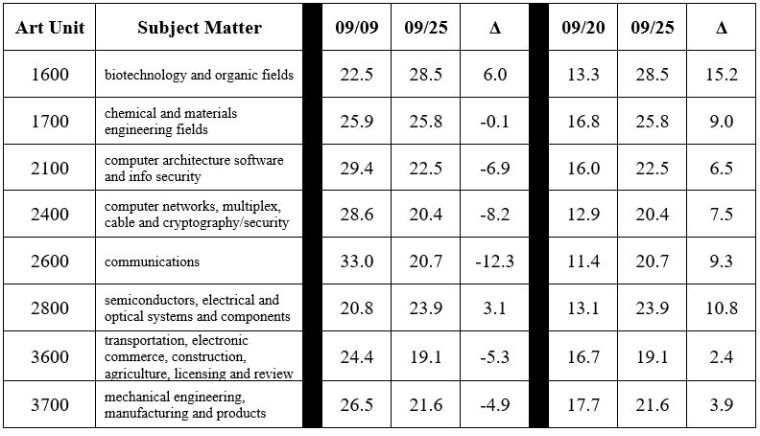
While the USPTO believes that the CAF is "relatively technology neutral," the data seems to tell a different story for biotech and life science patent applications. Reviewing USPTO data provided for Q3 of 2025, the traditional first action pendency for Art Unit 1600 is 28.5 months – the highest among all art units. In fact, the traditional first action pendency for Art Unit 1600 has increased from 22.5 months in 2009 to 28.5 months in 2025, while the first action pendency decreased for six other art units. The only other art unit to experience an increase in the traditional first action pendency over that same period was Art Unit 2800 (i.e., 3 months from 20.8 to 23.9).
Focusing on the immediate past 5 years, the traditional first action pendency for Art Unit 1600 increased by a whopping 15.2 months — 4.4 months longer than the the next most affected unit, Art Unit 2800, at 10.8 months.
Furthermore, in the last five years, the total pendency of an application having a RCE in Art Unit 1600 has increased to nearly 38 months — once again, the highest of all art units. This means that in the last five years, the average total pendency for an application having a RCE in Art Unit 1600 has increased by 8.6 months.
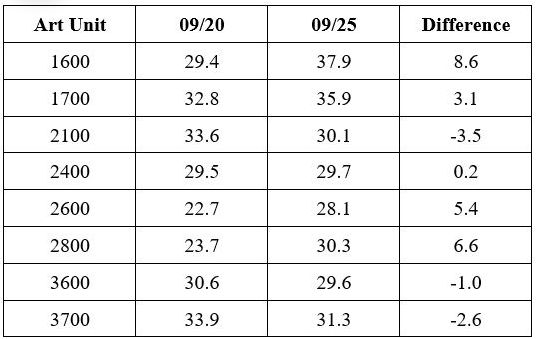
Part of this prolonged pendency for biotech and life sciences applications may be attributed to the fact that, as of Q3 of fiscal year 2025, Art Unit 1600 has the fewest examiners of any art unit and has issued the lowest number of allowances.
Delayed Continuation Filing Comes With New Risk
Consequently, a biotech application can easily spend more than three years in prosecution, working towards an allowance of a first elected invention. And if the application spent 18 months as an international application prior to national phase entry, then any ensuing continuing application directed at either a second non-elected invention (divisional) or other subject matter (continuation) may require payment of the CAF.
While biotech practitioners have routinely filed a "no fee" continuing application to defer paying the requisite filing, search and examination fees until responding to a Notice to File Missing Parts, the new CAF has changed that practice. For instance, if an applicant files a continuing application requiring the CAF without paying the necessary fee, then the USPTO will not acknowledge any part of a priority claim that extends past the six-year or nine-year mark. This means that the Filing Receipt will also exclude the full priority claim.
Interestingly (and perhaps unnervingly), the USPTO does not separately notify an applicant about the deletion of that part of the priority claim that extends past that six- or nine-year mark. This leaves an applicant with no explicit communication to provide a response or correct the priority claim. Instead, to reinstate the full priority claim, an applicant must submit a "corrected" Application Data Sheet (ADS) and pay the applicable CAF within four months of the continuing application's filing date.
Preserving Priority Under the New Fee Framework
Imposing the CAF for a continuing application with a priority claim beyond six-to-nine years has effectively eliminated the benefits of deferred "no fee" continuation filings. Applicants now have at most four months after the filing date to pay the CAF of the no fee continuing application and restore the full priority claim. Absent explicit communication from the USPTO, the risk of losing the benefit of the full priority claim likely outweighs any benefit obtained by filing the application without the CAF.
While the USPTO believes that these fees are relatively technology neutral, Art Unit 1600 boasts the longest traditional first action pendency and total pendency of an application, both with and without filing an RCE during examination. As a result, biotech applicants are especially likely to encounter the fee. Going forward, patent practitioners should develop strategies to avoid jeopardizing an application's full priority claim.
The content of this article is intended to provide a general guide to the subject matter. Specialist advice should be sought about your specific circumstances.
[View Source]
