

- within Corporate/Commercial Law topic(s)
- within Transport, Employment and HR and Antitrust/Competition Law topic(s)
- with Inhouse Counsel
Hanging out, 'situationships' and going official: it's complicated
Finding the right partner proved complex for some in 2025, but we're expecting a busy 2026
The global M&A market is nothing if not resilient. But its trajectory in 2025 was a complex affair. It was a tale of two halves – with a different story in different parts of the market, and for different types of buyers and sellers. We needed to find a new analogy this year – we have exhausted headwinds, tailwinds, foggy conditions and bumpy rides. All aircraft-related metaphors are now grounded, and we've instead gone with the complexity of the dating scene.
We faced a complicated picture with many buyers and sellers 'hanging out' with no serious near-term prospects of completing a deal, and others stuck in long-term 'situationships' – serious about moving forward but stuck in uncertain, messy dynamics. But with all this, we saw a happy number of buyers and sellers going official and declaring their commitment to each other.
M&A struggled to build real momentum in 2024 while we waited for macroeconomic conditions – inflation, interest rates and debt financing – to improve. 2025 began with a strong degree of optimism for a rebound in M&A, as inflation levelled off and interest rates further reduced.
The optimism was driven from the US, with the anticipation of a pro-business, anti-regulation approach of President Trump, with his bias to action driving up confidence and significant M&A activity in the US. The Trump bump, and CEO animal spirits, were set to unleash pent up demand...
True to the resilience that the M&A market has shown through other major shocks, sufficient equilibrium was reached for principals and advisers to pick up dealmaking plans.
Of course, the more careful voices, in particular those who cautioned around tariffs, called it right – at least for the first half of the year. The impact of 'Liberation Day' was felt around the world and M&A appetite was, with some exceptions, particularly hard hit – not simply through the tariffs themselves, but also the wider alarm sounded on the unpredictability of policy direction, and wider geopolitical implications of the US Presidency. Spring 2025 was a particularly gloomy time for the M&A market. But, true to the resilience that the M&A market has shown through other major shocks, sufficient equilibrium was reached for principals and advisers to pick up dealmaking plans and explore paths to navigate them in the Trump 2.0 world, as we got some degree of clarification on policy and direction of travel.
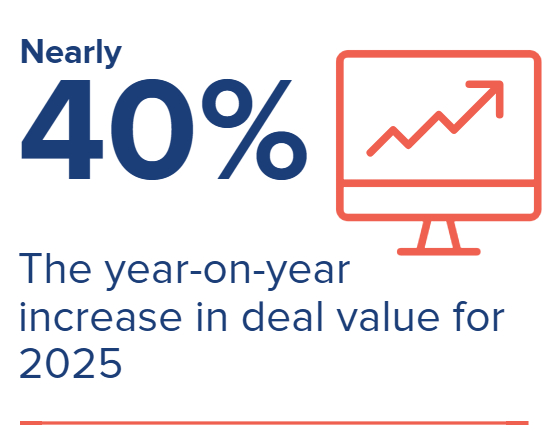
The year turned with a Q3 surge, one of the strongest quarters since 2021, which continued apace into Q4. By the end of the year, at over US$4.3 trillion, deal values were up nearly 40% on 2024. The hard work was done by the megadeals, as overall volumes were down around 2% from 2024. The appetite to catch up on the slow first half with a busy second half was evidenced as deals continued at full pace through August, untroubled by the traditional summer break in the northern hemisphere. To put 2025 into perspective, looking back over the past ten years, 2025 was second only to 2021 for deal value, but at the same time was also one of the lowest for number of deals.
The corporate ambition for growth, portfolio realignment and major strategic moves in a rapidly changing world has seen strategics catch up and, in some cases, overtake private equity in M&A activity in recent years. The Q3 surge in megadeals was led by corporate management deciding that the time was right to execute transformative M&A that had been long in evaluation, or that couldn't be delayed any further. In an uncertain world, M&A players seek the relative safety and resilience when navigating uncertain times that is provided by scale. Shareholders played their part as catalysts, sometimes publicly but also privately, encouraging moves to unlock value. Evolving megatrends that provide the backdrop for this activity include energy transition and digital transformation, and now AI too, as well as sectoral convergences (such as data centre investment) and more recent imperatives reflecting geopolitical concerns (notably the race for critical minerals and the rebuilding of defence capability).
Evolving megatrends that provide the backdrop for activity include energy transition and digital transformation, and now AI too.
Private equity was by no means absent, and achieved some significant deployments of capital, but in many cases had competing priorities. First amongst these remained the need to attend to their portfolio companies as they navigate a volatile business environment, and to recycle capital, whether through further creative M&A solutions (secondaries and other portfolio deals) or confronting lower value expectations in negotiated sales. In many transactions, especially in the middle to lower-middle market, buyers were sceptical that companies lacking significant scale would have the resources to grow profitably in a challenging economic environment.
The US market continues to dominate global M&A, accounting for around half of the deal value in 2025, and one in four deals involved US targets. But it wasn't all a US story. While some markets were slower, a number of other markets were particularly buoyant. China, India, Germany, France, Italy and Spain, as well as the Netherlands and South Korea, saw significant increases in deal values over 2024. Very few markets, though, saw increased deal numbers from 2024, with Brazil, Hong Kong and Indonesia being some of the exceptions. Japan has been a busy market for some years, attracting inbound interest from private equity as the market opened up through shareholder activism encouraged by government intervention, and now with wider outbound activity by Japanese corporates. Importantly for the major economies, geopolitical tensions and the deglobalisation drift means that new corridors for M&A activity are opening, and significant traffic is flowing through.
For the lawyers, there were, in our experience, two notable themes in 2025, which look set to continue for 2026.
The first is the heavy lifting needed to get deals done. Resilience and creativity have been needed to get deals across the line, both to signing and then through closing. Buyers are taking the time to test target businesses and derisk as thoroughly as possible through due diligence and price negotiation. Negotiation is required to regulate the longer periods between signing and completion and the risks of unexpected shocks, with debates around MACs and termination rights, as well as recourse for gaps in W&I insurance coverage. And creativity is needed to bridge valuation differences. The balance of power continues its shift back towards buyers in the absence of heavily contested auctions. Many auctions are now "soft" or develop into bilateral processes, assets are repackaged to suit buyers, and there may be more latitude for buyers to reposition deal terms. On a positive note, we have noticed a new dynamic of collaboration between parties on the most difficult deals – less a zero-sum negotiation on price and terms, and more working together to find the right structure, terms and regulatory solutions to create a deal that both principals are prepared to do. Less happily, 2025 seems to have been a year where more deals than usual were abandoned, sometimes at a very late stage, and more thought and planning is now going into ways to derisk that.
AI is now fully present in most deals, whether as a central driver to the investment proposition, or more typically as a key commercial risk factor to understand the extent of existential challenge to the target business model.
The second is the perennial regulatory risk to the deal. Cheer has come from some quarters, including the US – but also other jurisdictions such as the UK – where governments are rebalancing regulatory interventions against the need for economic growth. But the overall global direction of travel remains more regulators, more areas of regulation (including the worldwide growth of FDI screening, as well as the EU Foreign Subsidies Regulation) and the risk of compliance missteps in process as well as substantive negative rulings by regulators. For the M&A practitioner, both the governance around the compliance risk and the strategic planning for complex multi-filing, multi-jurisdictional processes are now established work streams in any significant deal. And overall, the interface of the regulation of the deal with national, regional and global politics (and therefore politicians) remains front of mind in deal risk.
AI is now fully present in most deals, whether as a central driver to the investment proposition, or more typically as a key commercial risk factor to understand the extent of existential challenge to the target business model. AI has not yet upended the way that M&A deals are conducted, but it is clearly encroaching. Everyone involved in a deal process is finding their own personal efficiency tools. Seniors are supercharging their analogue human experience, while juniors are leveraging their innate digital literacy. At a team level, the mission is to find ever better ways of taking chunks of process work away from humans. No one has yet seen a path to a wholesale remodelling of the M&A deal process, and the optimistic view is that as more drudgery is taken away, deal advisers can concentrate their efforts on the more interesting and valuable human elements, such as managing complex personal interactions in negotiation. As we all 'learn by playing', AI is giving practitioners pause to remember data security and intellectual property ownership, and the need for care as AI open systems democratise knowledge.
Everybody needs somebody to love, as The Blues Brothers sang in 1980. But the course of true love never did run smooth, as William Shakespeare would have cautioned. In 2025, M&A advisers dealt with a busy dating pool, but one with very variable outcomes – we saw plenty of buyers and sellers hanging out, some stuck for long periods in situationships but a happy number going official. While we don't yet anticipate the immediate return of the competitive PE-led speed dating auctions of a few years ago, we certainly expect a busy 2026.
The content of this article is intended to provide a general guide to the subject matter. Specialist advice should be sought about your specific circumstances.


