The Turkish Competition Authority's (“TCA”) conditional clearance of Uber Technologies, Inc.'s (“Uber”) acquisition of certain business lines of Getir Perakende Lojistik A.Ş. (“Getir”) is likely to become one of the most closely followed Turkish merger control decisions of 20261.
The transaction is important for two reasons. First, it may significantly alter the competitive structure of Türkiye's online food ordering and delivery services market. Second, and perhaps more importantly, the TCA appears to have cleared a transaction that may raise conventional competition concerns on the basis of a commitment package that includes a major investment commitment in Türkiye.
According to the TCA’s public announcement, the transaction concerns Uber's acquisition of sole control over Getir's online food ordering and delivery services business and online fast-moving consumer goods ordering and delivery services business. The TCA approved the transaction within the framework of the commitments submitted by Uber. The most visible element of the commitment package is Uber's commitment to make a total investment of USD 500 million in Türkiye. The TCA noted that this investment is expected to support high-skilled employment, strengthen local engineering capabilities and contribute positively to the development of Türkiye's digital and technology infrastructure. The reasoned decision has not yet been published. Therefore, the TCA's market definition, theory of harm, competitive effects assessment, and the precise scope and enforceability of the commitments remain unclear.
This limited public information is nevertheless sufficient to open a broader discussion: Is Turkish merger control moving towards a framework in which industrial policy, investment, employment and technological capacity are increasingly weighed alongside conventional competition concerns?
A changing merger control environment
Until recently, merger control analysis was generally focused on the effects of a transaction on competition in the relevant markets affected by the deal. The conventional assessment looked primarily at whether the transaction would lead to higher prices, reduced output, lower quality, less innovation or weaker competitive constraints. Non-price parameters such as privacy, sustainability or innovation were sometimes considered, but they generally operated as elements complementing the competitive analysis rather than as independent policy objectives.
This traditional distinction between competition law, competition policy and industrial policy is now under pressure. Digitalisation, geopolitical uncertainty, supply chain vulnerabilities and global competition have made it increasingly difficult to assess certain transactions solely through a static price-and-output framework. In this new environment, merger control is gradually being asked to account for broader considerations such as investment capacity, resilience, strategic autonomy, supply security and global competitiveness.
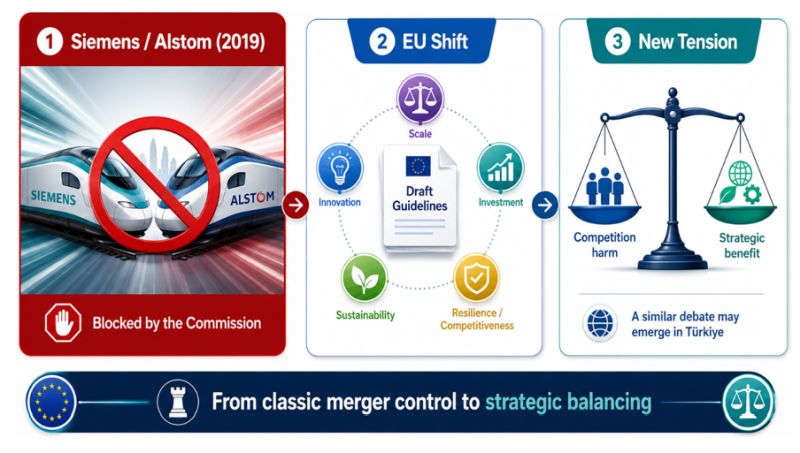
The European Union (“EU”) provides the clearest example of this shift. The European Commission's draft revised Merger Guidelines (“Draft Guidelines”) represent the most comprehensive methodological update to EU merger control in nearly two decades. The Draft Guidelines do not abandon competition analysis. However, it seeks to modernise it by expressly taking account of the changed geopolitical and trade context, industrial scale, global competitiveness, innovation, investment, sustainability and resilience2.
This development should also be read against the background of the political debate triggered by the Commission's prohibition of the Siemens/Alstom transaction in 20193. For a quick reminder: Siemens and Alstom had argued that the combination of their rail businesses was necessary to create a European industrial champion capable of competing more effectively with large global players, particularly in rail signalling and very high-speed trains. The Commission, however, prohibited the transaction on the basis that the merger would have significantly harmed competition in those markets and that the remedies offered by the parties were insufficient to address its concerns. Following that decision, several Member States, particularly France and Germany, questioned whether EU merger control was sufficiently aligned with Europe's broader economic and strategic interests4. Draghi Report5 later gave this debate a more structured policy foundation by arguing that Europe's competitiveness challenges require a more dynamic approach to investment, scale and innovation.
In other words, the EU debate is not simply about allowing larger mergers. It is about whether competition authorities should, in some cases, balance traditional theories of harm against broader theories of benefit. This is precisely the tension that now appears to be emerging in Türkiye.
The Turkish context: From Tofaş/Stellantis to Uber/Getir
The TCA's Tofaş/Stellantis decision6 had already signalled a possible change in Turkish merger control practice without any substantial change in the legislation. In that case, the TCA approved the transaction subject to commitments that included an investment plan and certain measures concerning distribution and sales channels. The TCA described the decision as historic, noting that it was the first clearance decision in its history linked to an investment commitment. The Authority also emphasised the expected contribution of the investment to Türkiye's economy, production and export capacity, employment and social welfare.
The Uber/Getir decision appears to continue this line. Based on the TCA's announcement, the TCA accepted Uber's commitment package, which includes a USD 500 million investment commitment in Türkiye. The stated benefits of this commitment relate to high-skilled employment, local engineering capabilities and the development of Türkiye's digital and technology infrastructure. These are important policy objectives. They are also objectives that go beyond a narrow assessment of whether the transaction will increase prices or reduce output in the relevant market.
This is why the decision is significant. The TCA appears to have authorised a transaction that may create conventional competition concerns by relying, at least visibly, on an investment commitment that is not obviously linked to those concerns.
Why the transaction may raise conventional competition concerns
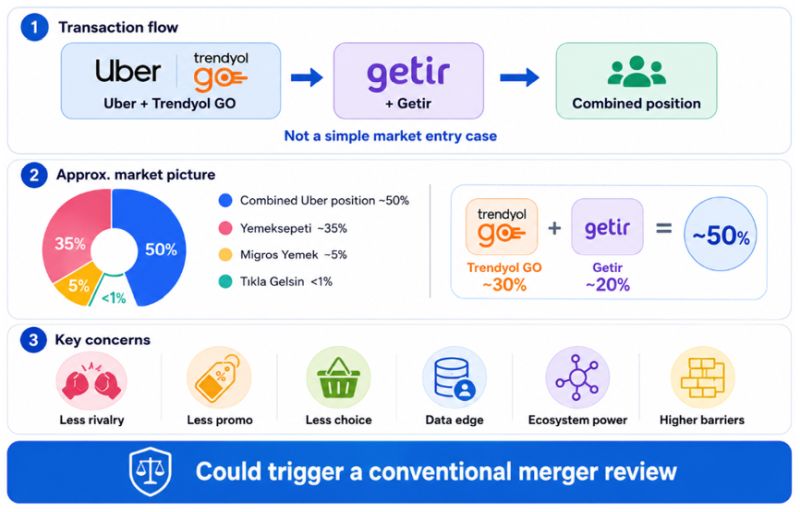
The competitive significance of the Uber/Getir transaction should be assessed against Uber's earlier acquisition of Trendyol GO. Through that transaction, Uber became active in Türkiye's online food ordering and delivery services market. Trendyol GO also remains connected to the broader Trendyol ecosystem, as Trendyol retained a minority shareholding in the business.
The Getir transaction is therefore not a simple market entry case. It follows a sequence of transactions through which Uber would combine Trendyol GO and Getir's delivery operations within a broader platform and ecosystem structure.
On a rough and indicative basis, and subject to confirmation in the reasoned decision, Trendyol GO may have a market share close to 30% in online food ordering and delivery services, while Getir may hold a share of approximately 20%. If this picture is broadly correct, the transaction could bring Uber's combined position close to 50%. This would potentially place Uber above Yemeksepeti, which had been the leading player in the market for many years. Other players such as Migros Yemek and Tıkla Gelsin appear to have more limited market positions, with estimated shares of approximately 5% and below 1%, respectively.
These figures should be treated with caution until the reasoned decision is published. However, they illustrate why the transaction is capable of raising traditional merger control questions.
The TCA may have had to assess, among other issues, whether the transaction would eliminate competition between Trendyol GO/Uber and Getir, reduce promotional rivalry, weaken restaurant or consumer choice, increase dependence on a smaller number of digital intermediaries, create data-related advantages, strengthen ecosystem effects or raise barriers to entry and expansion for rival platforms.
In a conventional merger analysis, these concerns would normally need to be addressed by commitments that preserve competition in the affected market. For example, if the concern relates to horizontal concentration, the remedy would be expected to preserve competitive pressure. If the concern relates to platform access, non-discrimination or data advantages, the remedy would be expected to address those issues directly. If the concern relates to foreclosure, the remedy would typically focus on access, supply or conduct obligations.
This is where the investment commitment becomes legally and conceptually difficult.
A comparative note: South African merger control
The use of investment, employment and local economic development commitments in merger control is not unique to Türkiye.
South Africa is the clearest example. South African merger control expressly requires the competition authorities to assess both the likely competition effects of a transaction and its public interest effects7. In practice, this has allowed the South African authorities to impose or accept conditions relating to employment, local procurement, supplier development, investment, empowerment and industrial participation. High-profile transactions such as Walmart/Massmart8 and AB InBev/SABMiller9 are frequently cited as examples of a system in which public interest commitments operate alongside competition-based merger remedies.
A similar policy orientation can also be seen more broadly in certain African merger control regimes. For example, merger review in the Common Market for Eastern and Southern Africa10 (“COMESA”) includes consideration of whether a transaction may be contrary to the public interest. Kenya's merger control regime also allows the authority to consider public interest issues in addition to competition effects11.
These examples show that merger control can, in certain jurisdictions, serve not only to preserve competition in the affected markets, but also to secure employment, investment, local participation and broader developmental objectives.
However, the comparison also highlights the difficulty in Türkiye. Unlike South Africa, Türkiye does not have an express public interest merger test that sits alongside the competition assessment. The TCA's legal basis remains Competition Act. Therefore, if investment commitments are to play a larger role in Turkish merger control, the TCA will need to explain how they fit within the statutory framework of competition law.
This is not a formalistic point. It goes to the legitimacy and predictability of merger control. Where a legal system expressly allows public interest considerations, the authority can openly balance competition effects against employment, industrial policy or investment objectives. Where the legal framework is primarily competition-based, the authority must be more careful in explaining how a broader economic benefit relates to the competition analysis.
A Turkish paradigm shift?
The Uber/Getir decision may therefore point to a broader shift in Turkish merger control. Together with Tofaş/Stellantis, it suggests that the TCA may be willing to consider investment, employment, local production, technological capacity and broader economic contribution when assessing complex concentrations.
This may be understood as a Turkish version of the wider international debate on the relationship between competition law and industrial policy. In the EU, that debate is reflected in the Draft Guidelines and in the increasing emphasis on competitiveness, resilience and investment. In South Africa and certain African regimes, the same debate is addressed more directly through public interest merger control. In Türkiye, the debate appears to be emerging through individual TCA decisions.
This may create both opportunities and risks. The opportunity is flexibility. Digital markets, platform ecosystems, mobility, quick commerce and technology-enabled delivery services do not always fit comfortably into traditional merger control categories. A more dynamic assessment may allow the TCA to account for investment incentives, technological development, innovation capacity and Türkiye's position in global digital markets.
The risk is uncertainty. If broader economic or industrial policy considerations are introduced through individual decisions without clear guidance, undertakings may find it difficult to predict which commitments will be considered sufficient, how the TCA will balance harm and benefit, and whether similar transactions will be treated consistently.
The deeper institutional question is whether the TCA can use individual merger decisions to create broader regulatory outcomes. This issue was recently addressed by Şahin Ardıyok, in his presentation titled “Can the Turkish Competition TCA Establish Generally Applicable Rules Through Individual Decisions?” delivered as part of the Uygulamalı Rekabet Hukuku Seminerleri (Applied Competition Law Seminars) organized by İstanbul Bilgi University12. In the presentation, now available on YouTube, Şahin Ardıyok examines the advantages and risks of using individual enforcement and merger decisions to create effects that may resemble general rules.
Uber/Getir fits directly within that debate. Türkiye has not announced any public initiative to revise its merger control guidelines in line with the European Commission's Draft Guidelines. That said, a formal guideline amendment is not necessarily required for the TCA to develop its decisional practice. Provided that it remains within the boundaries of the Competition Act, the TCA may introduce new analytical parameters into merger control through its decisions.
However, the more the TCA moves in this direction, the greater the need for transparency and reasoning.
Footnotes
1 Turkish Competition Authority, “The Acquisition of Certain Business Lines of Getir AŞ by Uber Technologies Inc. Was Cleared Subject to Commitments”, available at: https://www.rekabet.gov.tr/tr/Guncel/uber-technologies-inc-tarafindan-getir-a-b7a6d2dc226bf11193eb0050568549fa,
2 European Commission, Review of the Merger Guidelines - Competition Policy - European Commission
3 European Commission, Mergers: Commission prohibits Siemens’ proposed acquisition of Alstom, 6 February 2019, https://ec.europa.eu/commission/presscorner/detail/en/ip_19_881
4 Politico, Blocking Alstom-Siemens merger would be a political mistake, https://www.politico.eu/article/france-bruno-le-maire-blocking-alstom-siemens-merger-would-be-a-political-mistake/; Deutsche Welle, German and French ministers issue manifesto for European industrial policy, https://www.dw.com/en/german-and-french-ministers-issue-manifesto-for-european-industrial-policy/a-47591419
5 Mario Draghi, The Future of European Competitiveness – Part A: A Competitiveness Strategy for Europe, European Commission, September 2024, https://commission.europa.eu/document/download/97e481fd-2dc3-412d-be4c-f152a8232961_en?filename=The%20future%20of%20European%20competitiveness%20_%20A%20competitiveness%20strategy%20for%20Europe.pdf
6 TCA’s, Tofaş/Stellantis decision dated 18.04.2025 and numbered 25-15/359-172
7 Please see: Competition Act: Public interest guidelines relating to merger control: Revised
10 Home - Common Market for Eastern and Southern Africa (COMESA)
11 ConsolidatedMergerGuidelines.pdf
The content of this article is intended to provide a general guide to the subject matter. Specialist advice should be sought about your specific circumstances.