

The 26th Annual Report of the Commission for Employment Equity (CEE), published under the theme “Bridging the Equity Gap Through Diversity & Inclusion,” paints a picture of a labour market in transition. The Employment Equity Amendment Act No. 4 of 2022 and its accompanying Employment Equity Regulations, including five-year sectoral numerical targets for eighteen economic sectors, came into effect on 1 January 2025 and 15 April 2025, respectively, ushering in a tighter compliance environment.
The report records that 15,090 employment equity reports were received in 2025, a decline of 48.4% from the 29,269 reports received in 2024. This significant reduction is attributable to the amendments excluding employers with between one and 49 employees from the reporting obligation. Nevertheless, the total number of employees covered by the reports stood at 6,896,041. Meanwhile, representation of employees with disabilities remained at 1.3% of the total workforce across the private sector and government. At the apex of the corporate hierarchy (top management level), white individuals accounted for 57.1% of positions, followed by African individuals at 21.1%, Indian individuals at 12.2%, Coloured individuals at 6.4%, and foreign nationals at 3.1%. Male incumbents held 70.7% of top management posts, with female representation standing at 29.3%.
Against this backdrop, the report offers guidance on compliance obligations, provides an update on a wave of legal challenges to the amended framework, and sets out the national and provincial Economically Active Population (EAP) benchmarks that designated employers must consider when developing their employment equity plans.
The Employment Equity compliance certificate: Designated and non-designated employers
One of the most consequential innovations introduced by the 2022 amendments is section 53 of the Employment Equity Act (EEA), which provides for the issuing of an Employment Equity (EE) Compliance Certificate. Possession of this certificate is now a prerequisite for any employer seeking to conduct business with an organ of state, a provision that has implications, particularly for the private sector.
Employers must request the certificate through the Department of Employment and Labour’s Employment Equity online system, accessible via www.labour.gov.za. The criteria for obtaining the certificate differ depending on whether an employer is classified as a designated or a non-designated employer.
Non-designated employers
Non-designated employers, those with between 1 and 49 employees, face a comparatively streamlined set of requirements. To qualify for the certificate, such employers must:
- comply with the requirements of the National Minimum Wage Act, No. 9 of 2018 (NMWA) for the previous twelve months; and
- have no unfair discrimination award or court judgement against the employer for the previous twelve months.
Designated employers
Designated employers, those employing 50 or more employees, or fewer than 50 employees where the employer is an organ of state or is designated by a collective agreement, are subject to a more extensive set of obligations. They must:
- submit an annual EE report (EEA2 and EEA4 forms);
- comply with the annual numerical goals in their EE Plan towards achievement of the five-year sectoral EE targets, unless justifiable reasons are provided for non-compliance;
- comply with the requirements of the National Minimum Wage Act, No. 9 of 2018 (NMWA) for the previous twelve months; and
- have no unfair discrimination award or court judgement against the designated employer for the previous twelve months.
Validity, renewal and withdrawal
An EE Compliance Certificate is valid for twelve months from the date of issue. Should an employer wish to continue doing business with the state beyond that period, a fresh request must be submitted on the prescribed EEA15 Form via the Department’s online system, which remains accessible to employers beyond the annual EE reporting deadline of 15 January.
Importantly, a certificate may be withdrawn by the Minister, a labour inspector, or a delegated official of the Department. Grounds for withdrawal include the certificate having been issued on the basis of any misrepresentation, the provision of fraudulent or inaccurate information, or any condition necessary for its issuance no longer being in existence. Before any withdrawal may take effect, the employer must be served with a withdrawal notice (EEA16C) and afforded at least 14 days to make representations. Confirmation of withdrawal must be issued on the prescribed EEA16D form, as provided for in the Employment Equity General Administrative Regulations published on 15 April 2025 in Government Gazette No. 52515.
Litigation and enforcement: The legal landscape
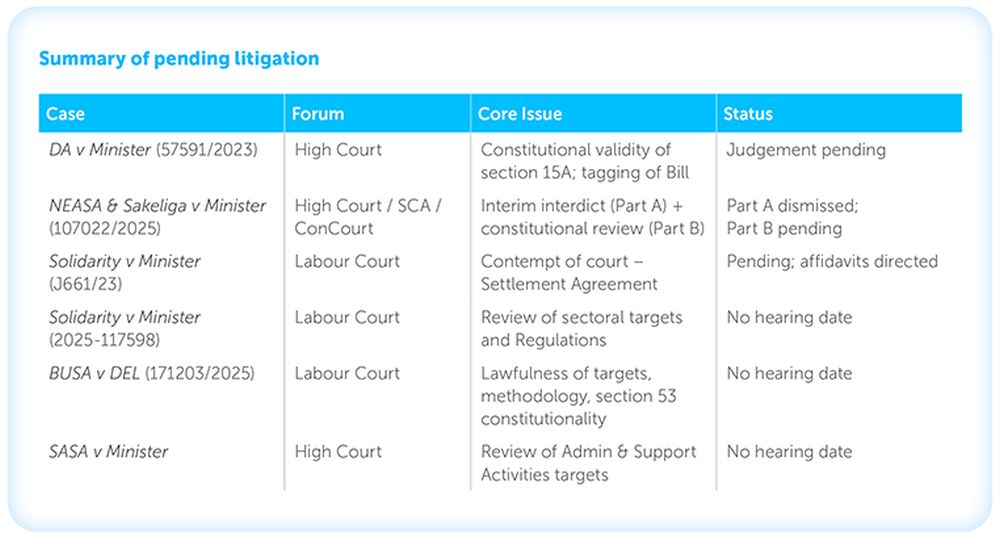
The commencement of the Employment Equity Amendment Act, 2022 and the publication of the five-year sectoral numerical targets have prompted a wave of legal challenges. Six matters are currently before various courts, each probing the constitutional validity, lawfulness and implementation of the amended framework. The report’s account of these proceedings underscores the intensity of the judicial scrutiny to which the amendments are being subjected.
Democratic Alliance v Minister of Employment and Labour (Case No. 57591/2023)
This matter, heard on 6 May 2025 in the Gauteng Division of the Pretoria High Court, strikes at the heart of the amended framework. The Democratic Alliance challenges the constitutional validity of section 15A of the EE Amendment Act, which empowers the Minister to set sector-specific numerical targets for designated groups. For an overview of this case, see our alert and infographic here.
The respondents maintain that the targets are flexible, the legislation was correctly tagged and processed, and the amendments are constitutionally sound and necessary to advance transformation in line with the objectives of the EEA, 1998.
NEASA & Sakeliga v Minister of Employment and Labour (Case No. 107022/2025)
The National Employers’ Association of South Africa (NEASA) and Sakeliga filed an urgent application heard on 15 August 2025 in the Gauteng Division of the Pretoria High Court. Part A sought interim relief to interdict or suspend implementation of the five-year sectoral numerical EE targets and certain provisions of the EE General Administrative Regulations. Part B seeks substantive relief, including a declaration that section 15A and related provisions are unconstitutional.
On 28 August 2025, the High Court dismissed Part A. The Court accepted urgency but held that an interdict was not appropriate where the Minister had already exercised statutory powers. It emphasised the separation of powers, held the consultation process preceding publication of the targets to be lawful, and observed that employers retain flexibility to justify deviations for non-compliance under section 42(4) of the EEA, 1998. Each party was ordered to bear its own costs.
In the absence of any court order suspending their operation, the Department continues to implement the Regulations and targets, and designated employers remain required to align the annual targets in their EE Plans accordingly.
Solidarity v Minister of Employment and Labour (Case No. J661/23) – Contempt application
This matter has its origins in a complaint lodged by Solidarity with the International Labour Organization, which led to a mediated settlement facilitated by the CCMA. A Settlement Agreement was concluded on 28 June 2023 and made an order of the Labour Court on 31 October 2023. Following publication of the EE Regulations and five-year sectoral targets on 15 April 2025, Solidarity alleged that the final Regulations materially deviated from the Settlement Agreement and that the Minister was accordingly in contempt of court.
The matter was heard on 24 July 2025, and judgement was delivered on 3 September 2025. The Court held that whilst the existence of the court order was established, the question of breach involved complex interpretative issues that could not be determined without hearing the Minister’s side. The Court directed the Minister to appear on 19 November 2025 and show cause why she should not be found in contempt. On 19 November 2025, the Labour Court ordered the Minister to file an affidavit by 15 December 2025 explaining why she should not be held in contempt for failing to appear. Solidarity was given until 23 January 2026 to respond. Leave was further granted for the filing of additional affidavits concerning the advice relied upon by the Minister in deciding not to publish the Settlement Agreement as part of the Regulations. Both parties were directed to file heads of argument by 30 January 2026. The matter remains pending.
Solidarity v Minister of Employment and Labour (Case No. 2025-117598) – Review application
Filed in July 2025 in the Labour Court, Solidarity seeks to review and set aside the sectoral numerical targets published under Government Notice 6124 and the General Administrative Employment Equity Regulations published under Government Notice 6125 on 15 April 2025. The relief sought includes declarations that the targets and Regulations are unlawful, unconstitutional and invalid. A hearing date has not yet been allocated.
BUSA v Department of Employment and Labour (Case No. 171203/2025)
Business Unity South Africa (BUSA) launched proceedings in September 2025 in the Labour Court. BUSA challenges the substantive and procedural lawfulness of the sector-specific numerical targets and related Regulations, including the methodology followed, the consultation process and the alignment of the targets with sectoral realities. BUSA also challenges the constitutionality of section 53 of the EEA. The matter is pending allocation of a hearing date.
SASA v Minister of Employment and Labour
In August 2025, the Security Association of South Africa (SASA) initiated proceedings in the High Court, seeking judicial review of the sectoral employment equity targets. The case specifically concerns the Administrative and Support Activities sector and challenges the numerical targets published by the Minister under sections 15A(1) and (2) of the EE Amendment Act. SASA contends the targets are unlawful and require review and setting aside. In addition to substantive relief, the association has requested that the Court order the respondent to pay costs on scales C and B respectively, including costs for both senior and junior counsel. The High Court has not yet scheduled a set-down date.
Economically active population: National and provincial benchmarks
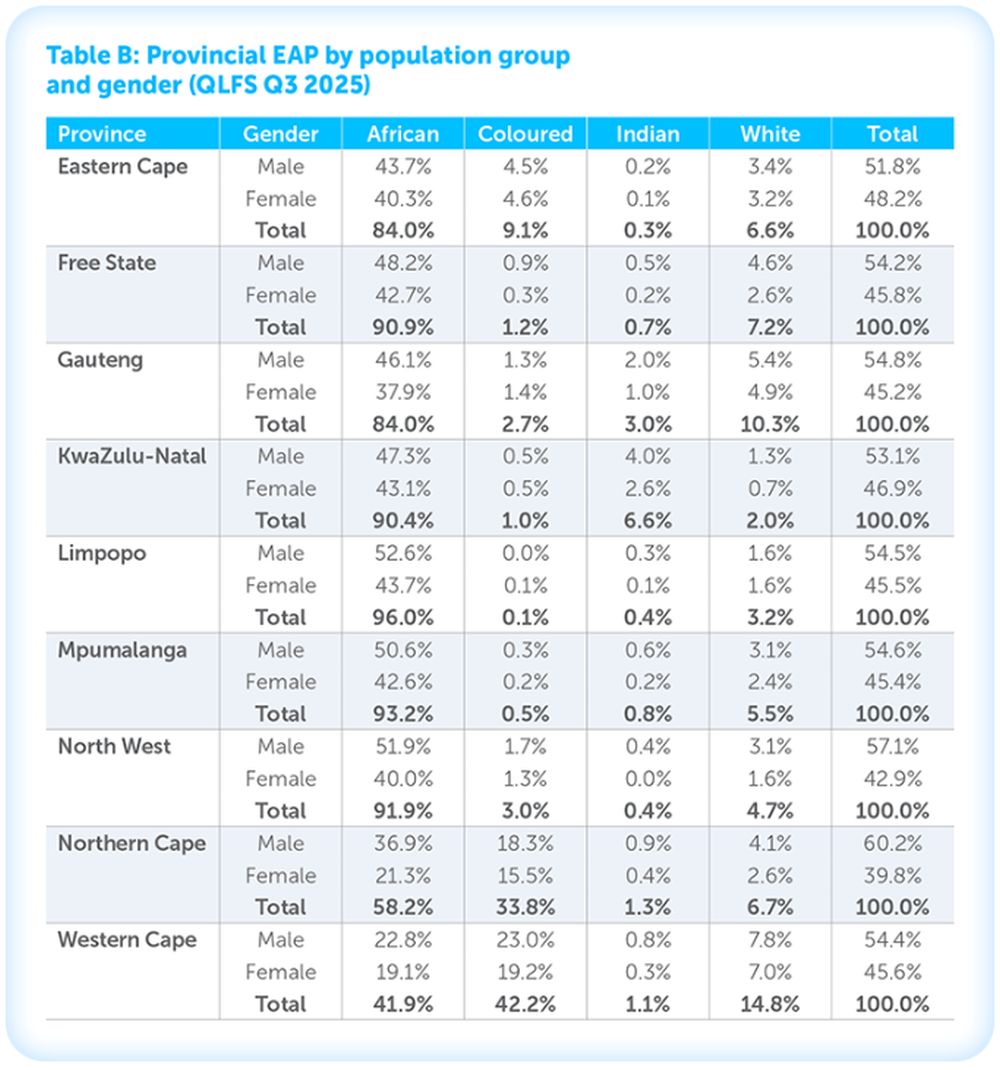
Section 42 of the EEA requires designated employers to take into account both the national and provincial Economically Active Population (EAP) when conducting their workforce analysis (section 19) and when developing and implementing their EE Plans (section 20). The EAP data, drawn from Statistics South Africa’s Quarterly Labour Force Survey (QLFS) for the third quarter of 2025, serves as the benchmark against which employers assess the degree of under- or over-representation of designated and non-designated groups within their workforce.
Table A: National EAP by population group and gender (QLFS Q3 2025)
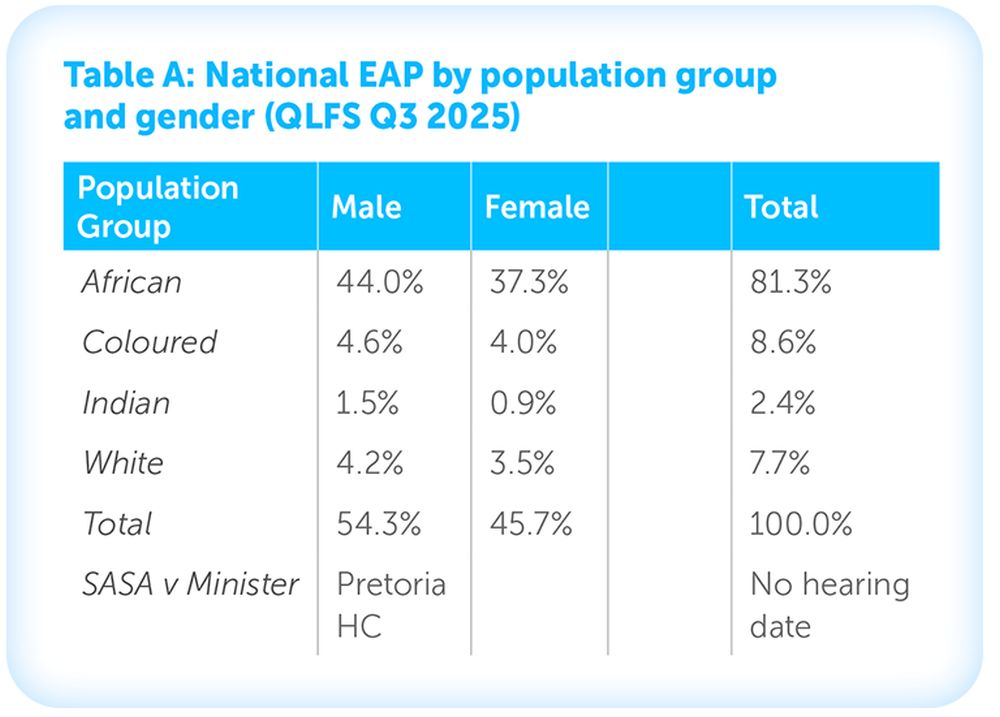
Table B: Provincial EAP by population group and gender (QLFS Q3 2025)
Important notes on the EAP
Employers should note that the EAP reflects the working population up to the age of 64. This is an important consideration for organisations whose workforce includes individuals beyond that age. Where employers employ individuals over the age of 64, those employees must nonetheless be included in the employer’s employment equity reporting. The EAP benchmark does not exempt such employees from the reporting obligation; it merely defines the demographic reference point against which workforce representation is measured.
In light of this threshold, employers may wish to consider aligning their compulsory retirement policies with the age of 64, both for the purposes of consistency with the EAP benchmark and to ensure that workforce planning and equity reporting remain coherent and reflect the composition of the active workforce. It may also assist in achieving transformation objectives.
What this means for employers
The 26th CEE Annual Report indicates that the compliance environment has shifted since the amendments. The introduction of the EE Compliance Certificate creates a direct link between employment equity performance and access to state business, a mechanism that affects all employers doing business with the state. For designated employers, the imperative is clear: annual EE reports must be submitted, EE Plans must set targets taking into consideration the five-year sectoral numerical targets, and the national and provincial EAP benchmarks must be integrated into workforce analysis and planning.
The litigation landscape should not be mistaken for a signal to delay compliance. Until a court orders otherwise, the amended framework remains in effect. Employers are advised to treat the current period not as a time of uncertainty, but as a window for proactive alignment: reviewing EE Plans, ensuring workforce data is current, and engaging meaningfully with the EAP benchmarks and sectoral targets that now define the standard against which compliance will be measured.
The content of this article is intended to provide a general guide to the subject matter. Specialist advice should be sought about your specific circumstances.
[View Source]