

One of the objectives of the new tax laws is to ‘optimize fiscal revenue’. It is expected that the implementation of the laws will double tax-to-GDP ratio in the short run. This is by widening the tax net while providing incentives to already-compliant taxpayers to pay more tax. The tax laws also increase the power of the tax authorities to have access to hitherto private banking records to discourage tax evasion.
However, the collection report for the first quarter of 2026 (January to March) indicates that there is still room for improvement. While tax collection fell short of target by about 25%, the amount collected was nevertheless higher than in the equivalent period in 2025. After adjusting for inflation, the gains are more modest, and overall performance appears broadly flat over the past five years.
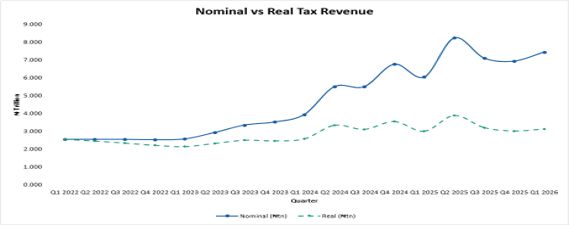
Source: FIRS/NRS FAAC documents and confirmed press statements (nominal tax revenue); NBS Headline CPI reports (inflation rate used to derive real revenue).
While it is early to conclude on whether the reforms will optimize tax revenue, it is not out of place to consider areas that may need ‘further reforms’ to enable the country to realize the full benefits of the exercise.
The objective of this article is to review the provisions of the new tax laws that have reduced the tax burden for compliant businesses. While this is an acceptable development to encourage investment, we suggest things that need to be done to ensure that tax payable by new taxpayers will not only be enough to cover the gap from reduced tax burden for the existing taxpayers, but the increment will lead to doubling the tax-to-GDP ratio.
Tax ‘incentives’
The new tax law introduced the following incentives, which are standard in most developed economies:
- Full recovery of input VAT – Section 155(4) of the Nigeria Tax Act 2025 (NTA) provides:
“Input tax incurred by a registered person on any taxable supply, including services and fixed assets made to such person, may be deducted from the tax payable by the person on its taxable supplies …”
On commencement of VAT in Nigeria in 1993, companies were permitted to recover all input VAT incurred from output VAT. The restriction introduced along the line represents a departure from that principle. It is encouraging that adjustment is now being made to reflect international best practice.
- Re-introduction of zero-rated VATable supplies– Section 186 of the NTA provides:
“Subject to paragraph 2 of the Tenth Schedule to this Act, the following taxable supplies are charged to VAT at the rate of zero percent”
This is not a new development in the history of VAT in Nigeria. The challenge in revenue generation to fund budgetary requirement and possible lack of trust in the system led the Federal Government to abrogate zero-rated VAT system. While it is a relief that this is re-introduced, one hopes government will be able to refund the input VAT that the affected suppliers will incur as required by the law.
- Non-restriction of claim of capital allowance: Section 24(7) of the Second Schedule of the abrogated Companies Income Tax Act 1990 limits the amount of capital allowance that non-manufacturing and non-agricultural companies can claim. It provides as follows:
“… the amount of capital allowances to be deducted from assessable profits in any year of assessment shall not exceed sixty-six and two thirds of a per cent of such assessable profits of a company …”
All expenditure incurred to generate taxable income should be tax-deductible. The practice of classifying some as capital for the purpose of creating timing difference in tax recovery is artificial. It is a relief to companies that are paying tax when they still have significant capital allowance to recover.
- Introduction of minimum top-up tax– Section 57(a) of NTA 2025 specifies the new minimum tax payable by large companies and multinational enterprises (MNEs):
‘Notwithstanding any provision of this Act or any other enactment, where, in any year of assessment, the effective tax rate that is, covered taxes as a percentage of net income, of a company is less than 15%, such company shall recompute and pay an additional tax that makes its effective tax rate equal to 15%.”
This provision is applicable to companies with turnover that is more than N50.0 billion and MNEs with consolidated revenue of more than £750.0 million.
This is a departure from when companies were assessed to minimum tax at a percentage of their turnover. Companies will now pay a percentage of their profits as tax in line with basic principle of taxation. Companies in net loss position are excluded from tax payment.
- Tax deductible expenses are no longer required to be reasonable and necessary – The acid tests for tax deductibility of expenses were also ‘halved’. Section 20 of NTA 2025provides that:
“Except where the provisions of section 18 of this Act or Part XI of Chapter Two apply, for the purposes of ascertaining the profits or loss from any trade, business, profession or vocation under this Act, there shall be deducted all expenses for that period wholly and exclusively incurred in the production of the income, including …”
Companies are no longer required to prove that an expense is both ‘reasonable and necessary’. Such should be dictated by business exigency. If incurring the expense will result in taxable income where NRS will also benefit, it does not need to be ‘reasonable and necessary’.
The above ‘incentives’ have reduced the tax burden for most companies. The widening of the tax net to include those operating in the free trade zones and selling into customs territory may not make up for the reduction.
In the remaining segment of this article, we suggest measures that can be considered to leapfrog the fiscal tax revenue generation that may help achieve one of the objectives of the tax reform legislation.
Suggested reforms for implementing the tax reform legislation
Possibly in response to the below target performance, NRS has stepped up on implementation of the fiscalisation policy in the Nigeria Tax Administration Act (NTAA) and conduct of tax audits and investigations.
NRS has rolled out the implementation of the invoicing arrangements where companies are required to register and validate all invoices issued to customers through the e-invoicing platform. This will enable online real time access of NRS to all invoices and monitoring of full report of taxable income for tax purposes. This scheme is being implemented in phases. Enforcement for companies with turnover of above N5billion commenced in April 2026. However, for those companies with turnover between N1billion and N5billion, enforcement will start in January 2027 while it will be 1 January, 2028 for others.
With regards to tax audits and investigations, NRS is pushing for faster resolution of issues with the aim of getting taxpayers to remit any agreed tax liability. This may, however, not remedy the situation. Based on available indications, however, this alone may not significantly change the overall position, as revenue generated from tax audits and investigations appears to represent a relatively small share of total tax collection.
Nevertheless, we suggest three major ways by which tax revenue generation can be accelerated:
- Voluntary compliance - The size of Nigeria’s underground economy significantly exceeds the formal sector. This is where the bulk of economic activities with significant taxable profits are hidden. Most Nigeria entrepreneurs exploit gaps in the tax revenue collection system to evade tax remittance. The provisions of the law to deter such acts are also relatively lax. Despite enormous tax evasion, one is not aware of anyone behind bars for tax evasion.
It will also be unrealistic to expect compliance without complementary appreciation where the citizens can identify the benefits of tax payment. Lagos State Government is an example of how to encourage taxpayers through obvious developmental strides. The aggression in tax collection is accompanied by provision of infrastructure.
There is positive correlation in tax compliance and good governance. Thus, with the noticeable improvement especially in road infrastructure in the country, there is need for NRS to use this to encourage voluntary compliance. Lagos State Government achieves this through adequate enlightenment programs. The breakthrough that the country requires to achieve high tax-to-GDP ratio is through massive voluntary compliance.
- Adopt performance-based compensation system – This may be a strange concept for government sector in Nigeria. One must, however, appreciate the importance of fiscal revenue generation to sustainable economic development. The country must do everything possible to avoid falling into debt trap.
Most tax officials do not appreciate how important their work is to the overall emancipation of the country. There is need to encourage proper attitude to work and high level of professionalism by tying their compensation to performance - meeting targets without any form of harassment and intimidation of the taxpayers.
The private sector, especially the leading ones, have discovered the benefits of rewarding employees based on the level and quality of performance. There is need to put an end to the era of rewarding everyone equally irrespective of level of contribution to the overall objective of NRS.
- Adopt risk-based audit procedure – NRS audit exercise focus mostly on the highly compliant ones. It mostly ignores those that are outside the tax net. There is need for NRS to adopt risk-based audit procedure. Of what significance is it for NRS to continue to audit a company that additional tax realized from the exercise does not exceed one percent of total tax self-assessed and remitted? Why does NRS still audit companies that they (i.e. NRS) itself give recognition award as responsible taxpayers? Why carry out an audit for the purpose of reducing tax loss/assets of a company?
If NRS were to be privatized today, would the new owner deploy resource to an activity that will not yield compensatory revenue? There is still much to be desired in the current approach, which appears to place a greater burden on compliant taxpayers, while the non-compliant ones are often left out.
Conclusion
One must commend the efforts of the current administration in reforming the entire framework and thrust of the Nigeria’s tax laws. It is also commendable that, despite all challenges, the Federal Government and its team stayed the course to complete the project. This is, however, the easiest part of any reform.
The real reform is implementation. There is need to reform the mindset of the people to make the policy work. Our submission is that the government should initiate steps that will make the efforts of the tax reform worth it. Laws should codify the people's discipline, not substitute it. To pass a law that will be ignored is to trade actual authority for the illusion of control. We would like to end this piece with the quotation by Thomas Jefferson: "The execution of the laws is more important than the making of them."
The opinion expressed in this article is solely personal and does not represent the views of any organization or association to which the authors belong.

