

Key Dates & Deadlines: Q2 2026
The following are key dates and deadlines in Q2 2026 and some key forthcoming dates in the legal and regulatory calendar.
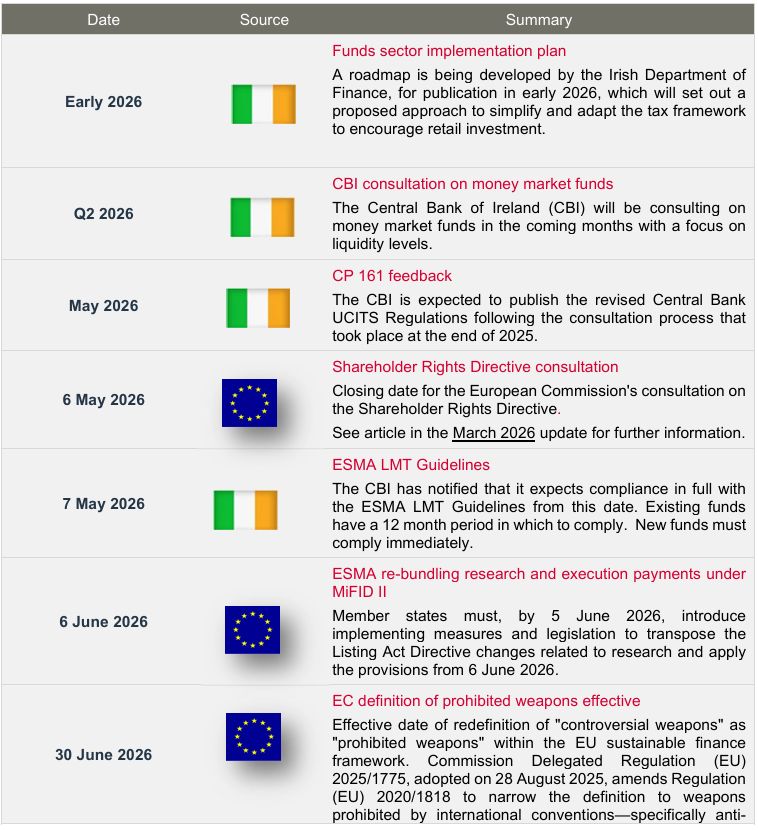
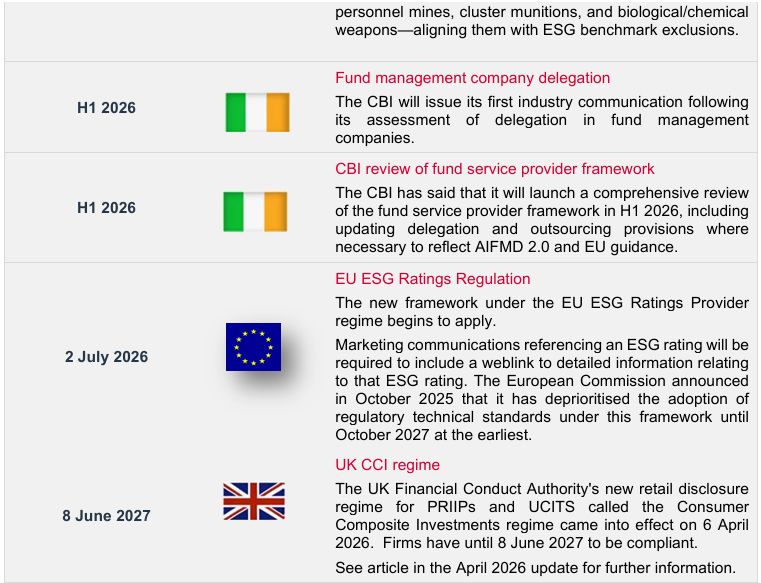
Irish AIFMD II statutory instruments and revised AIF Rulebook published
The Irish legislation implementing the provisions of AIFMD II updating the UCITS and AIF legislative frameworks has been published in Iris Oifigiúil and came into operation on 1 May 2026. The enhanced reporting provisions for AIFs and UCITS under AIFMD II will come into effect on 16 April 2027. The legislation is in the form of separate statutory instruments updating the existing Irish UCITS legislation and the existing Irish AIFMD legislation; S.I. No. 181 of 2026 European Union (Alternative Investment Fund Managers) (Amendment) Regulations 2026 and S.I. No. 182 of 2026 European Union (Undertakings for Collective Investment in Transferable Securities)(Amendment) Regulations 2026. We expect that the Irish implementing legislating implements the AIFMD II provisions with little or no changes to those set out in the AIFMD II Directive.
AIFMD II
AIFMD II became effective on 16 April 2026. Key changes include a new EU-wide regime for loan-originating AIFs, enhanced delegation requirements and strengthened liquidity management tools for open-ended funds. The reforms also refine regulatory reporting, data sharing and depositary oversight and extend relevant changes to the UCITS framework where appropriate, ensuring greater consistency between regimes while preserving their distinct fund models.
CBI rules
The CBI published its revised AIF Rulebook on 5 May 2026 as well as a feedback statement to CP162. Changes in the revised AIF Rulebook are being made to align with AIFMD II changes as they relate to AIFs. Other changes in the AIF Rulebook are being made to enhance Ireland's private asset fund offering.
The updated CBI UCITS Regulations are also expected following CP161.
AIF Rulebook: summary of key changes
The Central Bank of Ireland (CBI) has published the revised AIF Rulebook and its feedback statement to Consultation Paper 162 (CP162). The AIF Rulebook is effective from 5 May 2026.
This follows the transposition of Directive (EU) 2024/927 (AIFMD II) into Irish law amending the European Union (Alternative Investment Fund Managers) Regulations 2013 (AIFM Regulations). This is a significant update to the Irish regulatory framework for alternative investment fund managers (AIFMs) and alternative investment funds (AIFs).
The revised AIF Rulebook applies to Irish authorised AIFs and AIFMs. It also applies to non-Irish AIFMs to the extent provided for in the AIF Rulebook where they manage or market Irish authorised AIFs or are otherwise subject to CBI supervisory requirements.
CP162 proposed significant changes to the AIF Rulebook. These changes align with the AIFMD II transposition, the EU goal of reducing regulatory burdens and improving the accessibility of financial products and the Department of Finance Funds Sector 2030 Review objectives. The latter included a recommendation to further support the growth of private assets. The CBI has implemented substantially all of the key proposals set out in CP162 while also taking account of industry feedback.
AIFMD II rules on delegation, liquidity management tools, loan origination, reporting and depositaries have been implemented through the revised AIFM Regulations.
Fund managers should review existing documentation and operational frameworks to ensure alignment with the revised AIF Rulebook and updated AIFM Regulations.
Key updates in the revised AIF Rulebook
Qualifying Investor AIFs (QIAIFs)
- The loan origination QIAIF category has been removed. Instead, the harmonised EU loan origination framework under AIFMD II applies. This is implemented through the AIFM Regulations.
- Aligned with the new loan-originating framework, the restriction on QIAIFs granting loans or acting as a guarantor for third parties has been removed. Under the revised regime, QIAIFs may now provide third-party guarantees and security, without the need for complex “cascading security” structures that have historically characterised Irish fund finance transactions. This represents a significant and welcome development for lenders to, and sponsors of, QIAIFs, particularly in the context of fund finance and real estate finance transactions, and more broadly strengthens Ireland’s offering for private asset funds, enhancing its appeal to both investors and lenders. It also aligns the Irish regulatory position with leading fund jurisdictions in areas such as fund financing, downstream structuring and loan-origination and ensuring sponsors have sufficient flexibility to structure and operate private asset strategies consistent with international best practice.
- where a loan originating QIAIF under the new framework has a registered AIFM, the loan originating QIAIF must be closed-ended and must comply with the loan originating AIF rules contained in the AIFM Regulations.
- Non-EU AIFMs may now manage closed-ended loan-originating QIAIFs, subject to compliance with the loan originating AIF rules in the AIFM Regulations.
- The AIF Rulebook now clarifies that both open-ended and closed-ended QIAIFs may allocate assets at share class level, provided the arrangement does not pursue a separate investment objective, operate as a de facto sub-fund, or circumvent other share class requirements. The AIF Rulebook, provided certain rules are observed, now expressly permits QIAIFs
- to issue interests in a QIAIF other than at NAV without prior approval of the CBI
- to apply excuse and exclude provisions
- to facilitate stage investing; and
- to facilitate management participation/carried interest.
Charity share classes may also be established subject to specific requirements. In the case of Sharia-compliant funds the requirements will not apply in relation to the ordinary, day-to-day activities carried out in the management of their investments to ensure compliance with Sharia law.
- QIAIFs are no longer restricted from acquiring voting rights conferring significant influence over an issuing body.
- A framework for “intermediary investment vehicles” replaces the subsidiary provisions. This covers SPVs, aggregators and co-investment structures. Prior approval of the CBI to establish a subsidiary is no longer required. The subsidiary is no longer required to have a majority of the same directors as on the board of the QIAIF. The rule requiring the QIAIF to be a party to appointments of or contractual arrangements with third parties is removed. Instead these rules are replaced by disclosure, due diligence and ongoing AIFM oversight obligations. This must be supported by documented policies and procedures.
- QIAIFs can operate a capital commitment mechanism and permit the capital commitment to satisfy the minimum €100,000 subscription requirement. The list of entities that can be exempted by the QIAIF from the minimum subscription requirement has been extended to:
- the AIFM or other entity within the AIFM’s group
- non-discretionary and discretionary investment management or advisory entities to the QIAIF
- the equivalent of a director to those entities
- a consultant to, secondee or partner of any of the entities listed where they hold a formal agreement with those entities (and satisfy existing requirement of being directly involved in the investment activities of the QIAIF)
- The rule that the calculation of a performance fee is verified by the depositary or a competent person has been adjusted. The QIAIF must ensure that the depositary or a competent person appointed by the AIFM and who is approved for the purpose by the depositary, verifies that procedures have been effectively implemented to ensure that any performance fees payable and accrued pursuant to the QIAIF’s performance fee payment cycle are calculated in accordance with the QIAIF’s governing documents. The QIAIF must also ensure that its AIFM provides the depositary/competent person with all necessary information regarding the calculation of the performance fee before a performance fee is paid.
- The AIF Rulebook incorporates the LMT provisions from AIFMD II for the selection, disclosure and use of LMTs applicable to open-ended or open-ended with limited liquidity QIAIFs.
- The AIF Rulebook permits AIFMs to select additional LMTs for open-ended QIAIFs or open-ended QIAIFs with limited liquidity beyond those specified in AIFMD II. AIFMs must disclose at least two LMTs in governing documents and consider selecting at least one quantitative based LMT and at least one anti-dilution tool. Quantitative based LMTs are redemption gates, extension of notice period and redemption in kind. Anti-dilution tools are swing pricing, redemption fee, dual pricing and anti-dilution levy. General LMT notification to the CBI has been removed because the CBI has daily reporting requirements. Immediate notification remains for activation or deactivation of suspensions and specific requirements apply for redemption gates, side pockets and suspensions.
- The AIF Management Company chapter has been deleted. Governance and fitness and probity requirements will apply to directors of AIFM management companies. This will be addressed in a separate Q&A.
Other changes benefitting private asset structures include removal of the current market value cap on warehoused assets, simplified in specie redemptions, simplified process for distribution of assets on a winding up, deletion of the 10% redemption proceeds retention amount and preferential treatment provisions providing a disclosure-based framework for side letter arrangements.
Retail Investor AIFs (RIAIFs)
The CBI has focused on AIFMD II updates and has deferred a broader review of the RIAIF framework. Therefore changes to the RIAIF chapter are more limited. Key changes include the removal of the restriction on granting loans, new LMT requirements, revised performance fee verification procedures, more streamlined reporting and the introduction of stress testing requirements for Money Market RIAIFs.
European Long-Term Investment Funds (ELTIFs)
The ELTIF chapter has also been updated to align with the updated QIAIF framework. This includes new LMT provisions for open-ended ELTIFs, clarification of performance fee requirements, preferential treatment disclosure obligations, requirements relating to charity share classes, extension of entities exempt from minimum subscription requirements and consolidated and simplified voting procedures for changes to duration, investment objective and fees.
CBI fund management company board effectiveness through D&I lens
The CBI published a feedback report for fund management companies Board Effectiveness Review through the Lens of Diversity and Inclusion on 17 April 2026. The report finds that while examples of good practice exist, all fund management companies reviewed exhibited weaknesses in board effectiveness when assessed through a D&I lens. The review makes clear that diversity and inclusion are critical enablers of effective governance, not discretionary or solely cultural considerations.
The CBI emphasises that boards which actively embed D&I into their governance frameworks are better positioned to deliver effective oversight, robust challenge, sound risk management and higher-quality strategic decision-making. Conversely, weaknesses in D&I at board and senior management level are viewed as indicators of elevated governance, behaviour and culture risk.
Key findings
Key findings indicate that many boards:
- Adopted a narrow interpretation of diversity, often limited to gender, without sufficient consideration of diversity of thought, experience or background.
- Did not consistently integrate D&I into core board processes such as board evaluation, succession planning and strategic decision-making.
- Relied on board evaluations that lacked depth, with limited analysis of skills gaps, inclusivity, or effectiveness of challenge.
- Had succession plans that were underdeveloped, outdated or insufficiently linked to long-term board and leadership resilience, with little explicit consideration of D&I.
- Demonstrated inconsistent documentation and transparency in strategic decision-making, including weak evidence of challenge, debate and post-decision review.
- Did not always adequately assess the ongoing independence of long-tenured Independent Non-Executive Directors (INEDs).
Governance assessment by board
The CBI's expectation is that boards will actively respond to these findings. Firms are expected to assess their own governance arrangements against both the issues identified and the examples of good practice outlined in the report, and to implement concrete actions where gaps are identified. This includes embedding D&I considerations into board composition decisions, strengthening evaluation and succession processes, formally enhancing decision-making governance, and ensuring that independence, challenge and diversity of thinking are preserved over time.
Importantly, the CBI signals that D&I should be treated as a strategic governance issue, with clear board ownership, measurable objectives and ongoing review. Boards are expected to demonstrate that D&I is understood, monitored and embedded in how decisions are made—not merely articulated in policies or external initiatives.
In summary, the review requires boards to move beyond passive acknowledgment of D&I and towards intentional, evidence-based integration of D&I into board effectiveness frameworks, with clear accountability and demonstrable outcomes.
Navigating complexity: CBI speech
Gavin Curran, Head of Division – Capital Markets & Funds, CBI gave a speech on 6 May 2026. It covered key messages relevant to fund management companies in relation to the evolution of product complexity and growing reach of sophisticated products into the retail market, what this means for investor protection and why strong governance in distribution is a core determinant of whether investors are treated fairly. It also contains messages for administrators and depositaries in relation to their role under this agenda.
It is set against the backdrop of the EU agenda under the Savings and Investment Union to encourage greater retail investment in capital markets. The CBI's overarching objective is to ensure good investor outcomes and investor protection whilst enabling innovation and the broadening of access that the EU policy agenda demands.
Fund management companies should take time to assess the topics covered in this speech and to understand to what extent they are relevant to the funds legislative and regulatory framework as currently operated.
Themes covered
The first theme in the speech deals with the EU initiative to encourage greater retail participation in capital markets.
The second gives the CBI's views on how product complexity and distribution trends are changing risk in the retail perimeter.
The third theme outlines what the changing landscape means for the funds ecosystem, particularly for management companies.
The CBI also highlights the importance of business standards in its conduct framework and refers to the Consumer Protection Code 2025.
The following summary focuses on the third theme above.
Governance in distribution
The CBI's position is that governance in distribution is not a narrow "sales-compliance" matter. It is a cross firm risk. The CBI expects firms to take product governance frameworks seriously and assess the target market genuinely and rigorously. The distribution strategy must be appropriate for the complexity of the product.
The CBI sets out a series of questions that boards and senior management should be able to answer as part of good governance in distribution. It states that, in a complex ecosystem, these are questions for product manufacturers, management companies and distributors alike. Good governance in distribution means joining up responsibilities throughout the chain, across functions and across firms. Firms should have policies that are applied and work effectively in an investor-centric manner.
The management company as an anchor of confidence
The scale and sophistication of the Irish funds ecosystem means that when products become more complex, and as distribution to retail investors grows, governance becomes even more critical. The CBI considers that the management company is entrusted with core responsibilities that go to the heart of investor outcomes. Distribution strategies are governance decisions, as is made clear in the CBI Fund Management Companies Guidance. The management company should treat distribution as part of the product lifecycle not a downstream activity that sits outside the core control framework. This is particularly important in delegation models.
Boards of management companies must be able to see clearly what is being delegated, to whom, under what control, with what reporting and with what independent challenge.
Fund administrators and depositaries
The CBI looks at the administrator's role as extending beyond the operational, particularly in the context of valuation. It views depositaries as playing a critical role in safekeeping, oversight and in providing confidence to investors that their interests are protected through an independent control layer.
Corporate Governance: What the CBI expects
- Board and senior management of a firm should take genuine ownership of investor protection
- The board should ask probing questions like: Are our products delivering value to end-investors? Is our target market assessment realistic and evidence-based? Are we monitoring the outcomes that investors are actually experiencing and are we taking action where these outcomes fall short of investor expectations? The CBI views a board that delegates these questions entirely to the compliance department as failing in its responsibilities.
- Robust conflicts of interest management. Distribution of investment products to retail investors is an area where conflicts are particularly acute. Revenue-sharing arrangements between product manufacturers and distributors, inducements, tied remuneration structures and the commercial incentives inherent in vertically integrated business models can all create situations where the interests of the firm diverge from the interests of the investor.
- Firms should invest in the competence and professionalism of their staff, including those responsible for the design and oversight of digital distribution channels
- Full transparency and accountability in the use of data and technology
- Firms should foster a culture that prioritises the interests of the client
- Effective and timely reporting to the board. Boards must receive regular and comprehensive management information on product performance, investor outcomes, complaints trends and conduct risks.
High Court sets aside CBI Prohibition Notice of a PCF for serious breaches of fair procedures
The Irish High Court refused to confirm a Prohibition Notice issued by the CBI against a senior executive in the investment funds industry, finding serious breaches of fair procedures throughout the investigation and decision-making process. The individual held multiple pre-approval controlled functions (PCFs) at a fund management company, including CEO, Executive Director, and Designated Person for Investment Management.
The CBI issued a consultation on prohibition notices under the Fitness and Probity regime in January 2026. It included supplemental draft guidance on Prohibition Notices. The consultation closed on 25 March 2026 and a feedback statement and final guidance is awaited.
Hearing not in public
At the outset of the confirmation application, the individual sought an order that the hearing be conducted otherwise than in public. He argued that the proceedings would involve disclosure of deeply personal and sensitive information, including medical and financial matters, and that a public hearing would cause irreparable damage to his reputation, livelihood and family life, given that he had already been subject to the Prohibition Notice for almost the entirety of its duration before the hearing took place. While the CBI neither consented to nor opposed the application, and maintained that reputational harm is not ordinarily a basis for relief, it accepted that the unusual timing and circumstances of the case were relevant. The Court was satisfied that, taken together, considerations of confidentiality and the particular procedural context justified an order that the hearing be held otherwise than in public, emphasising that this was a fact‑specific decision not intended to set a general precedent, and directing that a suitably redacted version of the judgment be published.
Key facts
The individual held multiple PCFs at a fund management company, including CEO, Executive Director, and Designated Person for Investment Management. Following the suspension of a portfolio manager in July 2018 due to irregularities, the CBI commenced an investigation in July 2019 into the PCF holder's fitness and probity. The investigation focused on three grounds: (1) competence as Designated Person; (2) management of concurrent responsibilities; and (3) openness and transparency with the CBI, particularly regarding a meeting on 24 July 2018. The PCF holder resigned from all controlled function roles in February 2020 during the investigation. Despite being described as the "key witness," the PCF holder was never interviewed, nor were any of the numerous witnesses he identified. No oral hearing was conducted. The decision-maker held a brief meeting with the PCF holder in September 2021 but asked no questions. A Prohibition Notice was issued in February 2022, prohibiting the PCF holder from performing any controlled functions for one year.
Legal Analysis & Reasoning
The Court first addressed whether the investigation was ultra vires after the Respondent's resignation, concluding it was not. However, the Court found the process fundamentally flawed on fair procedures grounds. The Court held the burden lay on the CBI to establish the opinion (and process leading to it) was not vitiated by "significant and serious errors." The Court found multiple serious breaches: (1) failure to interview the PCF holder despite describing him as the "primary witness" and despite his medical condition being known; (2) failure to interview witnesses identified by the PCF holder who could provide relevant evidence; (3) failure to hold an oral hearing despite the PCF holder's credibility being central and allegations being extremely serious; (4) the investigator applied the wrong test (focusing on "gaps in evidence" rather than fair procedures requirements); (5) the decision-maker's meeting was a "box-ticking exercise" that failed to remedy earlier defects, with no questions asked despite credibility concerns. The Court emphasised that from the outset, extremely serious allegations were made affecting the PCF holder's honesty, integrity and truthfulness, with potentially catastrophic professional consequences. Given these factors, the PCF holder was entitled to extensive procedural protections. The Court held that while Central Bank legislation requires deference to the CBI's "expertise and specialist knowledge," this does not extend to decisions about procedural fairness, which remain for the Court to determine. The process as a whole was fundamentally unfair and vitiated by a series of significant and serious errors.
Conclusion & Decision
The Court refused to confirm the Prohibition Notice and instead set it aside. The Court declined to remit the matter to the CBI for reconsideration, finding it would be extremely unfair given the PCF holder had been subject to the Notice since February 2022 and the significant time elapsed since the 2018 events. The decision emphasises that serious regulatory allegations affecting credibility require robust procedural protections including interviews, witness evidence, and oral hearings, regardless of the regulator's expertise in substantive matters.
AIFMD II: ESMA simplification of EU reporting frameworks for funds and transactions
ESMA has launched a harmonised approach to funds reporting and an interim report on streamlined, more efficient transaction reporting across European markets.
Final Report on the integrated collection of funds’ data
This relates to the AIFMD II mandate for ESMA to develop a harmonised transaction reporting framework for the fund management sector which would adapt the existing AIFMD supervisory reporting regime and be newly applied to UCITS (which are not currently subject to EU level data reporting).
In the report, ESMA sets out its view on a feasible and proportionate integrated reporting system for investment funds and recommendations for the establishment of a single, modular and dynamic reporting template for reporting under AIFMD and the UCITS Directive. The aim is to reduce duplication, improve data consistency and enhance the usability of data for authorities.
ESMA recommends a two-phase implementation strategy for the new harmonised reporting framework. The first phase will involve consolidating AIFMD and UCITS supervisory reporting requirements with the development of draft regulatory and technical standards (RTS and ITS) for the revised reporting requirements under AIFMD 2. ESMA is due to deliver the draft RTS and ITS to the Commission by April 2027. A consultation on the RTS and ITS can be expected later this year.
ESMA will consider the need for a sufficiently long implementation period for stakeholders to implement the new RTS and ITS requirements. Following the entry into force of the RTS and ITS, go-live of reporting is expected in H1 2029 at the earliest.
Phase 2, which would follow immediately after and is expected to require a few years, would extend the framework to encompass the Money Market Fund Regulation, statistical reporting requirements and potentially other reporting obligations applicable to the fund sector.
Interim Report on the holistic review of transaction reporting
Based on the feedback received from more than 100 respondents to the previous call for evidence on transaction reporting simplification, ESMA has identified the main challenges in the current reporting frameworks, and the most promising approaches to overcome them: instrument‑based and dual-side simplifications and the implementation of a “report once” framework across EMIR, MiFIR and SFTR in the long term.
Most respondents indicated that overlapping and inconsistent reporting requirements, frequent and unsynchronised regulatory changes, fragmented reporting channels and dual reporting are major drivers of cost and complexity.
Considering the need to perform a thorough cost-benefit analysis, the report does not contain policy recommendations yet. As part of the next steps, ESMA will further engage with markets participants, including through an open hearing that will be held on 28 May, before moving forward with final recommendations to be published by mid-year.
Central Bank publishes Good Practices on incorporating implicit costs into the calibration of price-based LMTs
The CBI published a Good Practice note on incorporating implicit costs into the calibration of price-based liquidity management tools (P-LMTs) in April 2026. The good practices outlined in this paper directly support the AIFMD II LMT regime by providing a practical framework for calibrating P-LMTs (including swing pricing, anti-dilution levies, dual pricing and redemption fees) particularly in relation to estimating implicit costs and market impact.
Fund managers should review and incorporate these practices into liquidity management frameworks and policies as relevant. Boards and committees should approve, review and challenge LMT methodologies and outcomes. Processes and decisions should be clearly documented to support accountability. Investors should receive clear, accessible explanations of how P‑LMTs operate and why they are used. Disclosure should manage expectations by acknowledging estimation uncertainty.
Key message
Fund managers are expected to estimate and incorporate total liquidity costs, including market impact, as part of daily liquidity risk management.
P‑LMTs are designed to ensure that the full cost of liquidity arising from subscriptions and redemptions is borne by transacting investors rather than diluting remaining investors holdings.
Incorporating both explicit and implicit transaction costs, including significant market impact, is central to fair value allocation and to mitigating first‑mover advantage, particularly in stressed market conditions.
Explicit and implicit transaction costs
Explicit costs (e.g. commissions, taxes) are relatively stable and predictable, whereas implicit costs (bid‑ask spreads and market impact) are variable and sensitive to asset liquidity and market conditions.
Failure to allocate implicit costs to transacting investors results in material dilution for remaining investors.
Examples for Incorporating Market Impact into LMTs
ESMA requires fund managers to consider significant market impact on a best‑efforts basis when calibrating P‑LMTs.
The approach should be proportionate to fund strategy, asset liquidity and operating model.
Swing pricing
Market impact can be included in swing factors alongside explicit costs and bid‑ask spreads. Calibration should be dynamic, reflecting market conditions and fund‑specific asset liquidity profiles.
Anti-Dilution Levies (ADLs)
ADLs should include implicit costs where flows are large enough to influence NAV. Triggers and thresholds should be fund-specific and reviewed regularly to maintain effectiveness.
Dual Pricing
Dual pricing should be supplemented where necessary to reflect significant market impact, particularly in stressed or less-liquid markets. Pre-defined criteria should determine when additional adjustments are required.
Redemption Fees
Redemption fees should be subject to ongoing review to capture changes in liquidity conditions and implicit costs. Calibration should not be static where market volatility or liquidity changes materially.
Data Sources for Estimating Market Impact
Increasing Accuracy
Using multiple data sources improves the robustness and credibility of market impact estimates. Accuracy supports fair treatment of investors and effective LMT calibration.
Internal Data
Historical trading data provides fund-specific insights into realised market impact. Regular analysis and segmentation by asset class and market conditions is good practice.
Broker Estimates or Indicative Quotes
Broker input can enhance estimates, particularly for less liquid assets. Reliance on a single source should be avoided.
Third-Party Data Providers
External data can supplement internal records, especially for infrequently traded assets. Benchmarking against third-party data strengthens governance and oversight.
Stress Testing and Scenario Analysis
Scenario analysis helps estimate market impact under extreme but plausible conditions. Results should feed into conservative calibration and governance review.
European Commission celebrates 40 years of UCITS
The European Commission issued an article "Celebrating 40 years of UCITS – and looking ahead" in April, commenting on the strength and success of the UCITS brand and how it has been able to adapt to innovation in financial markets.
Notably, the article mentions that UCITS funds have remained by far the most popular type of collective investment vehicle for retail investors in Europe. But they have also established themselves as an attractive product for institutional investors. In fact, roughly only 30% of UCITS are held by retail investors directly, with the rest of the investment coming from institutional investors such as insurers or pension funds (sometimes on behalf of retail clients), corporates and others.
The European Commission is seeking to update the UCITS framework again as part of the market integration and supervision package it tabled in December 2025.
The content of this article is intended to provide a general guide to the subject matter. Specialist advice should be sought about your specific circumstances.
[View Source]
