

The Swiss Parliament has adopted two far-reaching reforms of the Federal Debt Enforcement and Bankruptcy Act (DEBA). The first modernizes and further digitalizes Swiss debt enforcement proceedings, notably through the introduction of a nationwide electronic debt enforcement register extract, expanded electronic communications and online auctions. The second introduces, for the first time, dedicated debt restructuring mechanisms for private individuals, including a simplified composition procedure and a debt restructuring bankruptcy proceeding with the possibility of a discharge of residual debt. Together, these reforms represent a significant modernization of Swiss debt enforcement and insolvency law and will have important implications for creditors, debtors and insolvency practitioners alike.
A Introduction
In the summer session, the Swiss Parliament passed two significant amendments to the Federal Debt Enforcement and Bankruptcy Act (DEBA).
The first amendment1 (I. below) encompasses a series of changes aimed at further digitalizing the debt enforcement process and enhancing its efficiency including the introduction of a Swiss nationwide (electronic) debt register extract, electronic delivery of notices, orders and decisions, as well as online auctions as a new avenue for asset realization, alongside other refinements.
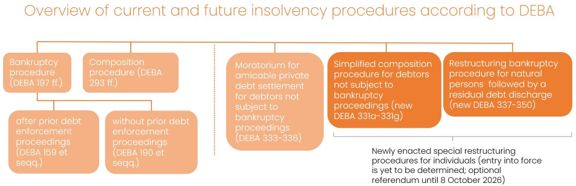
The second amendment2 (II. below) addresses cash-flow insolvency (Zahlungsunfähigkeit; in-solvabilité) of individuals through two new re-structuring mechanisms (Sanierungsverfahren für natürliche Personen; procédure d'as-sainissement pour les personnes physiques): (i) a simplified debt restructuring (composition) procedure (Vereinfachtes Nachlassverfahren; procédure concordataire simplifiée) for those debtors who are not subject to bankruptcy proceedings, and a (ii) debt restructuring bankruptcy procedure with discharge of resid-ual debt (Sanierungskonkursverfahren mit Restschuldbefreiung; procédure d’assainisse-ment des dettes par voie de faillite avec libération du solde des dettes) that grants a once-in-a-lifetime relief from debt under certain cir-cumstances, enabling a “fresh start” to highly indebted individuals.
These newly passed reforms are subject to an optional referendum until 8 October 2026 and their entry into force will be determined by the Federal Council.
B Key changes
1 MODERNIZATION OF THE DEBT ENFORCEMENT PROCESS
1.1 Nationwide debt enforcement register extract
Under Swiss Law, debt enforcement proceedings have hitherto relied on decentralized cantonal debt enforcement offices (Be-treibungsämter; offices de poursuites) with largely paper-based procedures. As a result, debt enforcement register extracts (Be-treibungsregisterauszüge; extrait du registre des poursuites) reflected only debt enforcement proceedings initiated against the debtor within a specific cantonal debt enforcement district, allowing debtors to change their seat or residence and effectively obtain a “clean” record, despite having active proceedings against them elsewhere. From a creditor's perspective, this weakened the extract’s ability to reliably represent a debtor’s financial situation and credit status and required them in order to have a complete view to seek extracts from all districts where their debtor resided in the previous five years.
The Swiss legislator set the ground for a nationwide register extract system. According to new art. 8b(1) DEBA, the Confederation is to operate a central information system containing the data required to provide information on debt enforcement proceedings. It may delegate this task, under its supervision, to an organization that meets the requirements set out in art. 8(2) of the Federal Act of 17 March 2023 on the Use of Electronic Means for the Performance of Public Authority Tasks (new article 8b(2) DEBA). The debt enforcement offices will be required to transmit the data required for the central information system from their own registers (new art. 8b(3) DEBA).
To enable the uniform identification of debtors, the debt enforcement offices and bankruptcy offices are obliged to systematically use the Old-Age and Survivors' Insurance (OASI) number (Swiss social security number) as an identifier for individuals and the enterprise identification number (UID number) for legal entities (new art. 8(1bis) DEBA). The details regarding the central information system including but not limited to its design and operation, data retrieval and security, shall be regulated by an ordinance issued by the Federal Council (new art. 8b(6) and new art. 8c(4) DEBA).
Going forward, two means will be available to obtain a debt enforcement register excerpt: The existing method via the local debt enforcement office, and the modernized central information system with the nationwide extract (new art. 8c DEBA).
The new system aims to mitigate the “debtor's absconding to evade debts” phenomenon and serves to increase substantially the informational value of the debt enforcement extracts for the benefit of creditors such as lenders, landlords and suppliers. Indirectly, the instrument should also lower credit costs for Swiss debtors.
This being said, the register will not be publicly available and, to the contrary, third parties seeking to access it will continue to have to prove an actual interest to the information or obtain the consent of the debtor.
1.2 Electronic deliveries
While creditors can already submit debt enforcement requests electronically today (art. 33a DEBA), the revised art. 34(2) first sentence DEBA provides that, in general, notices, orders and decisions shall also be served electronically, provided that the person concerned expressly requests this, or provided that they have submitted their submissions electronically and have not expressly requested service on paper. In such cases, the authorities will no longer have the choice to effect services electronically, and will not be required to duplicate the service with a service of paper documents. This applies in particular to the creditor’s copy of the payment order (revised art. 76 DEBA) and the loss certificate (Verlustschein; acte de défaut).
However, the amended art. 34 DEBA does not apply to the service of summons to pay (Zahlungsbefehle; commandements de payer) by the debt enforcement office under art. 72 DEBA. Pursuant to art. 72(1) DEBA, a summons to pay currently needs and will continue in the future to be served by the debt enforcement officer, an employee of the office or by post. Having said this, a new art. 72(3) DEBA provides that if such initial service fails, it may subsequently be effected electronically with the debtor’s consent (i.e. voluntarily), provided that the following conditions are met: 1.
The debtor has been reliably identified prior to service; 2. The debtor is made aware of the contents of the payment order; and 3. The debtor may lodge an objection against the payment order (Rechtsvorschlag; opposition) electronically immediately upon service (see also revised art. 74(1) DEBA).
These changes are welcome as they promote a more streamlined debt process and concomitantly diminish transaction and administrative costs for all parties involved, especially in paper-heavy affairs.
1.3 Online auctions
In addition to already existing methods of re-alization (physical public auction, private sale etc.) of debtor's movable property, the revision introduces an explicit statutory basis for auctioning such assets via publicly accessible online platforms (e.g. Ricardo, Tutti, Anibis, Auctim) in debt enforcement proceedings by way of seizure, bankruptcy proceedings and composition proceedings resulting in a composition agreement with assignment of assets (new art. 129a; revised art. 256(1) and revised art. 322(1) DEBA).
The decision to use an online auction as a method of realization is at the discretion of the debt enforcement office and bankruptcy office, respectively. The key prerequisite for opting for an online auction is the assumption that this method will yield a better realization result than other methods of realization.3
The online auction and its terms and conditions are ordered by an order of the debt enforcement office and bankruptcy office, respectively, which is served on the debtor, the creditor and any third parties involved (new art. 129a(2) and new Art. 259a DEBA). If the realization takes place by auction via a digital platform, it generally results in the conclusion of a contract under private law in accordance with the platform operator’s terms and conditions. Therefore, this contract can no longer be unilaterally rescinded by the debt enforcement office or the bankruptcy office in the event of an appeal against the realization. Consequently, only the said order concerning the choice and the terms of this method of realization (i.e. in particular the appropriateness of this method of realization, the choice of the online platform and the minimum price) may be challenged within 10 days (new art. 132a(4) and new art. 259a DEBA). By contrast, the actual conduct and outcome of the online auction can only be challenged in accordance with the rules on liability in debt enforcement and bankruptcy proceedings (see art. 5(1) DEBA), but while the actual contract of sale via the online platform itself will not be open to a direct challenge.4
1.4 Further minor amendments
Several additional smaller changes are introduced to the DEBA. First, in all debt enforcement proceedings cash payments may generally only be made up to a total amount of CHF 100,000. For higher amounts, the exceeding portion must be processed via a financial intermediary in accordance with the Money Laundering Act of 10 October 1997 (new art. 12(3) DEBA). Currently, this restriction applies only to public auctions according to art. 129(2) DEBA.
Second, regarding creditors' debt enforcement requests (Betreibungsbegehren; réquisition de poursuite), a new art. 67(4) DEBA is added stating that the Federal Council may regulate the content and form of the information contained therein and can, in particular, limit the number of claims made within a single request.
Finally, the revision codifies the case law of the Swiss Federal Supreme Court5 regarding the enforcement of freezing orders (Arrestvollzug; exécution du sequestre) in accordance with art. 275 DEBA. This modified provision will no longer just refer to art. 91-109 DEBA but also to art. 89 DEBA thereby clarifying that attachments may be enforced throughout Switzerland by way of nationwide mutual legal assistance (requisition).
2 DEBT RESTRUCTURING PROCEE-DINGS FOR INDIVIDUALS
The aim of the second reform is to give individuals in debt a second chance for a debt-free life, subject to certain conditions. According to the Federal Council, this is also in the interests of creditors and society as a whole. By providing incentives for reintegration into the labor market, the hope is that public expenditure can be reduced in the long term and the economy should also benefit by way of the removal of existing negative incentives and the economic reintegration of debtors. Hence, the goal of the amendment is to give heavily indebted or destitute individuals the opportunity to put their finances on a sustainable footing. Those affected have currently no realistic prospect of ever living debt-free again or of having more than minimum subsistence under debt enforcement law at their disposal. This can sap their motivation to earn a (higher) income and contribute to debtors remaining in precarious circumstances and, often, dependent on social security benefits. This lack of prospects is accompanied by negative effects on the health of those affected and places a strain on their families.6
The new bill therefore includes a simplified composition procedure for debtors who are not subject to bankruptcy proceedings, and a new debt restructuring bankruptcy procedure for all individuals.
In situations where an individual debtor has a regular income or future income entitlements, a compulsory composition – whereby a majority of creditors can bind individual creditors who do not consent – is considered the best way to find flexible solutions on a case-by-case basis. To facilitate the conclusion of such agreements, the existing rules governing composition proceedings are adapted by the former (simplified composition procedure) in specific areas to meet the needs of private individuals.
Regarding the latter (debt restructuring bankruptcy procedure), for situations in which the necessary majority of creditors cannot be achieved – notably in the case of individual debtors with no means to repay their debt or carrying a heavy debt burden – a fallback procedure is established which provides for the discharge of residual debt after a three-year or four-year repayment period (new art. 345(1) DEBA), during which the debtor may also receive counselling (new art. 25 DEBA).
2.1 Simplified Composition Procedure (Vereinfachtes Nachlassverfahren, Procédure concordataire simplifiée) (new art. 331a-331g DEBA)
The reform is intended to make restructuring accessible to individuals for whom ordinary composition proceedings have traditionally been too costly and cumbersome.
To initiate such simplified composition procedure, the individual debtor who is not subject to bankruptcy proceedings pursuant to art. 39 DEBA, must apply to the composition court, providing documents on its current and anticipated financial situation as well as a provisional debt restructuring plan (new art. 331a DEBA). Provided there is a prospect for the confirmation of a composition agreement, the composition court grants a moratorium (Stundung; sursis) of up to six months and appoints an administrator to oversee the process whereby such moratorium may be extended to a maximum of 12 months (new art. 331b DEBA).
During this period, all current and future debt enforcement proceedings against the debtor are stayed and various deadlines are suspended, except for periodic maintenance and support payments under family law and enforcement proceedings to satisfy claims secured
by a mortgage whereby, as in other composition proceedings, the realization of the mortgage itself, however, remains excluded (new art. 331f DEBA). To streamline the process, in general no creditors’ meetings are held, but instead, the administrator presents the draft composition agreement directly to the creditors for approval (new art. 331f(3) DEBA). Subject to certain exceptions, the composition agreement’s confirmation and its implementation are governed by the general provisions on the composition agreement under art. 305-313 DEBA as well as the provisions concerning ordinary composition agreements pursuant to art. 314-316 DEBA (new art. 331g DEBA). The composition agreement thus confirmed is binding on all affected creditors, including those who did not consent (new art. 331g DEBA in conjunction with art. 310 DEBA). If no agreement can be reached, then new art. 331g lit. c DEBA allows the debtor to pursue other routes such as bankruptcy due to cash-flow insolvency under art. 191 DEBA or the new debt restructuring bankruptcy procedure for individuals under new art. 337(3) DEBA (see hereinafter).
2.2 Debt Restructuring Bankruptcy Procedure with Discharge of Residual Debt (Sanierungskonkursverfahren mit Restschuldbefreiung; Procédure d’assainissement des dettes par voie defaillite avec libération du solde des dettes (new art. 337-350 DEBA)
Any individual, regardless of their asset or income situation, may apply to the bankruptcy court for such a proceeding.
The restructuring bankruptcy is initiated when the statutory conditions set out in new art. 337(3) DEBA are met. These include (a) permanent cash-flow insolvency, (b) no prospects of concluding a composition agreement according to ordinary or simplified composition proceedings or an amicable private debt settlement (which ensures the debtors take other reasonable steps before making use of this ultima ratio measure), (c) no risk of new uncovered liabilities arising during the proceeding, (d) no previous discharge of residual debt, be it in Switzerland or abroad and (e) no criminal conviction or pending proceedings regarding bankruptcy or debt enforcement crimes pursuant to art. 163-171 Swiss Criminal Code).
In many respects, the procedure is largely based on ordinary bankruptcy proceedings (new art. 338 et seqq.) including the liquidation of the debtor’s assets whereby the proceeding is free of charge for the debtor (new art. 340 DEBA).
The second feature of the new procedure is unique to it though: in a subsequent income allocation (Abschöpfung; Prélèvements) period under new art. 345 et seqq. DEBA, the debtor’s distrainable income is systematically allocated to the bankruptcy estate for a period of three or four years (new art. 345(1) DEBA). The bankruptcy estate is then regularly realized and its proceeds distributed to the creditors (new art. 347 DEBA).
Furthermore, the debtor is subject to an enhanced duty of cooperation under new art. 342(3) DEBA in conjunction with art. 232-234 DEBA and they must reasonably and actively look for a source of income during the allocation period (new art. 346 DEBA). In the meantime, the competent debt enforcement office or bankruptcy office (see new art. 341 DEBA) prepares an inventory (new art. 342 DEBA) and a restructuring plan and administers the entire process (new art. 343 DEBA).
At the end of the debt restructuring bankruptcy proceedings including the subsequent income allocation period, the bankruptcy court grants a discharge of residual debt provided the debtor has complied with all its obligations (information, surrender, cooperation and reporting obligations, and has made sufficient efforts to earn income), no new debts have arisen and all other statutory conditions are satisfied (new art. 349 (3) DEBA). The said discharge comprises all claims against the debtor which arose prior to the opening of the debt restructuring bankruptcy proceedings whether or not they were filed in the proceedings. Hence, subject to certain exceptions (such as e.g. fines, family maintenance obligations) (new art. 349a and 349b DEBA), the claims are deemed to have been discharged and become unenforceable against the debtor. Importantly for creditors, rights against co-obligors, joint debtors, guarantors and other persons liable for the debtor are not affected by the discharge (new art. 349a(3) DEBA).
Lastly, the new legislation includes novel measures meant to prevent abuse and avoid a disproportionate benefit to debtors, such as by restricting access to the proceedings in cases of past debt discharge (subject to limited exceptions) or by accruing new extraordinary windfall assets to the bankruptcy estate for up to 20 years after the closing of proceedings, e.g. by inheritance, donation or lottery (new art. 350 DEBA).
C Conclusion
The practical implications of the two new re-form packages remain to be seen. Creditors, debtors and the authorities can expect a more streamlined and digital debt-enforcement process and should thus adjust their internal debt-collection processes accordingly. In particular, the new regime enhances the protection of creditors through the introduced nationwide debt enforcement register extract.
The second part of the reform brings Swiss law closer to many other jurisdictions including neighboring jurisdictions (such as France, Germany and Austria) which are already familiar with such restructuring tools meant for as-set-poor and highly indebted individuals. This reform part constitutes a landmark development marking a paradigm shift in Swiss insolvency law. For the first time, individuals may obtain a comprehensive judicial release from pre-existing debt. Until now, Swiss law offered only limited mechanisms for financially dis-tressed individuals to achieve a comprehensive restructuring and obtain a genuine financial restart.
These new proceedings change the playing field for enforcing claims against private individuals, creditors must therefore anticipate whether their debtor may invoke the new debt restructuring instruments and adapt their enforcement strategies accordingly. Furthermore, guarantors and co-obligors may also be facing increased exposure as creditors will seek recourse to them after debt discharges unless they seek contractual protection taking such outcomes into account.
To sum up, Switzerland will in the future have the following insolvency proceedings whereby the three proceedings on the right only apply to individuals:
Footnotes
1. https://www.fedlex.admin.ch/eli/fga/2026/1767/de
2. https://www.fedlex.admin.ch/eli/fga/2026/1768/de
3. Message, BBl 2024 2173, 2201, 4.1.3.
4. Message, BBl 2024 2173, 2201, 4.1.3.
5. BGE 148 III 138.
6. Message, BBl 2025 356, p. 2.
The content of this article is intended to provide a general guide to the subject matter. Specialist advice should be sought about your specific circumstances.
[View Source]


