

BACKGROUND
- The Government of India promulgated the Income-tax (Amendment) Ordinance, 2026 (Ordinance No. 2 of 2026) on 5 June 2026, for immediate legislative action. The Ordinance amends the Income-tax Act, 2025, with retrospective effect from 1 April 2026.
- This measure forms part of a broader policy push, complemented by regulatory changes introduced by the Reserve Bank of India (RBI) with the objective of deepening India’s sovereign debt market, attracting KEY HIGHLIGHTS stable foreign capital, and providing a tax regime comparable with global financial markets.
KEY AMENDMENTS
TaxAmendment–ExemptionforIncomefromG-Secs
- Eligible taxpayers: The exemption applies to
- Foreign Institutional Investors (FIIs), and
- Bank for International Settlements (BIS)
- TaxexemptionforGovernmentsecurities:
TheOrdinance amends Schedule IV of the Income-tax Act, 2025, which deals with tax exemptions for non-residents and foreign companies, to provide complete exemption on interest income from Government securities and capital gains arising from sale, transfer, or exchange of such securities. This effectively reduces tax incidence on such investments to nil, thereby eliminating the requirement of withholding tax on such income. Prior to the exemption, such interest was taxable for FIIs at the rate of 20%* and capital gains at the rate of 30%*(short-term) and 12.5%* (long-term).
- Effectivedate: The provisions apply retrospectively from 1 April 2026, covering FY 2026–27.
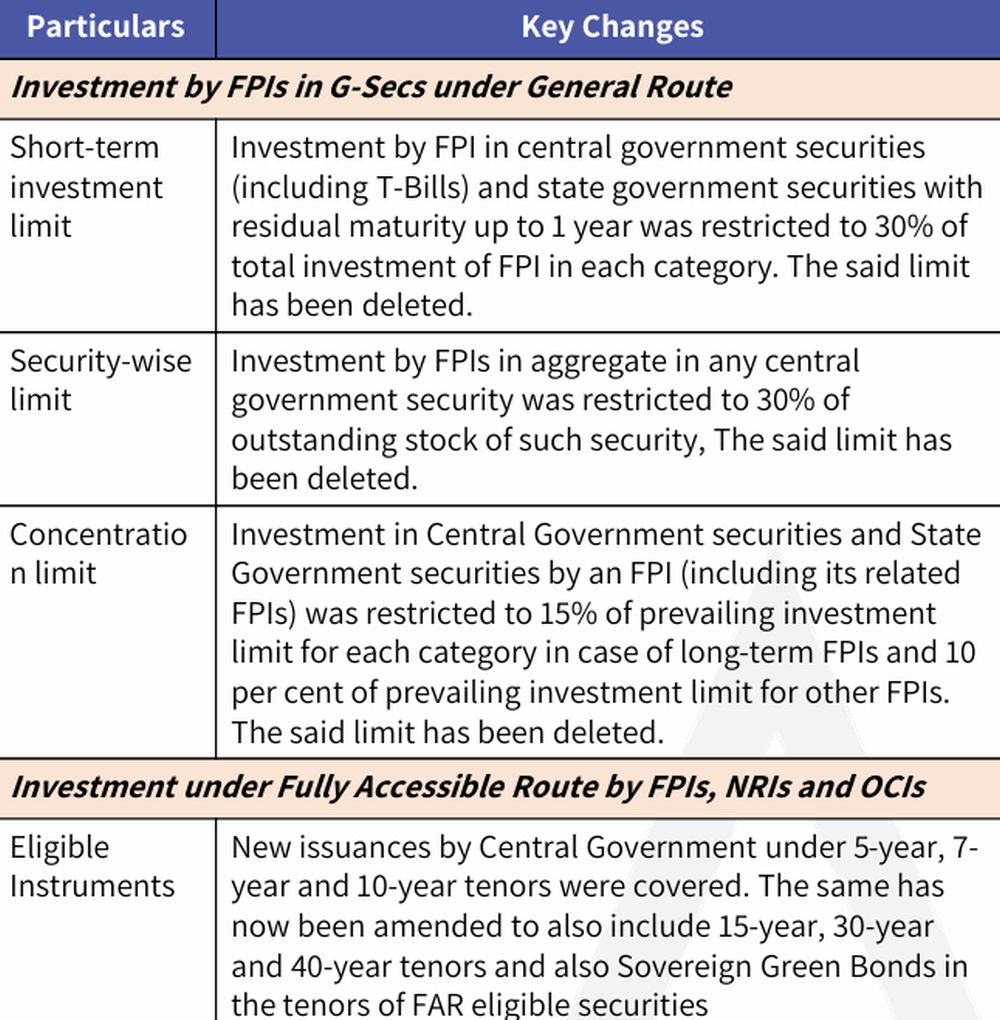
Complementary regulatory measures – Investmentin G-Secs by FPIs
In parallel with the tax changes, the RBI has introduced significant regulatory reforms toease foreign investment inG-Secs, including the
Other Proposed Amendments – Liberalisation of Investments under Portfolio Investment Scheme (PIS)
- In addition to NRIs and OCIs, individual Persons Resident Outside India (PROIs) will be permitted to invest in equity instruments of listed Indian companies under PIS route.
- Limit for investment in any company under PIS route to be increased from 5% to 10% for individual PROI and from 10% to 24% for all individual PROIs together.
- Legislation of above changes through Foreign Exchange Management (Non-Debt Instruments) (Third Amendment) Rules, 2026 is awaited.
AURTUS COMMENTS
- The Ordinance, read together with the RBI’s regulatory relaxations, represents a significant and well-coordinated policy shift aimed at transforming India’s government securities market.
- By providing a complete tax exemption on both interest and capital gains for FIIs and BIS, the measure meaningfully enhances post-tax returns and improves the relative attractiveness of Indian sovereign debt.
- That said, investors will still need to navigate compliance requirements.
The content of this article is intended to provide a general guide to the subject matter. Specialist advice should be sought about your specific circumstances.
[View Source]