
Published: March 3, 2020
Last Updated: September 28, 2026
CRA Net Worth Audits & Assessment: At a Glance
- A CRA net worth audit compares your finances against your reported income. The CRA examines changes in assets and liabilities, along with expenditures, to identify increases in wealth that it believes have not been explained by reported income.
- Lifestyle and spending can attract scrutiny. Real estate purchases, renovations, vehicles, travel, cryptocurrency holdings, cash-intensive businesses, and other spending that appears inconsistent with reported income can contribute to a net worth audit.
- A net worth assessment is not necessarily accurate. CRA calculations can depend on assumptions about assets, liabilities, expenses, transfers, gifts, loans, and other sources of funds, making a detailed review of the assessment important.
- Documentation can be critical when challenging the CRA’s assumptions. Bank statements, receipts, loan documents, mortgage records, and evidence of gifts or inheritances can help explain increases in wealth or expenditures that the CRA has characterized as income.
- Gross negligence penalties may significantly increase the amount at stake. A net worth reassessment can be accompanied by penalties equal to 50% of the understated tax, although the CRA must establish the required grounds for imposing them.
Facing a CRA net worth audit can be overwhelming, particularly when the Canada Revenue Agency is questioning whether your reported income aligns with your assets, spending, and overall financial picture.
At Taxpage, our experienced Canadian tax lawyers help taxpayers understand and respond to CRA net worth audits and assessments. If you’re facing a net worth audit, understanding how the CRA calculates your net worth, what may have triggered the audit, and how you can challenge its assumptions is an important place to start.
Here’s what you need to know about CRA net worth audits and net worth assessments in Canada.
What Is a CRA Net Worth Audit? An Overview from an Experienced Canadian Tax Lawyer
A net worth audit is one of the CRA’s most aggressive indirect verification tools for identifying unreported income. Rather than relying on a taxpayer’s books and records, the CRA tax auditor compares the taxpayer’s opening assets and liabilities for a given tax audit period to that same taxpayer’s closing assets and liabilities, adds in the taxpayer’s expenditures during that period, and treats any unexplained increase as unreported income.
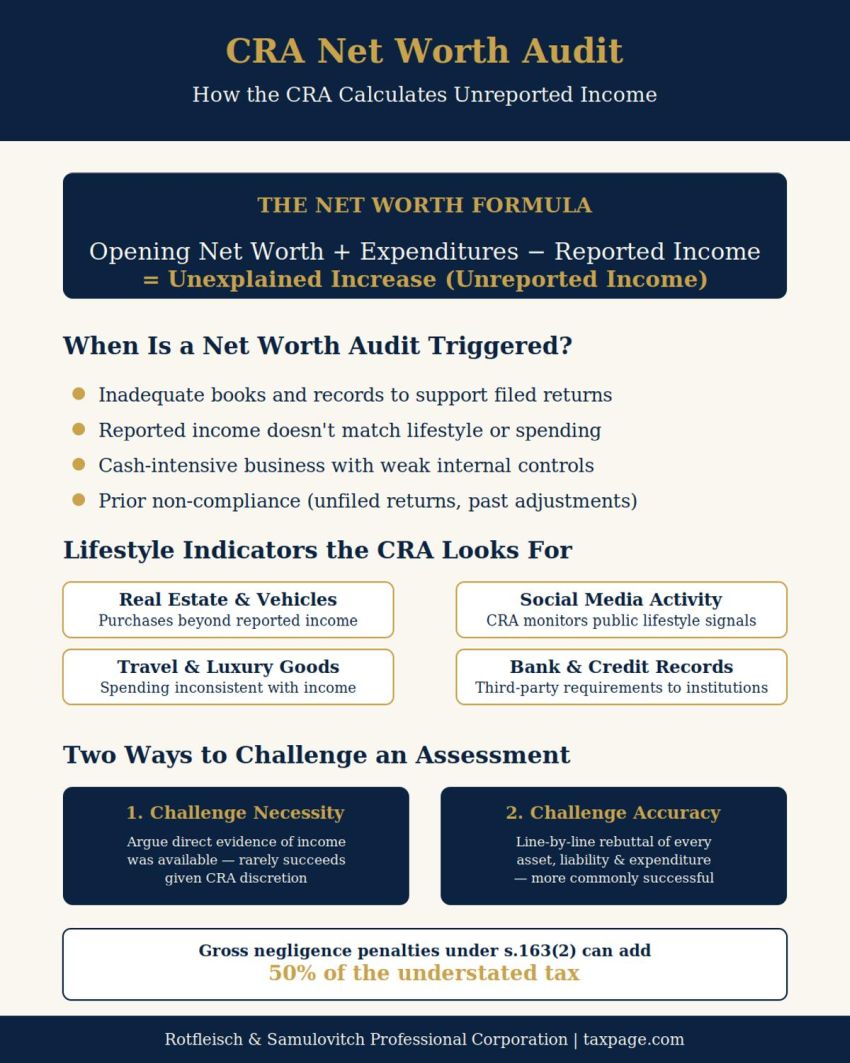
The formula can be expressed as:
Opening Net Worth + Expenditures − Reported Income = Unexplained Increase (Unreported Income)
Any positive difference becomes the basis for a reassessment, often accompanied by gross negligence penalties and interest that can turn a routine tax dispute into a six- or seven-figure liability.
Why Does the CRA Use Net Worth Audits?
The CRA turns to a net worth audit when it believes a taxpayer’s books and records (or the absence of them) do not reflect an accurate picture of income earned. Subsection 152(7) of the Income Tax Act gives the CRA broad authority to disregard a taxpayer’s filed return entirely and assess based on any information it can obtain, including from third parties.
A net worth tax audit is typically triggered by one of two situations:
- The taxpayer has inadequate books and records to support his or her filed returns; or
- The taxpayer’s apparent lifestyle and spending do not match his or her reported income.
The net worth method is one of several indirect verification techniques the CRA can use. The “application of funds” method looks only at expenditures, while the bank deposit analysis method treats unexplained deposits as unreported income. All three approaches are subject to review by the Tax Court of Canada, which has overturned CRA net worth assessments in numerous cases where the underlying assumptions were unsupported.
Lifestyle Indicators That Can Trigger a Net Worth Audit
CRA auditors are trained to look for a mismatch between reported income and observable lifestyle. Common triggers include:
- Real estate purchases, renovations, or mortgage paydowns inconsistent with reported income
- Vehicles, luxury goods, or travel that a taxpayer’s reported income could not reasonably support
- Cash-intensive businesses with weak internal controls or missing records
- Public information, including social media activity, showing a lifestyle at odds with a modest reported income
- Prior non-compliance, such as unfiled returns or earlier audit adjustments, which the CRA treats as a predictor of future non-compliance
- Cryptocurrency and digital asset holdings: the CRA now combines blockchain tracing, exchange reporting, and AI-driven analytics to flag a gap between reported income and actual crypto activity, and unreported digital assets can be folded directly into a net worth calculation as an unexplained increase in wealth
None of these factors alone proves unreported income, but together they can prompt the CRA to open a net worth audit rather than a conventional review.
How the Net Worth Audit Proceeds
Once the CRA decides a taxpayer’s books and records are inadequate, the CRA tax auditor typically issues third-party requirements to banks, credit card companies, and suppliers to obtain information about the taxpayer’s spending. The CRA will also search land title records, examine mortgages, and review the Personal Property Security Registry to identify assets and equity.
In a personal tax audit, the CRA will often examine the finances of the taxpayer’s family members as well, and may impute their spending into the taxpayer’s income if it cannot otherwise be explained.
Once this information is assembled, the CRA tax auditor transcribes it into a net worth schedule using the formula above. Given the sheer volume of information involved, errors are common, and identifying them requires a detailed, line-by-line review by an experienced Canadian tax lawyer.
Net Worth Audits and Gross Negligence Penalties
A net worth reassessment is frequently paired with gross negligence penalties under subsection 163(2) of the Income Tax Act, which can add 50% of the understated tax on top of the reassessment itself. The Tax Court has made clear that these penalties are not automatic and are assessed on a person-by-person basis: the CRA must establish that each individual taxpayer knowingly, or under circumstances amounting to gross negligence, made a false statement or omission.
In Guibord v. Canada, the Tax Court confirmed a gross negligence penalty against the corporate taxpayer but had vacated the penalties originally assessed against the individual family members, illustrating that a finding against one taxpayer in a family or corporate group does not automatically extend to the others.
Our detailed case commentary on Mann v The King and the CRA’s approach to net worth audits and penalty enforcement walks through a similar distinction between a taxpayer’s honest misunderstanding and the kind of conduct that supports a penalty.
How to Fight a Net Worth Assessment
Once the CRA issues a net worth assessment, subsection 152(8) of the Income Tax Act deems it valid, and the onus shifts to the taxpayer to disprove the CRA’s assumptions by establishing a prima facie case (what the courts call “demolishing” the Minister’s assumptions). Only once that threshold is met does the onus shift back to the CRA to justify its position.
Our case commentary on net worth assessments and the onus of proof illustrates just how costly it can be to leave that onus unmet.
There are two main avenues for challenging a net worth assessment:
1. Challenging the necessity of the method itself.
A taxpayer can argue the CRA should not have resorted to the net worth method at all. This argument succeeds infrequently: in Guibord v. Canada, 2011 FCA 344, the Federal Court of Appeal rejected exactly this argument, confirming that once a taxpayer’s books and records are found unreliable, the courts will generally defer to the Minister’s discretion to use the net worth method.
The taxpayers in that case, the family behind a Toronto restaurant, also failed to substantiate a claim that unexplained deposits came from slot machine gambling winnings; the Tax Court and Federal Court of Appeal both found the explanation not credible, illustrating how thin an unsupported explanation can look next to hard banking evidence.
2. Challenging the accuracy of the calculation.
This is the more commonly successful approach, though also the most labour-intensive. It requires an experienced Canadian tax lawyer to analyze and rebut every line item in the CRA’s net worth schedule (opening asset values, closing liabilities, and every expenditure assumption), often by substituting actual documented expenses for the Statistics Canada averages the CRA defaults to when records are incomplete.
David J. Rotfleisch, Certified Specialist in Taxation Law (Law Society of Ontario), notes:
“Net worth assessments are won or lost on documentation, not on legal argument. The taxpayers who come to us early, with bank records, receipts, and a clear paper trail for every gift or loan, are the ones who see their reassessment reduced or eliminated. The ones who wait until after the CRA has already built its schedule are fighting from a much weaker position.”
Related Case Law
Guibord v. Canada, 2011 FCA 344: the Federal Court of Appeal upheld a net worth reassessment against the family behind a Toronto restaurant, confirming the CRA’s discretion to use the net worth method once records are found unreliable and rejecting an unsupported gambling-winnings explanation for unexplained deposits.
Net Worth Assessment: Boroumand v The Queen: a taxpayer assessed over $3.5 million in unreported income was unable to substantiate a claim that the funds were gifts and an inheritance, illustrating the evidentiary burden a taxpayer faces at trial.
Myers v Canada (Attorney General), 2022 BCCA 160: confirms the net worth method is recognized by Canadian courts as a method of “last resort.”
How CRA Conducts Net Worth Audits & Penalty Enforcement: Mann v The King: the Tax Court’s most recent detailed treatment of net worth methodology and gross negligence penalties.
Get Net Worth Audit Help From a Canadian Tax Lawyer
If you are being subjected to a net worth audit, contact our experienced Canadian tax litigation lawyers. Our team can deal directly with the CRA tax auditor on your behalf, challenge the auditor’s schedules on an item-by-item basis, and ensure you are not forced into bankruptcy when the CRA deploys the net worth assessment against you.
In one recent net worth audit matter, our firm reduced a taxpayer’s reassessed income from approximately $727,000 to approximately $310,000 and eliminated gross negligence penalties exceeding $66,000, for total savings of approximately $330,000.
See our Case Results page for this and other outcomes.
FAQs
Who is most likely to undergo a net worth audit?
The CRA selects taxpayers for net worth audits based on risk indicators, including inconsistencies between third-party information and reported income, non-compliance with payroll or GST/HST obligations, failure to respond to CRA information requests, and unexplained amendments to prior tax returns.
Can I refuse to give certain information during a net worth audit if it’s private?
You can refuse, but doing so can result in significant penalties, since the CRA has broad legal authority to compel information from you and from third parties. The Privacy Act protects the confidentiality of information you do provide.
Is the CRA’s net worth audit methodology always reliable?
No. The methodology relies heavily on assumptions, and our firm has found fundamental errors in CRA working papers, including double-counted shareholder loan amounts and duplicated inter-bank transfers.
How far back can the CRA go in a net worth audit?
The CRA is generally limited to the normal three- or four-year reassessment period, but this limit does not apply where the CRA can establish that a taxpayer made a misrepresentation attributable to neglect, carelessness, or wilful default, which allows the CRA to reassess statute-barred years.
What penalties can result from a net worth reassessment?
Beyond the reassessed tax and arrears interest, the CRA frequently imposes gross negligence penalties under subsection 163(2) equal to 50% of the understated tax, and in the most serious cases may refer a file for criminal investigation.
Does the CRA use social media in a net worth audit?
Yes. The CRA has confirmed it monitors publicly available information, including social media, as one indicator of a taxpayer’s lifestyle relative to reported income.
What records should I keep to defend against a net worth audit?
Bank statements, credit card statements, loan and mortgage documents, receipts for major purchases, and records of gifts, inheritances, or loans from family members are all critical, since the CRA will assume any unexplained deposit or asset increase is taxable income absent documentation to the contrary.
Can a net worth assessment apply to a corporation as well as an individual?
Yes. While net worth audits are most commonly associated with individuals, the CRA can apply an analogous indirect verification approach to a corporation’s books and records where they are found to be inadequate.
What is the difference between a net worth audit and a bank deposit analysis?
A net worth audit compares a taxpayer’s total assets and liabilities at two points in time, while a bank deposit analysis focuses narrowly on unexplained deposits into a taxpayer’s bank accounts. The CRA may use either method, or both, depending on the available evidence.
Should I hire a lawyer or an accountant to fight a net worth audit?
Both roles matter, but only a lawyer can assert solicitor-client privilege over communications and represent you before the Tax Court of Canada if the dispute proceeds to litigation. The CRA can seize an accountant’s files, including meeting notes and planning memos, but cannot compel disclosure of confidential communications with a Canadian tax lawyer. Many taxpayers engage a Canadian tax lawyer early precisely to protect that privilege before sensitive information is created.
Does cryptocurrency get included in a net worth audit?
Yes. Unreported cryptocurrency holdings and gains are treated the same as any other unexplained increase in wealth. The CRA now combines blockchain tracing, exchange reporting, and AI-driven analytics to identify a gap between reported income and actual crypto activity, and can fold undisclosed digital asset value directly into a net worth calculation.
The content of this article is intended to provide a general guide to the subject matter. Specialist advice should be sought about your specific circumstances.
[View Source]