

Article Summary
Summary judgment is one of the most effective procedures available in Queensland debt recovery litigation, allowing a court to determine a claim without a full trial where the defendant has no real prospect of successfully defending the proceeding, and there is no need for a trial. When used appropriately, it can significantly reduce litigation costs, shorten the time required to obtain judgment, and allow creditors to pursue enforcement much sooner than through the ordinary litigation process.
However, summary judgment is not available simply because a debt is unpaid. Queensland courts exercise considerable caution before finally determining proceedings without a trial, particularly where factual disputes, credibility issues or competing evidence require judicial determination. Success depends not only on proving the debt, but on demonstrating through clear documentary and affidavit evidence that the defence has no real prospect of success and that a trial would serve no useful purpose.
This guide explains how summary judgment works under the Uniform Civil Procedure Rules 1999 (Qld), when it is appropriate, the evidence required to maximise the prospects of success, the leading authorities applied by Queensland courts, and the commercial risks that creditors should consider before making an application. It also compares summary judgment with default judgment, outlines the enforcement options available once judgment is obtained, and highlights the practical mistakes that frequently cause otherwise strong applications to fail.
Whether you are seeking to recover an unpaid debt or responding to a summary judgment application, understanding the legal test, evidentiary requirements and strategic considerations is essential. Obtaining experienced legal advice at an early stage can often determine whether summary judgment provides the fastest and most commercially effective path to resolving the dispute.
What Is Summary Judgment?
Summary judgment in debt recovery can provide an earlier pathway to judgment where the debtor has no real prospect of successfully defending all or part of the claim, and there is no need for a trial of that claim or part. It is not available simply because money is owed. The court must be satisfied that both requirements in r 292 of the Uniform Civil Procedure Rules 1999 (Qld) are met.
When appropriate, summary judgment can reduce litigation costs and allow earlier enforcement. However, strict evidentiary requirements apply, and courts remain reluctant to grant summary judgment where a genuine factual or legal dispute exists.
If you are facing a summary judgment application in a debt recovery proceeding and require legal assistance, contact us today for a free 30-minute consultation with one of our experienced debt recovery professionals.
What Is Summary Judgment in Debt Recovery?
One of the most common questions creditors ask is whether they can avoid the time and expense of a full trial when recovering an unpaid debt. This infographic provides a simple decision-making framework that explains when summary judgment may be available under Queensland’s civil procedure rules, helping readers quickly determine whether their claim is likely to qualify before investing further time and incurring legal costs.
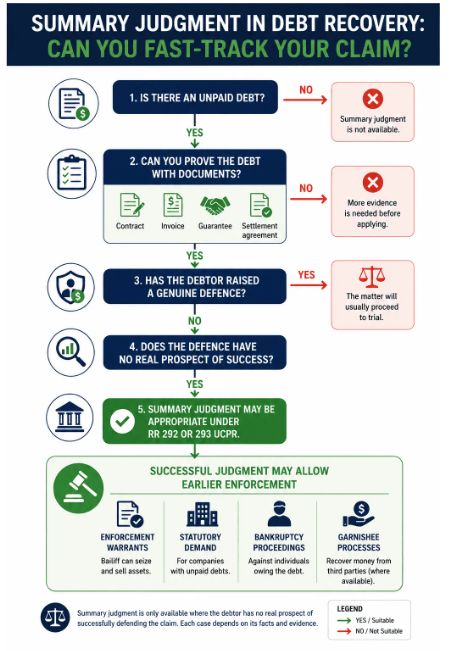
Summary judgment is a procedure that allows a court to determine all or part of a claim without a full trial where the opposing party has no real prospect of success and there is no need for a trial of the claim or relevant part. It exists to avoid unnecessary trials, resolve clear cases efficiently, and preserve court resources for disputes that genuinely require oral evidence and factual findings. Unlike default judgment, which is based on a defendant’s failure to respond, summary judgment requires the court to assess the merits of the defence.
If the debtor has failed to file any defence, the procedure is different. Our article Default Judgment Where No Defence Has Been Filed explains when default judgment may provide a faster pathway to obtaining judgment.
In Queensland, r 292 of the Uniform Civil Procedure Rules 1999 (Qld) permits a plaintiff to apply for summary judgment after the defendant has filed a notice of intention to defend. The court may give judgment for the plaintiff if the defendant has no real prospect of successfully defending all or part of the claim and there is no need for a trial of that claim or part. Rule 293 provides a corresponding procedure for a defendant where the plaintiff has no real prospect of succeeding on all or part of the claim, and there is no need for a trial. Comparable summary-disposition procedures also exist in other Australian jurisdictions, although their precise wording and operation differ.
In Spencer v Commonwealth (2010) 241 CLR 118; [2010] HCA 28, the High Court considered the federal summary-dismissal test under s 31A of the Federal Court of Australia Act 1976 (Cth), which asks whether a party has “no reasonable prospect” of success. Although that statutory language differs from the “no real prospect” wording in the Queensland rules, the decision provides important guidance about the caution required before finally determining a proceeding without a trial, particularly where disputed factual issues remain.
At [17], French CJ and Gummow J reproduced the relevant wording of s 31A(2) of the Federal Court of Australia Act 1976 (Cth):
The Court may give judgment for one party against another in relation to the whole or any part of a proceeding if:
(a) the first party is defending the proceeding or that part of the proceeding; and
(b) the Court is satisfied that the other party has no reasonable prospect of successfully prosecuting the proceeding or that part of the proceeding.
Many creditors assume that summary judgment and default judgment are interchangeable because both can result in judgment being entered before a full trial. In reality, they apply in very different circumstances and have different legal requirements. The table below provides a quick comparison to help readers identify which procedure may be available in their debt recovery matter and avoid pursuing the wrong application.
| Issue | Summary Judgment | Default Judgment |
| When is it available? | Where the defendant has no real prospect of successfully defending the claim. | Where the defendant fails to file a required response within the prescribed time. |
| Has the defendant participated? | A notice of intention to defend must have been filed. A defence may or may not yet have been filed. | The defendant is in default because the required notice of intention to defend or defence has not been filed within the applicable time. |
| Does the court consider the merits? | Yes. The court considers whether the defendant has a real prospect of successfully defending the claim and whether there is a need for a trial. | Usually no. The court primarily considers procedural compliance. |
| Evidence required | Comprehensive documentary evidence and supporting affidavit material. | The request and supporting material required by the applicable default-judgment rule, including evidence establishing the defendant’s default and the amount or relief properly claimable. |
| Court hearing required? | Usually yes. | Often determined administratively, depending on the court and circumstances. |
| Can enforcement begin after judgment? | Yes. | Yes. |
| Best suited for | Clearly documented debts where the defendant has no real prospect of successfully defending the claim. | Claims where the defendant simply ignores the proceedings. |
When Can You Apply for Summary Judgment?
The strongest cases for summary judgment in debt recovery usually involve written contracts, invoices, guarantees, settlement agreements, account statements or clear admissions of liability. If the debtor raises a genuine factual or legal dispute, the Court may require the matter to proceed through the ordinary litigation process.
When Summary Judgment Is Most Likely to Succeed
A summary judgment application is most appropriate where the debt is readily proven, the defendant has no real prospect of successfully defending the claim, and there is no need for a trial. Common examples include unpaid invoices, loan agreements, personal guarantees, written contracts, settlement agreements, and debts that have been expressly acknowledged. Although these matters often lend themselves to summary determination, the existence of clear documentation alone does not guarantee success.
How Courts Decide Summary Judgment Applications
The court considers whether the defendant has a real prospect of successfully defending the claim and whether there remains a need for a trial. Relevant considerations may include whether material factual disputes exist, whether credibility findings are required, whether further interlocutory processes may affect the evidence, and whether questions of contractual interpretation depend on contested facts. A defence does not justify a trial merely because it is arguable, but summary judgment should not be entered simply because the court considers that the defence is unlikely to succeed.
Importantly, the court does not conduct a mini-trial on a summary judgment application. It does not resolve contested questions of credibility, make final findings of fact, or weigh competing evidence as though finally determining the proceeding. Instead, the court considers whether the material demonstrates that the opposing party has no real prospect of success and whether there remains any need for a trial.
Practical Example
A supplier commences proceedings to recover an unpaid invoice supported by a written contract, invoices, delivery records and an account statement. The defendant files a defence alleging that the goods were defective but produces no evidence identifying the alleged defects, when they were reported, or how they affected the amount claimed. Depending on the circumstances, the court may conclude that the defence has no real prospect of success and that there is no need for a trial. By contrast, if the defendant produces credible evidence raising genuine issues about the quality of the goods, contractual performance or the amount owing, summary judgment is unlikely to be appropriate.
In Deputy Commissioner of Taxation v Salcedo [2005] QCA 227; [2005] 2 Qd R 232, the Queensland Court of Appeal considered the “no real prospect” test under the UCPR. In Spencer v Commonwealth (2010) 241 CLR 118; [2010] HCA 28, the High Court considered the differently worded federal test and emphasised the caution required where disputed factual issues or unresolved interlocutory processes may affect the ultimate determination.
French CJ and Gummow J stated at [25]:
Where there are factual issues capable of being disputed and in dispute, summary dismissal should not be awarded to the respondent simply because the Court has formed the view that the applicant is unlikely to succeed on the factual issue.
What Evidence Is Required for Summary Judgment in Debt Recovery?
Success in a summary judgment application usually depends more on the quality of the evidence than the strength of the legal argument. Creditors should prepare all documents establishing both the existence of the debt and the evidence demonstrating that the defendant has no real prospect of successfully defending the claim. This typically includes the contract, invoices, payment terms, guarantees, relevant correspondence, letters of demand, account statements, and a supporting affidavit.
Before commencing proceedings, a properly drafted letter of demand may resolve the dispute without litigation. Our guide explains when a solicitor’s demand should be sent and what it should contain.
Affidavit evidence is ordinarily central to a summary judgment application. The applicant’s material should identify the legal and factual basis of the debt, explain how the amount claimed has been calculated, establish when payment became due, exhibit the material documents and address the defence or anticipated defence. The affidavit should be made by an appropriate deponent who can give admissible evidence of the relevant facts or properly explain the source and basis of information drawn from business records. Deficiencies in the affidavit material may prevent the applicant from establishing that there is no real prospect of a successful defence and no need for a trial.
Common evidentiary weaknesses include inconsistent account balances, unclear calculations, missing contractual terms, unsupported assumptions, unexplained business records and evidence that does not adequately identify its source or basis. A material evidentiary deficiency may prevent the applicant from proving that there is no real prospect of a successful defence and no need for a trial.
From a practical perspective, careful affidavit drafting often determines the outcome. Ensuring every material assertion is supported by contemporaneous documents reduces opportunities for a defendant to demonstrate a real prospect of successfully defending the claim. In Deputy Commissioner of Taxation v Salcedo [2005] QCA 227; [2005] 2 Qd R 232, Williams JA explained that rr 292 and 293 effected a significant change to the former approach to summary judgment. In practical terms, this lowered the focus from asking whether a defence was merely arguable to whether it had any realistic prospect of succeeding. At [11], his Honour quoted Lord Woolf MR in Swain v Hillman [2001] 1 All ER 91:
The words ‘no real prospect of succeeding’ do not need any amplification, they speak for themselves. The word ‘real’ distinguishes fanciful prospects of success or … they direct the court to the need to see whether there is a ‘realistic’ as opposed to a ‘fanciful’ prospect of success.
How Quickly Can You Obtain Summary Judgment in Debt Recovery?
Obtaining judgment is only one stage of the debt recovery process. Many creditors are unsure what practical enforcement options become available once judgment has been entered. This infographic explains the next steps, reinforcing that early judgment can lead to faster recovery rather than simply ending the court case.
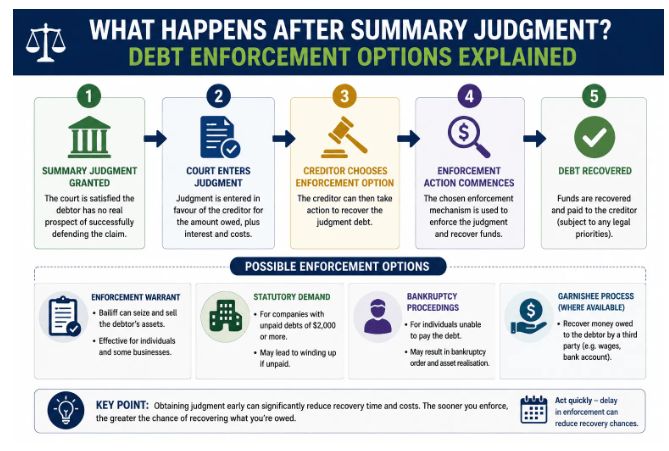
The content of this article is intended to provide a general guide to the subject matter. Specialist advice should be sought about your specific circumstances.
[View Source]