

- within Strategy topic(s)
- with readers working within the Accounting & Consultancy and Construction & Engineering industries
- within Strategy, Intellectual Property and Criminal Law topic(s)
From cost center to competitive advantage: Rethinking labor strategy for restaurant and hospitality operators
The labor model that defined restaurant and hospitality operations for the past 30 years is being structurally disrupted by AI and automation—and leaders are already separating from laggards. Operators who treat this moment as a cost-reduction exercise alone will lose; those who use it to redeploy talent toward guest experience will win. This paper outlines a framework for workforce strategy as a deliberate, staged transformation and identifies where the highest-ROI opportunities currently sit.
Why the status quo is unsustainable
Labor costs for the average restaurant have risen approximately 36% over the past four years, with minimum wage legislation now expanded across more than 20 states driving wage inflation in the 5–8% range annually. For full-service operators, labor as a percent of sales reached a median of 36.5% in 2024. Operators who remained profitable held that figure at 34.2%; those running at a loss averaged 42.9%. That 8-point spread is the difference between a viable business and a distressed one.
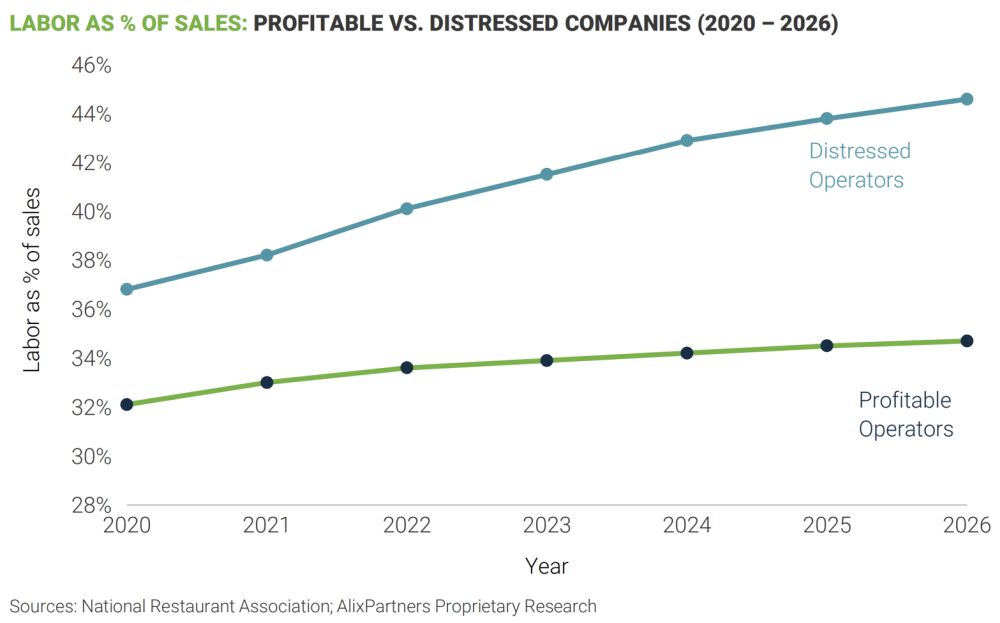
The less-discussed issue is structural: Standardization is no longer the right objective. For decades, multi-unit operators set labor rules that applied system-wide, an approach that ignored nuances with outsized operational impact. Customer demographics, population density, manager tenure, nearby competition, order channel mix—all of these factors create meaningful variance in what right labor looks like at the unit level. Operators now have the capacity to ingest this complexity and act on it in near real time.
Lastly, guest expectations are rapidly rising. Speed, accuracy, and personalization demands have shifted and the workforce model must do more with the same or fewer people to meet them. This is what makes the loyalty flywheel so consequential: Consistent operational execution builds guest trust; trust drives loyalty program enrollment; loyalty data enriches demand forecasting; better forecasting makes labor planning more precise. Brands running this loop well are compounding their operational advantage, while those still scheduling off last week's actuals are not.
The AI opportunity in workforce management
Operators benefit from thinking about AI applications across three distinct tiers that have differing maturity levels and impact today. The experience of one national operator—a 350-unit fast casual brand with a hybrid dine-in and digital ordering model—illustrates how the tiers work in practice and in sequence.
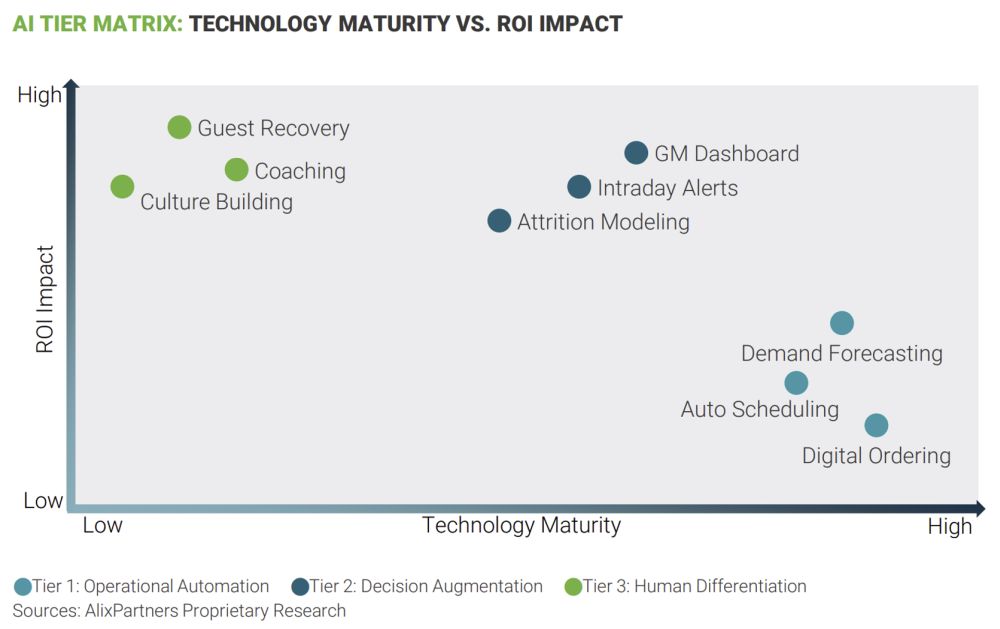
Tier 1 — Operational automation: AI can fully absorb or meaningfully augment scheduling, demand forecasting, inventory workflows, digital ordering, and front-line customer query resolution. Modern forecasting tools ingest inputs—weather, local events, and macroeconomic signals—that legacy platforms could not access. The result is a much more predictable demand picture, though one caution: As pricing strategy, promotional cadence, and competitive dynamics shift, forecasting models require active management. Deploying a model and walking away is not a strategy.
For the operator referenced above, integrating loyalty transaction data into the forecasting model reduced scheduling variance and increased anticipated demand accuracy.
Tier 2 — Decision augmentation: This is where most operators are under-invested and where the highest per-dollar ROI typically lives. AI-driven performance analytics and coaching prompts for GMs and shift supervisors are moving from pilot to standard practice at leading brands.
For the same operator, the highest-impact intervention was not the forecasting tool itself—it was the GM-facing dashboard that surfaced intra-day demand projections and prompted managers to release staff when sales were trending below plan. Within the first full quarter of deployment, actual-versus-scheduled-labor-hours variance narrowed meaningfully, and the improvement was concentrated in locations where managers engaged most consistently with the tool.
Tier 3 — Human-centered differentiation: High-touch guest recovery, relationship management, culture-building, mentorship, and bespoke hospitality experiences are not automation candidates—they are the elements where meaningful human interaction remains most critical.
For the operator above, the labor hours saved from Tiers 1 and 2 were deliberately reinvested into a guest recovery program: Front-line staff trained and empowered to resolve service failures in the moment, supported by AI-flagged alerts from the loyalty platform identifying guests who had experienced long wait times or order errors. Return visit rates among recovered guests exceeded averages, a direct line from workforce transformation to increased revenue.
A framework for strategic workforce transformation
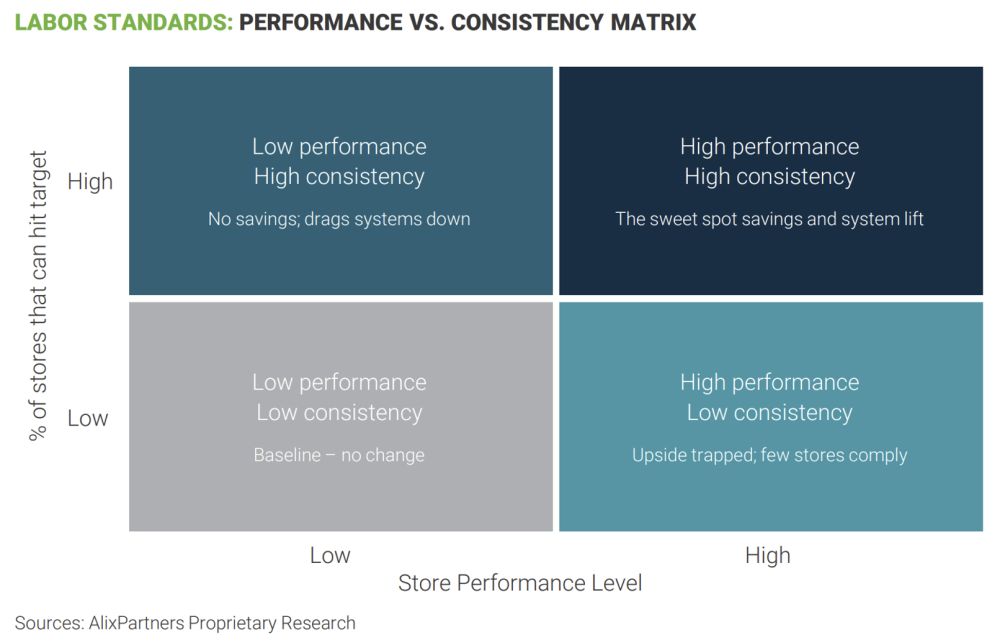
Layer 1 — Assess. Segment your portfolio by average unit volume (AUV) tier, trade area type, channel mix, and daypart demand profile before drawing any system-level conclusions. Then observe the work directly: Bottoms-up, in-unit time, and motion analysis will surface location-specific factors that calibrate labor standards differently across cohorts. What you find on the floor will not match system-level data, and that gap is where the opportunity lives.
Layer 2 — Redesign. Consolidate transactional roles, elevate guest-facing positions, and build the "AI-augmented manager" model—a unit leader who interprets data, coaches a leaner team, and spends far less time on administrative scheduling. Pilot redesigned standards across representative cohorts before system-wide commitment, measuring labor productivity, guest satisfaction, and manager decision quality in parallel.
Layer 3 — Invest. Redirect cost savings from automation into training, retention, and compensation for the roles that drive guest satisfaction and repeat visitation. The savings fund the investment, the investment improves the demand signal, and a stronger signal sharpens labor planning.
The organizing principle: Labor cost reduction is the byproduct, not the goal. The goal is labor productivity and guest experience ROI.
Where to start: A practical agenda for operators
Executives already know their labor model needs to evolve. The harder question is where to start and how to sequence the work so that early wins fund the broader transformation. The following five steps reflect how leading operators have structured the journey:
- Conduct a labor model diagnostic. Before deploying any new technology, understand your current role distribution, cost structure by unit type, and automation readiness by position. Segment the analysis by store cohort, not system average. A uniform view of your portfolio will give you uniform answers, which is precisely the problem you are trying to solve.
- See the work before you set the standard. There is no substitute for direct in-unit observation. Time and motion analysis across a representative sample of locations will surface the location-specific factors—task sequencing, channel mix, daypart demand curves, staffing patterns—that no system-level report captures. Cohort-specific labor standards built from this foundation will consistently outperform any standard, system-derived benchmark, and they will be defensible to franchisees and operators in a way that top-down mandates rarely are.
- Pilot before you scale. The operators who move fastest are the ones who design the tightest pilot, measure the right metrics, and use the results to accelerate rollout with confidence. Test redesigned standards across representative cohorts and measure labor productivity, guest satisfaction, and manager decision quality in parallel.
- Build a change management playbook. Implementing new tech is the easy part. Getting 300 general managers to change how they build a schedule is the hard part. Operators who invest in the change management narrative early—framing AI as a tool that makes managers better at their jobs, not a tool that replaces them—retain the talent they need to execute the transformation.
- Tie AI adoption to guest outcomes, not just cost lines. The executives who sustain momentum with their boards and ownership groups are the ones who can show a direct line from workforce investment to NPS improvement, return visit rate, and average check—not just labor as a percent of sales. Build those KPIs into the program design from day one.
This agenda is achievable in a focused 90-day sprint for the diagnostic and pilot phases. The question is whether your organization has the structure, data systems, and operational discipline to execute it without external support.
The road ahead
The brands that will lead their categories in 2030 are not waiting for the technology to mature. They are building the operating model, data infrastructure, and management capability while the window for first-mover advantage is still open.
The critical unlock is not AI alone; it is the marriage of AI's speed to insight and capacity for automation with deep four-walls operational know-how. Technology can process more data faster than any management team, but it cannot replicate the judgment that comes from understanding how a kitchen actually runs at 7pm on a Friday, what a tenured GM does differently than a new one, or why a location two blocks from a competitor behaves nothing like the system average. The operators getting the most out of AI are the ones pairing it with that operational intelligence, using it to sharpen decisions that humans still need to make.
Workforce strategy is no longer just a human resources issue. It is a competitive strategy conversation that belongs in the boardroom, on the PE sponsor's agenda, and in every operational review where labor as a percent of revenue is a line item. The operators who treat it that way will have a structurally lower cost base, a more resilient workforce, and a guest experience that compounds over time. Those who don't will find themselves managing the consequences of inaction in a market that is running out of patience for margin compression.
The content of this article is intended to provide a general guide to the subject matter. Specialist advice should be sought about your specific circumstances.
[View Source]

