

3 Coordinates. 1 Reset. And the Order Is the Whole Game
No, this is not a spy novel with the coordinates to the buried treasure. Or is it?
Zero. Naught. Zero. Three coordinates: the customer base, the organization, the budget. Set all three back to zero and you have not trimmed a company, you have rebuilt your business. Set them in the wrong order and you have burned 12 months, spent political capital you cannot get back, and handed the next owner a business that looks reorganized and performs exactly the same.
Here is the thesis, and it is not a comfortable one. What is going to gut you will not be fixed by trimming the little branches. Nobody has ever cut their way to a 2x on travel policy. Killing the offsite, renegotiating the copier lease, squeezing the print budget: That is theater, and everyone in the room quietly knows it. It feels like action, it photographs beautifully in a board deck, and it moves nothing.
The reset that actually moves Multiple on Invested Capital (MOIC) starts at the top of the P&L with the revenue you decided to accept.
The Room You Are Actually Standing In
If you are reading this as a credit investor who just became an owner, the room changed and nobody sent a memo. Goldman Sachs Alternatives ran a proprietary review of publicly noted credit events in senior direct lending and counted 146 European private companies handed to their lenders through insolvency or debt-for-equity swap.1 2 Moody’s data shows roughly 65% of all corporate defaults in 2025 were distressed restructurings rather than hard defaults.3 Medallia went to Blackstone, Apollo, and KKR. Curia Global went to Apollo.4
Translation: Loan to own stopped being a specialist trade and became a standard operating procedure.
What you own is rarely a broken company. It is usually a company perfectly optimized for a plan that stopped being true in 2022. The cost base was built for a growth curve that flattened. The org chart was built for an acquisition strategy that stopped. The customer book was built by a sales team paid on revenue, not on margin. Every line of it was rational when it was decided. None of it is rational now.
You do not have five years. Hold periods are compressed, exits are normalizing rather than surging, and your basis is underwater on the day you take title.5 So the question is not whether to reset. The question is where you point first.
Could you name, right now, the 20 accounts that destroy the most profit in your business? Not the smallest accounts. The most destructive. Could anyone in your building name them?
This Is a Story From the 1970s
Zero base is not a new idea. It is not remotely a new idea, and that matters, because the history tells you exactly why it keeps failing and exactly why this time is different.
Peter Pyhrr was 27 years old and running staff control at Texas Instruments (TI) in Dallas when he got tired of watching last year’s budget become this year’s starting point. He built a method where nothing carried forward. Every activity justified itself from nothing. Every manager wrote a decision package saying what they did, what it cost, and what would happen if it simply stopped. TI ran it company-wide in the 1970 budget. Pyhrr wrote it up for the November-December 1970 Harvard Business Review and by his own account was surprised they published it.6
The governor-elect of Georgia read it. In his January 1971 inaugural address Jimmy Carter declared Georgia would be the first state to run zero-based budgeting, then hired Pyhrr onto his staff to build it. When Carter reached the White House, zero base went federal in 1977.7
And then it collapsed. Not because the idea was wrong, but because it was crushing to run. Every agency had to define decision units and produce decision packages, and the paperwork buried the insight it was supposed to surface.[7] By the 1980s zero base had become a punchline, filed alongside every other management fad that asked more of an organization than the organization can give.
It came back once already. Between 2010 and 2014, 3G Capital made zero base the operating core of Burger King, Heinz, and the combined Kraft Heinz, and by AB InBev’s own accounting the Anheuser-Busch deal produced at least $2.25 billion of cost savings, most of it through zero-based budgeting.8 What powered the revival was not a better idea. It was a cheaper way to run the old one, built on analytics, cloud computing, and the margin pressure that arrived after 2008.
That is the pattern worth digesting. Zero base has never once failed on logic. It has failed on the cost of execution, twice, in two different decades. The question was never whether starting from nothing was right. The question was always whether you could afford to ask the question about enough things, fast enough, before the answer went stale.
Now the tooling has finally caught up with the idea, and something changes. When the cost of asking collapses, the scope of what you can zero base expands. Pyhrr had one coordinate, the budget, because in 1970 that was all anyone could afford to interrogate. You have three. The budget was never where the money was. It was just the only place the arithmetic was cheap enough to look.
Before You Point Anywhere, 1 Habit Must Die
Every cost program you have ever sat through opens with a benchmark. SG&A as a percentage of revenue against the peer set. Finance headcount per billion of revenue. Days sales outstanding against the industry quartile. The deck comes back and says you sit at the 60th percentile and should get to the 25th. Everybody nods. Somebody writes the number on a page and it becomes the target.
Benchmarks are not a strategy. A benchmark is a photograph of what your competitors decided, and most of them were guessing too. Reach the top quartile of a peer set and all you have done is become average among the better guessers. Call it parity, and remember that parity only keeps you level with the Joneses, who were never the ones taking your customers in the first place.
A benchmark answers how much. It never answers why at all. And why at all is the entire point of zero. The zero question is not whether a line item is oversized relative to the peer median. It is this: If this activity stopped tomorrow, who would notice, and would any of them pay to get it back? That is a raison d’etre question. It is a self-disruption question. It has no benchmark, because nobody outside your building has ever asked it about your business.
There are three reasons the benchmark actively hurts you here. It is backward looking, so it measures how expensive things used to be when they were done the old way. The peer median for finance headcount is an artifact of a world where a person keyed the invoice, and anchoring to it caps your ambition at somebody else’s legacy. It is also a defense mechanism, because when a manager walks in holding a benchmark, they are usually telling you they intend to survive the program. “We are already at the peer median” is the single most effective sentence in corporate cost work. It should be the sentence that makes you look harder, not the one that ends the inquiry.
Being strategic means beating the competition, not matching them. If you exit the destructive tail of your book, redesign the work around what agents can now carry, and rebuild what is left from zero with owners attached, you will not be sitting at the 25th percentile of your peer set. You are running a different cost curve than your peer set, and they cannot follow you onto it without dismantling themselves in the same order. Most of them will not, because it is hard and because nobody has forced them.
That is the case for self-disruption. Do it to yourself, on your schedule, with your evidence, before somebody with a clean balance sheet and no legacy does it to you on theirs.
So here is the first coordinate, and there is no benchmark for it.
Zero One: The Customer Base. Do Not Fill the Jar With Bad Investments
Start here. Always.
Everybody knows the jar metaphor. Big rocks first, then pebbles, then sand. Fine. But nobody asks the better question: What are you putting in the jar in the first place? A beautifully organized jar of bad investments is still a bad jar. Your customer book is the jar. Every account in it consumes capacity, working capital, management attention, and cash. Some of them pay you back. Some of them are charging you for the privilege of being served.
Robert Kaplan and V.G. Narayanan put numbers on this a quarter century ago and almost nobody acts on it. Their whale curve work found the most profitable 20% of customers typically generate 150% to 300% of total profits, the middle band runs roughly breakeven, and the bottom band destroys 50% to 200% of profit before you arrive back at the 100% you actually reported.9 10 One manufacturer that ran the analysis found its top 20% delivered more than 200% of profits, and that its two largest volume customers were among its least profitable.11
The two biggest were two of the worst.
What you hear: We cannot walk away from revenue. We need the volume for absorption. The market punishes a shrinking top line. That account is strategic.
What it is: Absorption is an accounting argument, not a cash argument. “Strategic” is the word people reach for when they cannot produce a contribution number. And the reason nobody can produce the contribution number is that cost to serve has never been allocated below the gross margin line. Freight, expedites, returns, custom packaging, credit memos, engineering changes, support tickets, and the selling time itself all sit in a bucket labeled SG&A, where they are invisible and therefore innocent.
Why it goes first, and this is what people get wrong. Every other zero is downstream of this one. Your organization is sized to serve the demand you accept. Your budget is built to fund the organization. Zero-base the budget before you have fixed the book and you have carefully optimized the cost of doing the wrong work. You will have to do it twice, and you will not have time to do it twice.
What is hard: Nearly all of it. Sales compensation pays on revenue, so your commercial team will fight you with everything they have, and they will be sincere. The CEO has a relationship with the worst account in the portfolio. Contracts carry notice periods and minimum volume commitments. The lender’s own model, the one that justified the basis, was built on the revenue line you are about to cut. And then there is the plain fear of standing in front of a board and saying you intend to make the company smaller on purpose.
What is easy: the analysis. That is new, and it changes everything. More on that below.
The move is not “fire the bottom 20%.” That is lazy, and it is how you blow a real hole in your absorption. The move is a three-way sort: fix, reprice, or exit. Most of the tail is fixable, and a price increase is the cheapest diagnostic you own. Put one in front of an account and find out what they actually think you are worth. A meaningful share will say “yes” and become good accounts overnight. The ones who say “no” were telling you the truth about the relationship, and you should thank them for the clarity.
What share of your accounts have never had a price increase conversation? And what would change on Monday if that number were zero?
Zero Two: The Organization. Design for the Work That Is Left
Now, and only now, you look at the organization.
This is why sequencing is not a preference. When you exit and reprice the tail, work disappears. Not headcount. Work. Order lines, expedites, credit memos, custom quotes, support tickets, month-end reconciliation exceptions, collection calls on accounts that were never going to pay on time. Cut the organization first and you cut against the old work volume, and within two quarters you are rehiring, because the work you never removed came back and found whoever was left.
Zero-basing the organization means you do not start from the chart. You start from the work. What has to happen for a customer to get what they bought and for the company to get paid. Who has to touch it. How many times it moves. Where a decision actually gets made, versus where it merely gets reviewed. Spans and layers is the blunt instrument here, and it is genuinely useful, but only if you run it against the demand that remains rather than the organization you inherited.
The AI point belongs here, not in an appendix. In 2025 MIT looked at hundreds of enterprise AI efforts and found something that should stop any operating partners cold: Despite billions of dollars in spending, roughly 95% of generative AI pilots produced no measurable impact on the P&L.12 What set apart the few that worked was not a smarter model. It was that they rebuilt the work around the tools instead of bolting the tools onto the process they already had. That is the whole game here too. You remodel the work from the ground up around what agents can actually do, rather than paying to run a broken process a little faster. And the workforce side is not gentle. The World Economic Forum expects 39% of workers’ core skills to be obsolete by 2030, and figures that out of every 100 people on the payroll, roughly 59 will need retraining or redeployment before then.13
The operating model that falls out of this is simple to say and hard to run: The agent does the work and the human supervises it. Spans widen because volume tasks stop flowing through people at all. And every agent you deploy needs a named owner and a clear exception path. Skip that and you have not removed the work, you have only buried it somewhere harder to see.
What you hear: We will get there through natural attrition. We cannot afford to lose anyone right now. Let’s wait until after the audit.
What it is: Attrition takes the wrong people. Attrition takes the people with options, and that is the same list as the people you need. Waiting is a decision to let the market pick your organization for you.
And here is the one nobody wants written down. You cannot zero-base the organization and exempt your own seat. Finance in a mid-market portfolio company is usually the most layered, most manual, most exception-driven function in the building, and it is the function with the clearest line of sight to what agents can now absorb. If the CFO builds a design that thins everyone else and leaves finance untouched, the whole company knows inside a day, and the program loses its moral authority permanently. Zero-base finance first. Publish it first. Then go ask operations for theirs.
If you rebuilt your finance function from zero tomorrow, with the tools available today, how many of the roles you currently have would you create again? Say the number out loud before you keep reading.
Zero Three: The Budget. The Easy One, and the One That Comes Back
Budget goes last, and it is the one everybody does first, because it is the safest thing to be seen doing.
The upside is real and it is documented. Run properly, zero-base budgeting takes money out of a cost base and takes it out fast, which is exactly what AB InBev’s filings show, and because it runs as a standardized playbook a sponsor can carry it across a portfolio instead of rebuilding it at every company.8 The arithmetic is what makes sponsors reach for it. Cut 5% of cost at a $200 million company and you have found $10 million, and at a 10x multiple, that is $100 million of enterprise value. Now the other half of the file, the part that rarely makes the board deck. When researchers went looking for the payoff, in a study of U.S. firms that adopted zero-based budgeting, they found no significant cost savings on average. The gains showed up only where the discipline was taken seriously, in the companies closest to 3G, and they faded wherever it was run as an on-time event.14 That is the real lesson. Zero base does not fail on its logic, it fails on follow-through, and last year’s number plus a few points is still how most companies quietly plan.
What you hear: We did zero-based budgeting last year.
What it is: You ran a zero-based budgeting event last year, and the cost came back, because you changed the number without changing who owns it or how it refreshes. An event produces a number. A system produces a base.15
So here is the system. A resilient budget is built from drivers, not last year’s number plus a few points. Each assumption is tied to something that drives it, whether a volume, a rate, or a headcount, and written down so the logic outlives whoever built it. The person who owns the line owns the number, not the one who rolls it up. Do that mapping once and you are not having the same argument every October: When the top line moves, you already know which costs follow and which just sit there.
And this is the MOIC consequence. A buyer’s diligence team will run your cost base across three years. If they see a step down followed by a creep back, they will normalize your EBITDA up to the creep and pay you on that number, not yours. Every dollar of erosion between the reset and the exit gets multiplied against you at exactly the multiple you were hoping would be multiplied for you. That is the entire argument for the system over the event.
The Three Zeros Are Not Equal
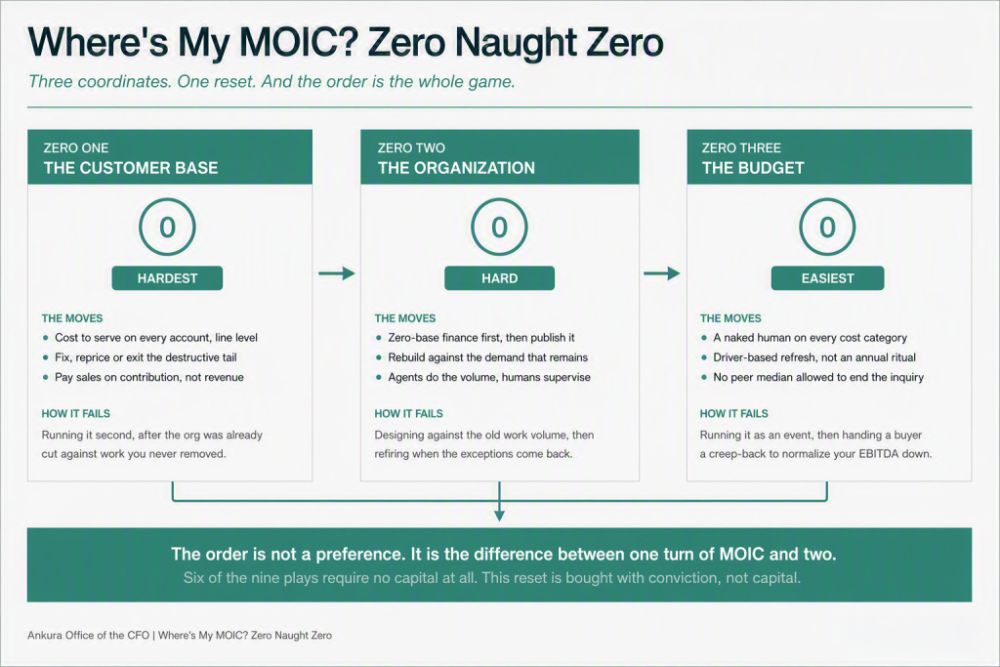
Notice the inversion. The easiest coordinate is the one most companies run first, and it is the one that gives value back fastest. The hardest coordinate is the one that compounds, and it is the one that makes the other two work.
The Plays, and What They Actually Cost You
Here is the entire reset as a set of plays. Before you read the first column, read the third one.
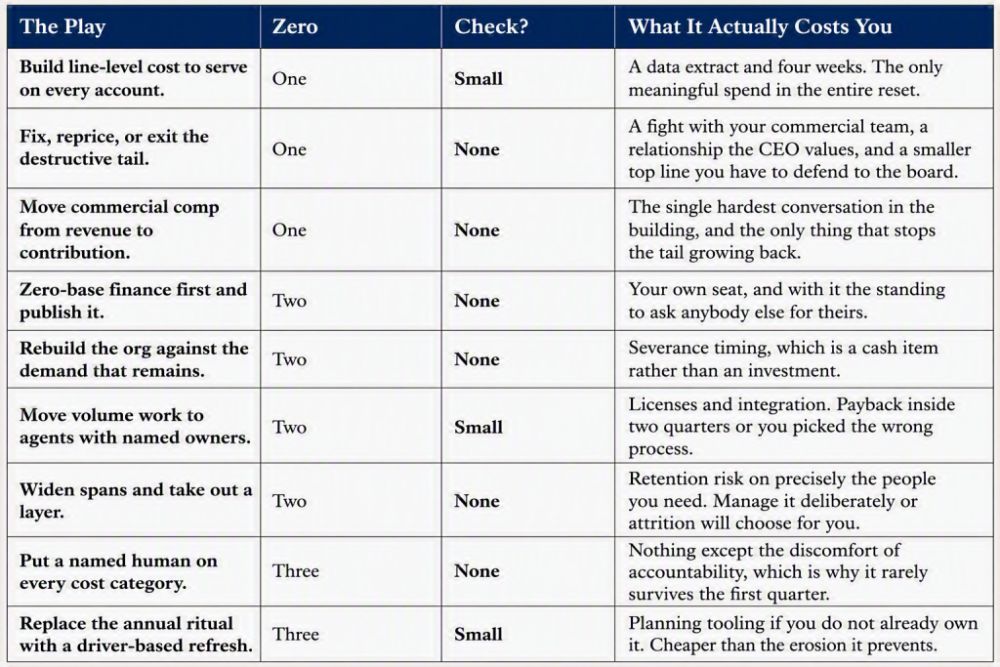
Six of the nine require no capital at all. The three that do are small, and they are funded several times over by the working capital the first play releases within a quarter of running it.
That matters more than it sounds. The objection a credit fund raises when you put a reset in front of them is almost never that the logic is wrong. It is that they cannot afford to fix the thing they just took ownership of, because every cost program they have ever been handed came with an invoice attached and a payback date somewhere past their exit. This one does not. This reset is bought with conviction, not capital.
Which is precisely why so few companies run it. Conviction is the one-line item you cannot put on a term sheet, and it is the only one that has ever mattered.
And the arithmetic is not subtle. Take a $180 million industrial business running 8% margins that a lender group ended up owning at a $62 million basis. Stabilize it, protect the base, sell at 18 months, and you return something around 1.1x. Run the three coordinates in order instead, exit at 30 months on the same multiple with no expansion assumed anywhere, and you return something around 2.2x. Same company. Same team. Twelve additional months, and not one dollar of the difference came from a better market.
AI-Powered Zero Naught Zero
The reason zero-basing the customer book has been preached for 25 years and practiced by almost nobody is not that CFOs disagreed with Kaplan. It is that true cost to serve at the account level was an eight-to-16-week activity-based costing project requiring a consultant, a warehouse extract, and a set of allocation assumptions the sales team could shred in the first meeting. By the time you had an answer, the quarter was gone and the answer was stale. The economics of knowing were worse than the economics of guessing.
That constraint is gone. Line-level cost to serve across every invoice, order line, service ticket, and credit memo is now days of work rather than a quarter. Contract abstraction across a thousand agreements is a weekend. Process mining shows you the real path of a work order rather than the one drawn on the conference room wall.
So, the honest framing is not that AI makes zero-basing cheaper. It is that AI makes the hardest coordinate, the customer base, reachable inside a hold period for the first time. That is the unlock. Everything else is speed.
And now the part that will not appear in the vendor deck. AI gets you to the answer. It does not get you to the decision. No model is going to call your second largest customer and tell them their price is going up 11 points. No agent is going to sit across from a plant manager and explain why a layer of supervision is going away and what that means for the people who report to him. The analysis compresses from 16 weeks to four. The courage does not compress at all. It is the same conversation it has always been. You simply have to have it much sooner, with far better evidence, and with no excuse left for not knowing.
What the CFO Owns
All of it. That is the uncomfortable part.
The sponsor or the lender sets the return expectation. The CEO owns the market story. But a reset is architecture, and architecture is finance. The customer sort requires a cost to serve model nobody else can build or defend under fire. The organization design requires a work-based cost baseline nobody else has. The budget system requires ownership, cadence and consequence, and finance is the only function that touches every dollar in the building.
Which means the CFO spends the first 100 days as the least popular person in the company and has to be first through the wall on their own function to have any standing at all.
If you want a test for whether this is real where you sit, it is not whether you have a plan. Everyone has a plan. It is whether three things are true at the same time. A named human owns every cost category and every retained account. The contribution margin on your bottom decile of customers is a number you could put in front of a buyer’s diligence team without flinching. And the finance function you run today looks materially different from the one you inherited. Two out of three is a program. Three out of three is a reset.
The Last Coordinate
Zero. Naught. Zero. Customer, organization, budget, in that order, and the order is not a preference. It is the difference between one turn of MOIC and two.
The treasure was never buried. It has been sitting on your customer master file the whole time, in the accounts you were afraid to price and the work you should never have accepted. The map was always the P&L. Nobody read it below the gross margin line.
Stop admiring the problem. Stop trimming the little branches. Go find your zero.
Footnotes
1 Goldman Sachs Asset Management, “Taking The Keys: Insights On The European Private Credit Market,” March 2026. https://am.gs.com/en-us/advisors/insights/article/2026/insights-on-the-european-private-credit-market
2 Bloomberg, “Private Creditors Are Taking The Keys to More Failing Companies,” March 10, 2026. https://www.bloomberg.com/news/newsletters/2026-03-10/private-creditors-are-taking-the-keys-to-more-failing-companies
3 Moody’s Ratings, “Lend, extend, and then…,” May 2026. https://www.moodys.com/web/en/us/insights/credit-risk/private-credit/lend-extend-and-then.html
https://octus.com/resources/articles/private-credit-wants-a-plan-in-when-taking-the-keys/
4 Medallia recapitalization (lender group led by Blackstone, Apollo and KKR): Bloomberg, April 2, 2026, https://www.bloomberg.com/news/articles/2026-04-02/blackstone-squeezes-thoma-bravo-and-its-ailing-software-company-medallia. Curia Global recapitalization (Apollo majority): Curia Global press release, July 8, 2026, https://curiaglobal.com/about-us/news/curia-global-announces-recapitalization-with-its-financial-stakeholders-to-support-long-term-growth/
5 PitchBook, “US PE Breakdown,” 2026 (on compressed hold periods and normalizing exit activity).
6 Peter A. Pyhrr, “Zero-Base Budgeting,” Harvard Business Review, November-December 1970; origin and adoption history. https://en.wikipedia.org/wiki/Peter_Pyhrr
7 The Conversation, “Zero-based budgeting: everything old is new again”. https://theconversation.com/zero-based-budgeting-everything-old-is-new-again-50633
8 Anheuser-Busch InBev, Form 20-F (fiscal year 2011), U.S. Securities and Exchange Commission. The company credits the Anheuser-Busch acquisition with at least $2.25 billion of cost savings, the majority delivered through zero-based budgeting. https://www.sec.gov/Archives/edgar/data/0001140467/000119312512160960/d330420d20f.htm
9 Robert S. Kaplan and V.G. Narayanan, “Measuring and Managing Customer Profitability,” Journal of Cost Management, 2001.
10 Pragmatic Institute, “Maximizing Profitability with a Whale Curve” (on Kaplan and Narayanan, 2001). https://www.pragmaticinstitute.com/resources/articles/product/maximizing-profitability-with-a-whale-curve/
11 Robert S. Kaplan, “Kanthal (A),” Harvard Business School Case No. 190-002, 1989 (the heating-systems manufacturer whose two largest-volume customers ranked among its least profitable).
12 MIT NANDA, “The GenAI Divide: State of AI in Business 2025,” 2025. Roughly 95% of enterprise generative-AI pilots showed no measurable P&L impact; the differentiator for the 5% that succeeded was workflow redesign, not model quality. https://mlq.ai/media/quarterly_decks/v0.1_State_of_AI_in_Business_2025_Report.pdf
13 World Economic Forum, “Future of Jobs Report 2025,” January 2025. Employers expect 39% of workers’ core skills to be outdated by 2030, and roughly 59 of every 100 workers to need reskilling or upskilling. https://www.weforum.org/publications/the-future-of-jobs-report-2025/
14 Rodney Coyte, Martin Messner and Shan Zhou, “The revival of zero-based budgeting: drivers and consequences of firm-level adoptions,” Accounting & Finance 62(3), 2022, 3147-3188. A study of US adopters finds no significant cost savings on average, with gains concentrated among firms tied to 3G Capital. https://onlinelibrary.wiley.com/doi/10.1111/acfi.12884
15 ExpenseAnywhere, “What’s Replacing Zero-Based Budgeting in Spend-Conscious Companies,” 2026. https://expenseanywhere.com/zero-based-budgeting-is-dead/
The content of this article is intended to provide a general guide to the subject matter. Specialist advice should be sought about your specific circumstances.
[View Source]